
claude-pr-review
Multi-axis PR review orchestration for Claude Code — 5 independent review perspectives, symmetric cross-verification, deterministic coverage assertion
Install with your AI
Paste into Claude Code, Cursor, or any agent — it reads the repo and wires the tool into your project.
Install and set up claude-pr-review (git-clone project) into my current project.
Found on https://claudeers.com/claude-pr-review
Repo: https://github.com/GGGODLIN/claude-pr-review
Homepage/docs: —
Detected install method: git-clone → git clone https://github.com/GGGODLIN/claude-pr-review
Category: security. Platforms: cli, api, web.
Read the repo's README for exact setup and env vars, then install it and wire it into my project.

Claudeers Health Verdict:
active; community-verified: false. Confirm the source before running anything.
git clone https://github.com/GGGODLIN/claude-pr-review
// compatibility
| Platforms | cli, api, web |
|---|---|
| Operating systems | — |
| AI compatibility | claude |
| License | MIT |
| Pricing | open-source |
| Language | Python |
claude-pr-review
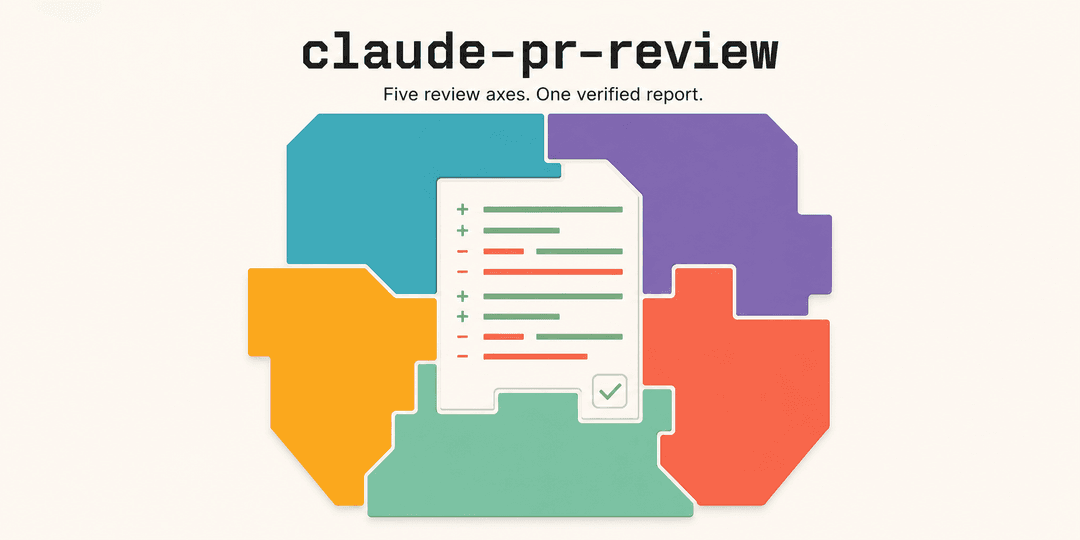
Multi-axis PR review orchestration for Claude Code — one /pr-review <PR-URL> command that runs up to five independent review perspectives against the same pull request, cross-verifies every finding between axes, and compiles a single comparison report with copy-paste-ready inline comments.
Built and battle-tested over months of daily production PR review. Extracted from the author's personal setup; see Prerequisites honestly before expecting it to run as-is.
Why this design — the methodology behind the command, told through real catches and misses (a dead Save button four reviewers missed, red-team refutation rates, why consensus still gets verified): 一個模型不夠:五軸交叉審的 code review 工作流 (zh-TW). The article states the three design philosophies; this repo is the implementation, and has kept evolving since it was written (formal-spec gate, provenance discipline, Codex presets came later) — where they differ, the command file is current.
Why multi-axis
A single reviewer — human or model — has a single blind spot profile. This command deliberately combines perspectives with different blind spots:
| Axis | Runtime | Perspective |
|---|---|---|
| Context-aware reviewers | Claude Code subagents (agents/) | Language/domain specialists with full repo search access — catch cross-file gaps |
| Codex neutral | codex review (bare CLI) | Diff-only, no context — reads the PR the way a reviewer reads a PR email |
| Codex adversarial | Codex plugin red-team template | Actively attacks the change — catches fail-open, visibility, day-boundary hazards |
| Gemini Flash | agy CLI (permanent axis) | Cheap independent pass — has repeatedly caught the only confirmed finding in a round |
| Gemini Pro | agy CLI (opt-in) | Deeper but hallucination-prone — off by default |
The design principle borrowed from security auditing: the agent that finds an issue never verifies it. Context-aware findings are verified by the diff-only axis and vice versa (symmetric cross-verification), consensus findings still get a convention-baseline check, and no finding is ever dropped — refuted ones ship in the report with both sides' evidence so the human makes the final call.
What you get
- Coverage as set arithmetic, not trust — every changed file must be explicitly accounted for (
finding/REVIEWED_NO_ISSUES/INTENTIONALLY_SKIPPED), asserted deterministically after review - Deterministic re-anchoring — findings carry verbatim source anchors and are re-located by exact match before the report, so line numbers survive model drift
- Provenance discipline — on hotfix→staging PRs, files inherited from the default branch are detected and capped so their defects don't land on an innocent author
- Severity calibration gates — Must Fix requires a concrete user-visible repro path and a shippable-thing broken; severity built on unverified premises gets recomputed without them
- A formal-spec compliance lane (experimental) — normative spec clauses (MUST/SHALL, invariants, formulas) are extracted, canonicalized by a deterministic reducer (
scripts/pr-review-c4.py), dispatched through a hash-bound single-use envelope (optionally enforced by a PreToolUse permit-gate hook), and traced against authored hunks with full hash binding - Two-layer report publication — the full-evidence audit report (
pr-<id>-review.audit.md) is canonical; the decision-facing main report (pr-<id>-review.md) is produced from it by a deterministic projection helper (scripts/pr-review-report-projection.py), never rewritten by a model, with a shared generation hash binding the pair - Report Self-Verify gate — before publication a read-only auditor subagent checks the draft against a fixed R1–R10 rubric (input binding, axis states, per-file coverage, severity calibration, silent-skip disclosure); violations must be repaired with evidence before the report ships
- Traditional Chinese comparison report with colloquial, paste-ready inline comment blocks (the command's working language is bilingual zh-TW/English; reports render in zh-TW — fork and adjust if you want another language)
Repo layout
commands/pr-review.md            the orchestrator command (install → ~/.claude/commands/)
commands/tests/                  contract tests pinning the command's report/dispatch wiring (run in-repo)
agents/*.md                      five reviewer subagents + one rubric auditor (install → ~/.claude/agents/)
scripts/pr-review-c4.py          deterministic spec-clause reducer + dispatch envelope/permit issuer
scripts/pr-review-report-projection.py   deterministic audit→main report projection (Step 6 publication)
scripts/poll-liveness.sh         background-process poll helper (3-signal: done/dead/stuck)
scripts/sem-pr-blast-radius.sh   entity-level dependency blast radius (needs `sem`)
hooks/pr-review-c4-dispatch-gate.py     optional PreToolUse permit gate for the formal-spec dispatch
references/severity-calibration.md      security impact×likelihood matrix
references/finding-severity-rules.md    6c/6d gates: Must/Should/Nice calibration (platform-neutral SSOT)
skills/bitbucket-pr-review/      optional Bitbucket adapter, read path (GitHub needs none of this — `gh` covers it)
skills/bitbucket-pr-mutation/    optional Bitbucket adapter, write path (proposal/approval-gated, contract-tested)
Install: see INSTALL.md — an agent-executable guide (point Claude Code at it and say "set me up for my configuration"). Everything lands under ~/.claude/; the command references its helpers at ~/.claude/scripts/... and ~/.claude/skills/... at runtime.
Minimum install (GitHub-only) = commands/ + agents/ + references/ + scripts/ — the command dispatches reviewers by the agent names defined in agents/, reads both reference files during severity calibration, and probes the bundled scripts at fixed steps (they self-skip when their underlying tool is absent, but the files must exist for the skip to be graceful). skills/bitbucket-* only if you review Bitbucket PRs.
Prerequisites
Tiered honestly — the command degrades gracefully when an axis is missing (it reports the gap instead of failing the review):
Required
- Claude Code with subagent support;
ghCLI for GitHub PRs - A local clone of the repo under review (the command builds a temporary
git worktreepinned to the PR head — the single most important mechanism here; stale local state silently invalidates an entire review)
Per-axis (optional, skip = axis skipped)
- Codex axes: OpenAI Codex CLI + the Codex Claude Code plugin
- Gemini axes:
agy(Google Antigravity CLI) with a signed-in account - Blast radius:
semindexed for your repo - React mechanical axis:
npx react-doctor(auto-skipped on non-React PRs)
Bitbucket only
- An Atlassian API token (app passwords are dead since mid-2026, CHANGE-3222); configure your email + workspace per
skills/bitbucket-pr-review/SKILL.md
Caution
- The Codex sections mutate
~/.codex/config.tomlduring a run (MCP strip + effort override, pristine-backup + restore). Read Step 3 and Step 7 before first use. skills/bitbucket-pr-mutationis the only write path to Bitbucket and is deliberately ceremony-heavy (typed approval, proposal hashing, read-back). Its contract tests also pin the command's Step 8 wording — runcd skills/bitbucket-pr-mutation/scripts && python3 -m unittest discover -s tests -qafter editing either file.commands/pr-review.mdis additionally pinned by three contract tests incommands/tests/(report projection wiring, C4 dispatch envelope, report Self-Verify). Run all three after editing the command or thespec-compliance-revieweragent — the command's header lists the exact invocations.- Test coverage, stated honestly: those three are text contract tests — they assert that specific wording still exists in the command, and do not execute a review, the projection helper, or the dispatch gate. No behavioral test suite ships for
scripts/pr-review-report-projection.py,scripts/pr-review-c4.py, orhooks/pr-review-c4-dispatch-gate.py. Treat the C4 dispatch permit lifecycle in particular as unexercised here: a permit is keyed per Claude Code session and is not reissued once one has been granted, so a second formal-spec dispatch in the same session finalizesSKIPPEDwithC4_DISPATCH_PERMIT_EXISTS. Start a fresh session for the next PR, and read the permit code before relying on it. - Costs are real: a default-preset run of a mid-size PR spends tens of minutes wall-clock and millions of Codex tokens. Presets (
light/sol-lite) exist for a reason.
License
MIT
// faq
What is claude-pr-review?
Multi-axis PR review orchestration for Claude Code — 5 independent review perspectives, symmetric cross-verification, deterministic coverage assertion. It is open-source on GitHub.
Is claude-pr-review free to use?
claude-pr-review is open-source under the MIT license, so it is free to use.
What category does claude-pr-review belong to?
claude-pr-review is listed under security in the Claudeers registry of Claude-compatible tools.
// embed badge

[](https://claudeers.com/claude-pr-review)
// retro hit counter

[](https://claudeers.com/claude-pr-review)
// reviews
// guestbook
// related in Security & Compliance
 🔓
🔓A complete AI agency at your fingertips - From frontend wizards to Reddit community ninjas, from whimsy injectors to reality checkers. Each agent is a specia…
 🔓
🔓π RuView turns commodity WiFi signals into real-time spatial intelligence, vital sign monitoring, and presence detection — all without a single pixel of video.
 🔓
🔓Prowler is the world’s most widely used open-source cloud security platform that automates security and compliance across any cloud environment.
 🔓
🔓🐶 A curated list of Web Security materials and resources.