
claude-plugins
Claude Code plugins built and maintained by Whitebeard
Install with your AI
Paste into Claude Code, Cursor, or any agent — it reads the repo and wires the tool into your project.
Install and set up claude-plugins (claude-plugin project) into my current project.
Found on https://claudeers.com/claude-plugins-4
Repo: https://github.com/whitebeardit/claude-plugins
Homepage/docs: —
Detected install method: claude-plugin → /plugin install claude-plugins@whitebeardit/claude-plugins
Category: plugins. Platforms: web.
Read the repo's README for exact setup and env vars, then install it and wire it into my project.

Claudeers Health Verdict:
unknown; community-verified: false. Confirm the source before running anything.
⚠ Unverified / not recently updated — review before pasting a run-this config.
/plugin marketplace add whitebeardit/claude-plugins
/plugin install claude-plugins@whitebeardit/claude-plugins
git clone https://github.com/whitebeardit/claude-plugins
// compatibility
| Platforms | web |
|---|---|
| Operating systems | — |
| AI compatibility | claude |
| License | MIT |
| Pricing | open-source |
| Language | Python |
Whitebeard plugins
A Claude Code plugin marketplace.
/plugin marketplace add whitebeardit/claude-plugins
/plugin install sherlock-holmes@whitebeard-plugins
Plugins
| Plugin | What it does | Docs |
|---|---|---|
| sherlock-holmes | Incident investigation by trace ID, over Grafana Loki and Tempo, with an optional interactive sequence diagram of the trace, and a deterministic error sweep of a time window. Read-only. | README · Quick setup · Design decisions |
Sherlock Holmes
Evidence-first incident investigation by trace ID, using Grafana Loki logs and Grafana Tempo traces. Give it a trace ID; it rebuilds the timeline across services, finds the first anomalous event, separates cause from consequence, and tells you how confident it is and what the evidence cannot show.
/sherlock-holmes:trace-debug 4bf92f3577b34da6a3ce929d0e0e4736   # why did this request fail?
/sherlock-holmes:error-sweep --last 2h                          # were there errors in this window? then: map
/sherlock-holmes:trace-diagram 4bf92f3577b34da6a3ce929d0e0e4736 # draw the call sequence
/sherlock-holmes:setup                                          # wire it to your Grafana
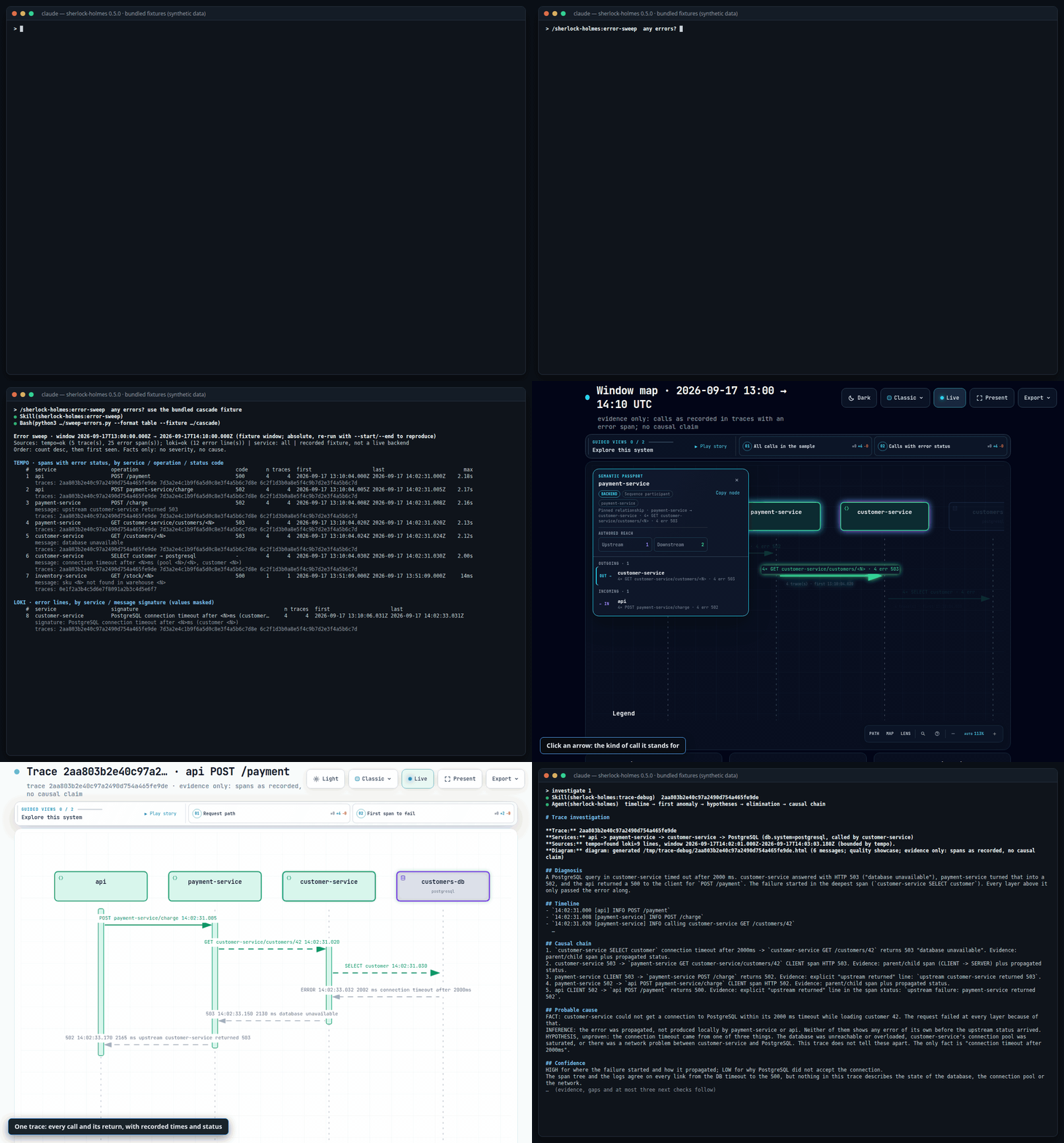
Only the investigation runs a model; the sweep and the diagram are deterministic scripts, so the same input gives the same answer.
It is read-only by construction: the collector only issues HTTP GET, the agent has no write tools, and credentials are read from the environment and never printed. It works against any Loki and any Tempo, directly or through Grafana's datasource proxy.
The rule it is built around: never prefer a convincing story to incomplete evidence. "There is not enough evidence to determine the root cause" is a valid answer, and the agent is built to give it.
Its README carries the quick setup (or run /sherlock-holmes:setup), the full configuration reference, the report format and the error sweep.
Repository layout
.claude-plugin/marketplace.json   the marketplace manifest
sherlock-holmes/                  one directory per plugin
Development
Each plugin carries its own tests and eval suite:
cd sherlock-holmes
python3 -m unittest discover -s tests -v
claude plugin validate .
claude plugin eval . --scaffold --no-publish --ablation none --judge-model sonnet \
  --allow-tools "Bash(python3 *collect-trace.py*)"
The eval suite runs fully offline against recorded Loki and Tempo responses, so it needs no live backend. It does need an OS sandbox for Bash; see sherlock-holmes/evals/README.md for the prerequisites.
Pre-push gate
Verification runs locally, before a push, rather than in CI, so that no Claude Code credential has to live in a repository secret and the eval spend stays visible to whoever triggers it. Enable it once per clone:
git config core.hooksPath .githooks
On every push the hook validates each plugin manifest, runs the unit tests and checks that regenerating the fixtures leaves the tree unchanged. That part is free and takes a couple of seconds.
The paid eval suite runs only when the push touches a plugin's agents/, skills/, evals/ or tests/ — the files that can change behaviour or change how it is graded. Pushing a README or a doc does not trigger it.
| Variable | Effect |
|---|---|
SKIP_EVALS=1 | Skip the eval suite for this push. The cheap checks still run. |
FORCE_EVALS=1 | Run the eval suite for every plugin, whatever changed. |
EVAL_BUDGET_USD | Hard cost ceiling passed to --max-cost-usd. Default 8. |
Use SKIP_EVALS=1 rather than git push --no-verify: it keeps the free checks running instead of disabling the whole gate.
The free half of that hook also runs in GitHub Actions (.github/workflows/verify.yml), so anything arriving by another route — a web edit, a pull request from a fork, a clone that never enabled the hook — is still checked. It needs no credentials.
Releasing
Versions are managed by release-please from Conventional Commits, one independently versioned release per plugin.
Push to main with a feat: or fix: commit and the action opens a Release PR for the affected plugin. Merging it bumps the version, writes the changelog, tags the commit and publishes a GitHub Release.
| Commit prefix | Version bump |
|---|---|
fix: | patch |
feat: | minor |
feat!: or a BREAKING CHANGE: footer | major |
docs:, ci:, chore:, refactor:, test: | none |
Tags are per plugin, in the form sherlock-holmes-v0.2.0, so one plugin releasing never moves another. That form is also what an external directory pins:
{ "source": "git-subdir",
  "url": "https://github.com/whitebeardit/claude-plugins.git",
  "path": "sherlock-holmes", "ref": "sherlock-holmes-v0.2.0", "sha": "…" }
The version lives in one place only: each plugin's .claude-plugin/plugin.json. It is deliberately absent from the marketplace entry, because Claude Code always prefers the plugin.json value, so a version in both is a way for a stale one to silently mask the real one. verify.yml fails the build if a version reappears in a marketplace entry, or if plugin.json and .release-please-manifest.json disagree.
Behavioural verification is not part of the release job: the eval suite has already run locally, before the commits were pushed.
Submitting to the community marketplace
Anthropic runs two public marketplaces. claude-plugins-official is curated at Anthropic's discretion and has no application process. claude-community is where third-party submissions land after review, and is the one to submit to, through the claude.ai form (Team or Enterprise organisations with directory management access) or the Console form (individual authors).
Run claude plugin validate ./sherlock-holmes --strict before submitting; the review pipeline runs the same check alongside automated safety screening. Approved plugins are pinned to a commit SHA in the community catalog, and their CI bumps the pin as new commits land, so no tag or SHA has to be supplied by hand.
License
MIT. See LICENSE.
// faq
What is claude-plugins?
Claude Code plugins built and maintained by Whitebeard. It is open-source on GitHub.
Is claude-plugins free to use?
claude-plugins is open-source under the MIT license, so it is free to use.
What category does claude-plugins belong to?
claude-plugins is listed under plugins in the Claudeers registry of Claude-compatible tools.
// embed badge

[](https://claudeers.com/claude-plugins-4)
// retro hit counter

[](https://claudeers.com/claude-plugins-4)
// reviews
// guestbook
// related in Claude Plugins
 🔓
🔓A single CLAUDE.md file to improve Claude Code behavior, derived from Andrej Karpathy's observations on LLM coding pitfalls.
 🔓
🔓Claude Code is an agentic coding tool that lives in your terminal, understands your codebase, and helps you code faster by executing routine tasks, explainin…
 🔓
🔓"CLI-Anything: Making ALL Software Agent-Native" -- CLI-Hub: https://clianything.cc/
🔓financial-services — a Claude ecosystem project on GitHub.