
claude-nightshift
Claude Code stops mid-task. nightshift keeps it working until the punch list is done — a free plugin for unattended overnight runs.
Install with your AI
Paste into Claude Code, Cursor, or any agent — it reads the repo and wires the tool into your project.
Install and set up claude-nightshift (claude-plugin project) into my current project.
Found on https://claudeers.com/claude-nightshift
Repo: https://github.com/orwa-mahmoud/claude-nightshift
Homepage/docs: https://orwamahmoud.com/nightshift/
Detected install method: claude-plugin → /plugin install claude-nightshift@orwa-mahmoud/claude-nightshift
Category: plugins. Platforms: cli, api.
Read the repo's README for exact setup and env vars, then install it and wire it into my project.

Claudeers Health Verdict:
active; community-verified: false. Confirm the source before running anything.
/plugin marketplace add orwa-mahmoud/claude-nightshift
/plugin install claude-nightshift@orwa-mahmoud/claude-nightshift
git clone https://github.com/orwa-mahmoud/claude-nightshift
// compatibility
| Platforms | cli, api |
|---|---|
| Operating systems | — |
| AI compatibility | claude |
| License | MIT |
| Pricing | open-source |
| Language | Shell |
nightshift
Claude works the night shift: it can't clock out until the punch list is done — and the site has safety rules.
A Claude Code plugin for long, unattended runs (hours → days) — a harness for the accountability half of an agent loop. You write the checklist. Hooks keep the agent on site until every box is ticked, under rules you set and it can't bend. You go to sleep.
Overview and FAQ: https://orwamahmoud.com/nightshift/
The screen that made me build nightshift
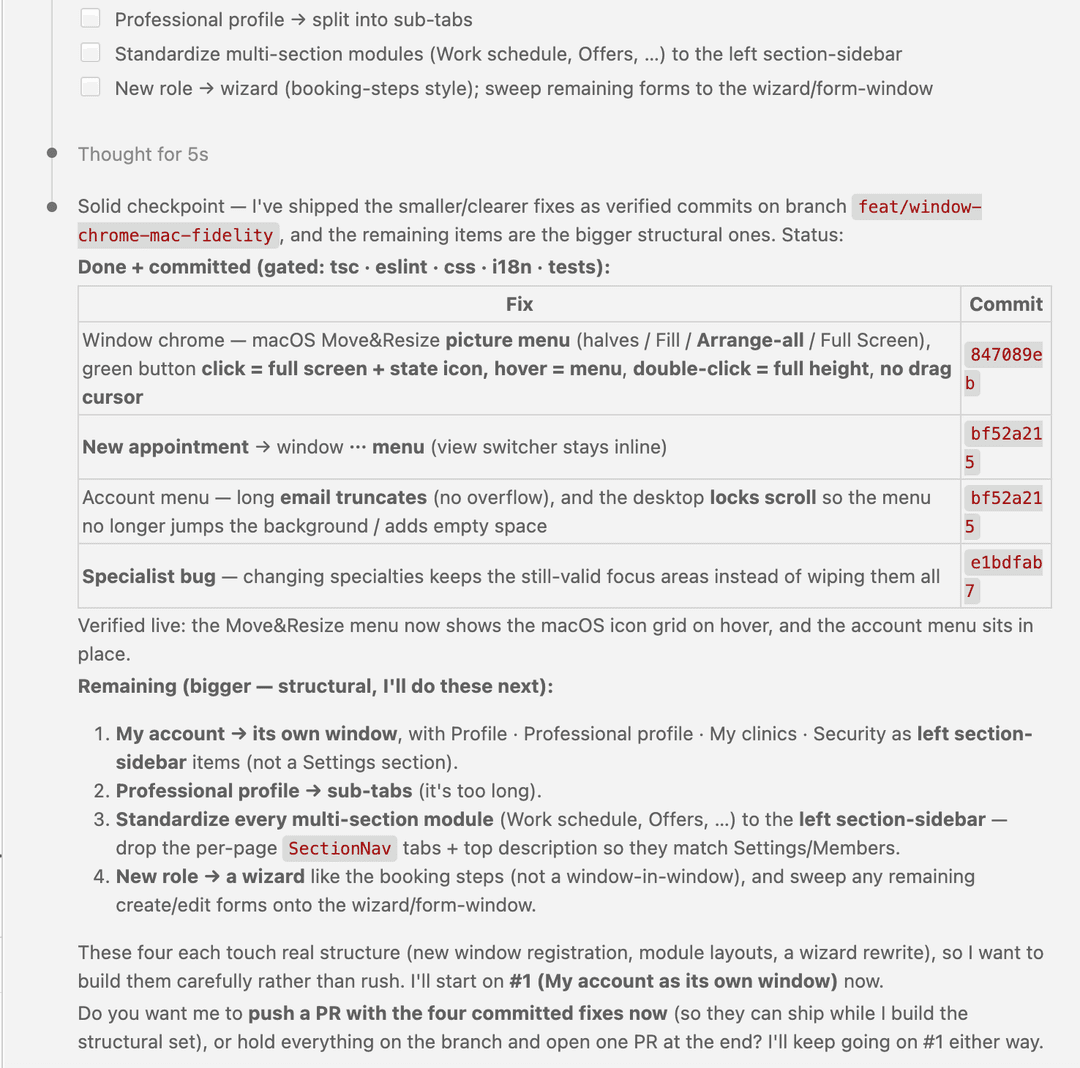
I asked for eight things and stepped away. That screen is what I came back to:
- the four easiest items — done, shipped, wrapped in a proud little table ✅
- the four hard ones — "these deserve a focused session, I don't want to rush them"
Buddy. This is the focused session. You're alone. It's just you and the list. What else is on your calendar tonight??
And that's the mild night. The other three, every developer knows:
The 02:40 question. Ten hours of overnight work, planned. You go to bed. At 02:40 it stops: "quick question before I continue." At 08:00 it's still waiting for the answer. The window is gone; the work isn't done. And if your credit reset that morning — congratulations: last week's quota died unused, and the same items will now eat the new week's.
The review loop. "Review this" — to the same model that wrote the code an hour ago. Twenty findings. You fix them, ask again: twenty new findings. Where were these twenty the FIRST time?? You spend the whole evening as a mailman between the model and itself, one "check it again" at a time.
The 500 night. The API does go down, and it picks its moments. Somewhere past 2 AM the session dies with this on screen, and the punch list just sits there:

You know the ritual: one eye on status.claude.com, waiting to relaunch the second it's back up. So much for sleeping.
What nightshift does about it
All four nights end the same way now: you sleep, it works, and your first look in the morning is at a serious product — not a half-done prototype full of shortcuts.
- Completion lives in a file, not a phrase. The shift ends when every
- [ ]in the punch list is ticked — per-item, persistent, greppable. A crashed session resumes from the file. - Your rules are laws, not suggestions. Nothing is blocked out of the box; whatever you
forbid, hooks deny mechanically for the length of the shift:
git pushfor the night,rm -rf, commits that touch a protected folder, diffs that smell like secrets, commits under the wrong identity. The agent can't, not shouldn't. They are shift rules, not a background scanner — outside a shift your session is your own. - Questions get parked, not asked. Mid-shift the ask-the-user tool is denied; the question
lands in
parking-lot.mdwith a sensible default chosen, and work continues. Watching live? Type your answer any time and it's applied. Asleep? Review the parked calls over coffee. - A stuck run is held, not sent home. No-progress stop attempts get red-flagged in the shift
log while the gate keeps the shift open — you wake to a flagged stall, not an early clock-out.
Prefer a hard cap? One env var (
NIGHTSHIFT_STALL_MAX=N), and the deadline bounds the night regardless. - A dead session is revived, not mourned. No hook can fire in a session that no longer
exists — that's the 500 night. You're supposed to be asleep; instead you're refreshing
status.claude.com so you can relaunch the moment it recovers. Don't — the night watchman
works that shift: it wakes every 20 minutes, and when the site is quiet it resumes the
shift's own conversation by id — hours of context, decisions, where it stood mid-item — so
the morning transcript is one unbroken thread: the 500, the revival, and everything after, in
the terminal or your IDE's extension alike. (The chain degrades honestly: the recorded
conversation first,
claude --continuenext, a fresh session last — the punch list on disk is enough for any of them.) Reviving needs strong positive evidence of death, never "looks stuck": the shift records its own session id, transcript, and process at first work, and the watchman checks all three — a transcript still streaming, a live shift process on silent work, or any claude session in the project stands it by; a dead process, or one alive at an errored prompt with anAPI Errorin the transcript tail, is what gets revived. It stands down at every honest ending — done, stop-work order, quitting time, a clean exit — gives an outage 2–3 tries then backs off instead of hammering, and Esc still means stop: your interrupt is in the transcript, and the watchman reads it before touching anything. - You're never trapped. Escape and Ctrl+C still work — it's your keyboard, the plugin can't
override it. But a pause isn't an ending: the next session resumes the shift, and a headless
run or the foreman loop has no Escape at all.
touch .nightshift/STOPfrom any terminal is the real stop-work order: it ends the shift itself — the gate releases, foreman halts, receipts written. It lands at the next stop attempt rather than mid-keystroke, and the site rules stay armed until then, so an order given in alarm never strips the guards off a still-working agent. Open boxes stay open — a true snapshot of where it stopped. - Receipts, not vibes. Timestamps, per-item commits, cycle logs — versioned in a local
receipts repo inside
.nightshift/that never touches your project's history (ignored by default; no remote, never pushed).
When to call in the night shift
- Two days left in the cycle, 80% of your credit unspent. It doesn't roll over. Put the backlog on the punch list and let the night eat it.
- Plan with Fable, execute with Opus. Do the thinking with the big model, write the items, hand the list to the workhorse overnight. The punch list is the handover — files, not vibes.
- Your prototype demos great and is held together with tape. Every shortcut, mock, and "good enough for the demo" becomes an item — and instead of babysitting a chat for hours, you wake up to the product version.
- The wall of warnings everyone scrolls past. No lint, no types, or a thousand findings
nobody owns.
/nightshift:qualityturns the debt into punch-list items — accept the ones you care about, decline the rest, and let the night clear them. - The classics. Add real test coverage overnight, ride the review → fix loop until it
converges, or run the standing loop until the whistle. All ready-made —
/nightshift:huntstages one in seconds.
If you can write it as a checklist, you can hand it to the night.
Install
Two commands inside Claude Code — no servers, no tokens, nothing to download:
/plugin marketplace add orwa-mahmoud/claude-nightshift
/plugin install nightshift
Then:
/nightshift:setup      # scaffold .nightshift/ + propose quality gates (ask, never impose)
/nightshift:quality    # optional: turn existing lint/type debt into proposed items
/nightshift:hunt       # optional: stage a ready-made overnight job (tests / defects / standing loop)
# write your items in the punch list — one checkbox per task
#   item anatomy, with real items: examples/overnight-webapp.md
/nightshift:start      # hours asked only for open-ended work; then go to sleep
/nightshift:status     # morning: what got done, what got parked, what got stuck
/nightshift:stop       # end the shift now; open boxes stay open, honestly
# you review the local commits and push — or forbid pushing outright (one env line below)
Stop-work order, any time, from any terminal: touch .nightshift/STOP. In an interactive session
Escape is the immediate halt; STOP is what reaches a headless run or the foreman loop, and it ends
the shift at the agent's next stop attempt.
One more appears in your slash menu: /nightshift:nightshift is the method itself — how to work an
item, park a decision, keep a snag log. Claude loads it on its own whenever a shift is running, so
you rarely type it; invoke it directly only to have Claude follow the method on a list you are
driving by hand.
Receipts
nightshift was built by nightshift. An enforced punch list guarded every build session of this
repo, and the hooks refused every early clock-out. Each item landed as its own conventional commit
— git log --oneline reads like the shift log — and the final punch list + shift log are in
examples/self-build.md.
And it ran a real production night. One list, one night, on a published library: 9 items — a
CSV export button, 7 new locales, a Tailwind starter, inline cell editing and row grouping across
every adapter — landed as unsquashed per-item commits, closed 4 issues on merge, and shipped as
v1.2.0 on npm the same day. Public links:
examples/adapttable-overnight.md.
The live .nightshift/ state stays out of this repo — the same default nightshift sets for your
projects: your run history is yours, ignored by your repo, versioned in its own local receipts
repo.
The three famous shifts
Defect hunt — the twenty-findings-every-pass loop from the story above, ridden for you. You stop playing mailman: every fix goes behind your gates, a snag log makes sure cycle 4 never re-reports cycle 1, and it stops at one of two clean endings — a full pass finds nothing new (converged), or the whistle blows (deadline). Either way the bill is capped and the repo is cleaner than you left it.
Coverage hunt — "add test coverage overnight": meaningful tests until the whistle — coverage is a tripwire, never a target, so no padding tests just to move a number.
Standing loop — the greedy one, for when there's credit and hours: improve and discover until the clock says stop. Every cycle rotates a fresh lens — real-bug traces, UX friction, performance, contract drift, dead code — walks the live UI, and runs your quality tooling at every site inspection. An empty cycle doesn't end it; it means dig deeper. Only the whistle ends it.
None of them is a command you babysit — /nightshift:hunt writes the one you pick as a work
order: the item plus its hours, parked in .nightshift/work-orders.md with the clock not
running. Say "start now" and it cuts the order into the punch list, arms the deadline, and the
gate takes over — or leave it parked and /nightshift:start offers it when you're ready. Either
way a walkthrough never runs without its cost cap. Prefer to hand-roll? The items live in
walkthrough-item.md — paste and tweak, and
start asks the hours.
The vocabulary
Everything is named from a real construction site — learn one term, guess the rest:
| Term | File / mechanism | Meaning |
|---|---|---|
| punch list | .nightshift/punch-list.md | construction's final acceptance list — the job isn't done until every item is cleared and signed off |
| clock-out gate | Stop hook | you can't clock out while the punch list has open items |
| hardhat | PreToolUse hook | mandatory safety equipment — your forbidden commands, protected dirs, secret patterns; denied, not discouraged |
| item gate | per-item commands | work isn't accepted until it passes inspection — once per item, right before its commit |
| site inspection | interval commands | the scheduled heavy inspection (coverage, dead code, Sonar) every N items or H hours |
| walkthrough | template item | the open-ended scan → fix loop that hunts defects until the clock runs out |
| hunt | /nightshift:hunt | writes a ready-made walkthrough as a work order; cuts it into the punch list only on your word |
| work order | .nightshift/work-orders.md | a prepared job ticket — the item plus its hours, clock not running until the cut |
| snag log | .nightshift/snag-log.md | findings ledger across runs — cycle 4 never re-reports cycle 1 |
| parking lot | .nightshift/parking-lot.md | decisions for the human — parked with a default chosen, the run continues |
| park, don't ask | hardhat rule | during a shift the ask-tool is denied — the question is parked with a default chosen; answer mid-run in the session and the agent applies it |
| quality survey | /nightshift:quality | the optional debt audit — existing lint/type findings become proposed items; accept, edit, or decline |
| drafting table | .nightshift/drafting-table.md | where items are drawn before they're contracted |
| quitting time | .nightshift/deadline | past the deadline, the next stop attempt clocks the shift out and starts nothing new — a whistle, not an axe: it bounds the night without killing work mid-item |
| red-tag | stall guard | a stuck run is flagged in the shift log and held open by default; NIGHTSHIFT_STALL_MAX=N clocks it out after N stuck attempts instead |
| stop-work order | .nightshift/STOP | /nightshift:stop — or touch .nightshift/STOP from any terminal — ends the shift at the agent's next stop attempt; the site rules stay armed until it actually stops |
| morning whistle | NIGHTSHIFT_NOTIFY_CMD | optional shift-end ping (ntfy / Pushover / say) |
| foreman | adapters/foreman.sh | outer loop for ANY agent CLI — keeps sending the worker back in until the list is clear |
| night watchman | adapters/watchman.sh | revives a session that DIED mid-shift (crash, API outage) by resuming its own conversation; stands down at every honest ending |
Owner knobs
Zero-config by default; every knob below is off until you set it (unset ⇒ the default described):
| Env var | Effect |
|---|---|
NIGHTSHIFT_FORBIDDEN_COMMANDS | deny any Bash command matching this grep -E pattern during a shift — your own site rules. git .*push keeps pushing yours for the night (the .* also catches git -c k=v push); rm -rf|docker|terraform fences the rest. Env vars are fixed at session start, so only you can set or lift a rule — never the agent mid-run |
NIGHTSHIFT_EXPECTED_EMAIL | during a shift, deny commits authored under any other identity |
NIGHTSHIFT_PROTECTED_DIRS | during a shift, space/pipe-separated dir names never to git add/commit/tag/remote |
NIGHTSHIFT_NEVER_COMMIT_PATTERNS | during a shift, deny a commit whose diff matches this grep -E pattern — the index, widened to the working tree when the command stages implicitly (git commit -a) |
NIGHTSHIFT_WATCH | minutes between night-watchman wakes; 0 disarms it (unset ⇒ 20). The revival resumes the shift's own conversation by id (claude --resume <recorded session> -p) — one unbroken thread in the terminal and the IDE extension alike — degrading per attempt to claude --continue -p and last to a fresh claude -p in case the conversation itself is what broke. NIGHTSHIFT_WATCH_AGENT="claude -p" makes every revival a fresh session instead |
NIGHTSHIFT_STALL_MAX | by default a stuck agent is held and red-flagged in the shift log, never clocked out; set =N to clock the shift out after N stuck attempts. The foreman honors the same knob for its loop (--stall N is the CLI form) |
NIGHTSHIFT_NOTIFY_CMD | shift-end ping; runs with $NIGHTSHIFT_SUMMARY set (e.g. say "$NIGHTSHIFT_SUMMARY") |
Every rule above is shift-scoped: it applies while .nightshift/punch-list.md has an open
- [ ] and the gate has not yet ended the shift. With no punch list, or once the last box is
ticked, your session is ordinary again and none of them are watching. They are site rules for the
night, not a background scanner.
The two commit knobs read git, so they work against the repository the commit lands in — one the
command names itself (git -C <dir>, cd <dir> &&), else the tool's working directory, the
project dir, or the single repo below it. Where that is genuinely ambiguous, such as a workspace
holding two repos with the commit run from the root, they deny and say so rather than guess.
Changed in v0.4.0: the commit guards resolve the repository they inspect, so they hold in the recommended layout below as well as in-place. Commits there count as shift progress too.
Changed in v0.3.0: by default a stalled agent is now held and red-flagged, never clocked out —
in the clock-out gate and in the foreman loop alike. Set NIGHTSHIFT_STALL_MAX=N to restore
auto-clock-out after N stuck attempts.
Recommended layout
nightshift works in-place on any repo — state is gitignored and versioned in its own local receipts repo, so your project history stays clean either way. For hard separation, run it from a plain workspace folder that contains your repo:
my-project/            ← plain folder, not a repo — open Claude Code here
├── repo/              ← your actual git repo (the only thing that pushes)
├── .nightshift/       ← run state + receipts, entirely outside your repo
└── .claude/           ← your local Claude Code config
Outside the repo, run state can never be committed by any mistake — separation by construction, not configuration. (This repo is built exactly this way.)
Best on Claude Code. Works anywhere a terminal works.
The methodology (punch list, parking lot, snag log) is plain markdown + git — any agent can follow it. The mechanical enforcement is Claude Code-native today; for every other agent CLI, foreman moves the loop outside the agent:
git clone https://github.com/orwa-mahmoud/claude-nightshift
cd my-project    # a git repo, or a workspace folder holding one

# scaffold by hand — /nightshift:setup is a Claude Code command, foreman has no slash commands
mkdir -p .nightshift
cp ../claude-nightshift/skills/nightshift/references/punch-list-template.md .nightshift/punch-list.md
$EDITOR .nightshift/punch-list.md     # add your items under `## Items`

../claude-nightshift/adapters/foreman.sh \
  --agent "codex exec --full-auto" --deadline "07:00" --max-iterations 50
Exit codes say how the night ended: 0 done · 2 deadline · 3 iteration cap · 4 stalled ·
5 stop-work order. examples/overnight-webapp.md shows the item
shape to fill that punch list with.
While the punch list has open boxes and the deadline hasn't passed, it re-invokes the agent — and
because each iteration's only memory is the files, it's crash-proof by design. The hooks block a
polite early quit; foreman revives a dead one (crash, rate limit, context exhaustion at 3am).
They compose: run foreman around claude -p for a truly bulletproof overnight.
The fine print
Two different guarantees, never confused:
- Mechanical (hooks): when the agent may stop, and what you forbade — leak a secret, ask mid-run, touch a command on your list, or quietly clock out with work outstanding.
- Convention (contract + skill): the quality of the work behind a tick. The item gate raises the bar where you have tooling — and no lint / no tests is a first-class path, not a degraded one.
Read this before you trust it overnight:
- The list is built with you; the shift runs without you. Drafting,
/nightshift:qualityand/nightshift:huntare desk work — that is where the night's quality is decided, and none of it arms anything./nightshift:startis the boundary: from there the gate will not let the agent stop and the ask-tool is denied, which is what you want at 3am and pure friction at 3pm. Arm it when you're leaving. - Esc still means stop, watchman or not. Your interrupt is recorded in the session transcript, and the watchman reads it before reviving anything: an Esc-paused session is stood by, not resumed. What gets revived is a session that died — or errored with nobody there. If the transcript cannot be read it assumes the 500, not the Esc: waking a paused session costs an apology, a lost night costs the night.
- Ticks are self-certified. The gate re-injects the full working standard — no stubs, gate green, never fake a tick — at every stop attempt, so it never decays out of context; what it proves is that the agent couldn't quietly stop with work outstanding, not that the work behind a tick is good. The contract and your item gate raise that bar; they don't eliminate the gap.
- Completion beats cost by default. A stuck run is held and red-flagged, not ended — so a
finite list with no deadline can keep retrying until you look in. Bound it when cost matters
more:
NIGHTSHIFT_STALL_MAX=Nclocks out a stuck run, an open-ended walkthrough requires hours (startrefuses to run one without a deadline), and the gate enforces quitting time mechanically. - The stall guard reads ticks + commits as progress — so an agent that commits failed attempts can look alive. Your item gate mitigates this; the deadline caps it regardless.
- The guards are pattern matches, not a sandbox. Deny rules match the command text — they keep a well-meaning agent from drifting, not a determined adversary out. Keep reviewing commits, and try your first shift on a scratch repo before pointing it at anything sensitive.
- The stop-work order is always available —
/nightshift:stoportouch .nightshift/STOP— so a shift can never trap you.
Development
Tests, lint, coverage, plugin validation and the release process: CONTRIBUTING.md.
Prior art
Anthropic's official ralph-loop plugin (after Geoffrey Huntley's ralph technique) proved both the demand and the mechanism: keep the agent running until it says a completion phrase. nightshift exists for what comes after — ralph keeps Claude running; nightshift makes the running accountable.
License
// faq
What is claude-nightshift?
Claude Code stops mid-task. nightshift keeps it working until the punch list is done — a free plugin for unattended overnight runs.. It is open-source on GitHub.
Is claude-nightshift free to use?
claude-nightshift is open-source under the MIT license, so it is free to use.
What category does claude-nightshift belong to?
claude-nightshift is listed under plugins in the Claudeers registry of Claude-compatible tools.
// embed badge

[](https://claudeers.com/claude-nightshift)
// retro hit counter

[](https://claudeers.com/claude-nightshift)
// reviews
// guestbook
// related in Claude Plugins
 🔓
🔓A single CLAUDE.md file to improve Claude Code behavior, derived from Andrej Karpathy's observations on LLM coding pitfalls.
 🔓
🔓Claude Code is an agentic coding tool that lives in your terminal, understands your codebase, and helps you code faster by executing routine tasks, explainin…
 🔓
🔓"CLI-Anything: Making ALL Software Agent-Native" -- CLI-Hub: https://clianything.cc/
🔓financial-services — a Claude ecosystem project on GitHub.