
claude-kit
Claude Code plugin for writing triager-grade bug bounty reports
Install with your AI
Paste into Claude Code, Cursor, or any agent — it reads the repo and wires the tool into your project.
Install and set up claude-kit (claude-plugin project) into my current project.
Found on https://claudeers.com/claude-kit
Repo: https://github.com/yeswehack/claude-kit
Homepage/docs: —
Detected install method: claude-plugin → /plugin install claude-kit@yeswehack/claude-kit
Category: plugins. Platforms: cli.
Read the repo's README for exact setup and env vars, then install it and wire it into my project.

Claudeers Health Verdict:
active; community-verified: false. Confirm the source before running anything.
/plugin marketplace add yeswehack/claude-kit
/plugin install claude-kit@yeswehack/claude-kit
git clone https://github.com/yeswehack/claude-kit
// compatibility
| Platforms | cli |
|---|---|
| Operating systems | — |
| AI compatibility | claude |
| License | GPL-3.0 |
| Pricing | open-source |
| Language | — |

YesWeHack Claude Kit
A Claude Code plugin that helps bug bounty hunters write clear, well-evidenced reports - the kind a triager can validate quickly.
Used well, AI speeds up report writing. The risk is that it can fill in technical details no one actually verified. This toolkit keeps the assistant honest: it drafts, structures, and validates reports only from the facts you provide - the real URLs, payloads, responses, and observed behavior - and asks instead of guessing when something is missing.
One install adds two things to Claude Code: an always-on discipline layer applied to every session, and three on-demand skills for writing, triaging, and class-specific checks.
Full walkthrough: Triager-grade reports with Claude Code on YesWeHack.
Install
The plugin is its own marketplace, so installation is two commands inside Claude Code:
/plugin marketplace add yeswehack/claude-kit
/reload-plugins
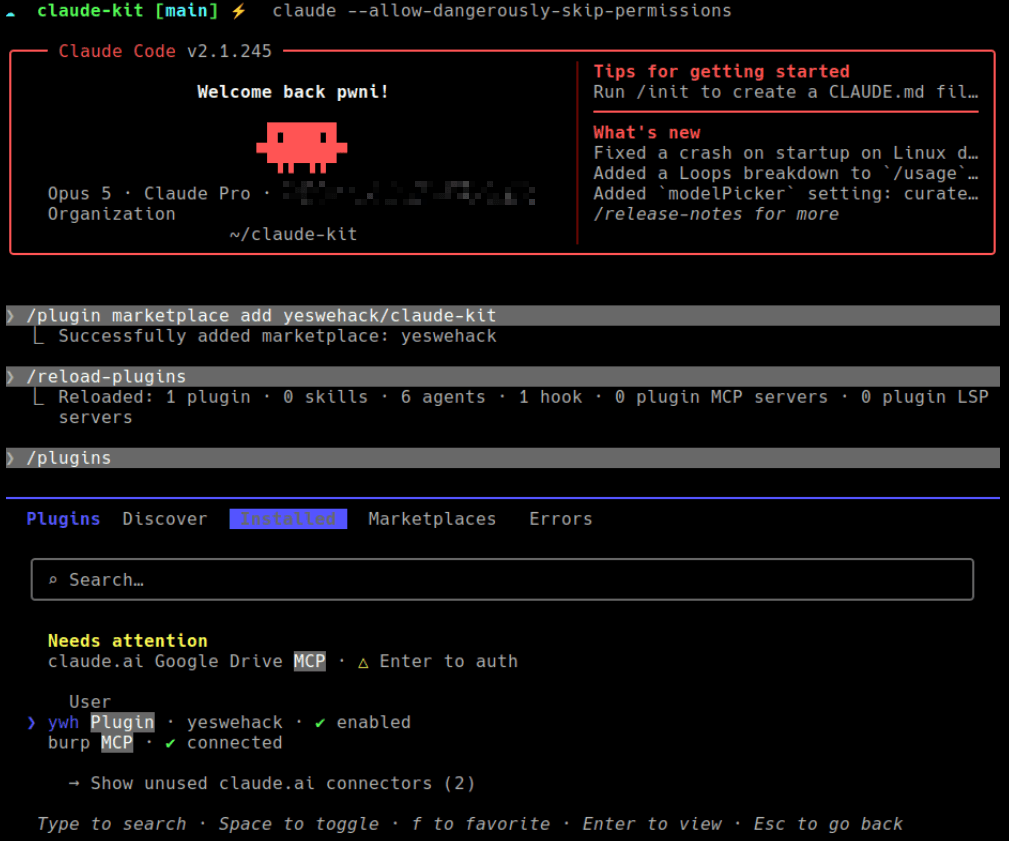
Run /plugin to confirm it is listed and enabled - both layers are now
active.
By default the plugin installs at user scope (active in all your projects). The installer also offers project and local scopes if you prefer to keep it to a single workspace.
In action
Ask whether a folder of drafts is ready to submit - it reads the scope and hands back one verdict per draft, worst-first:
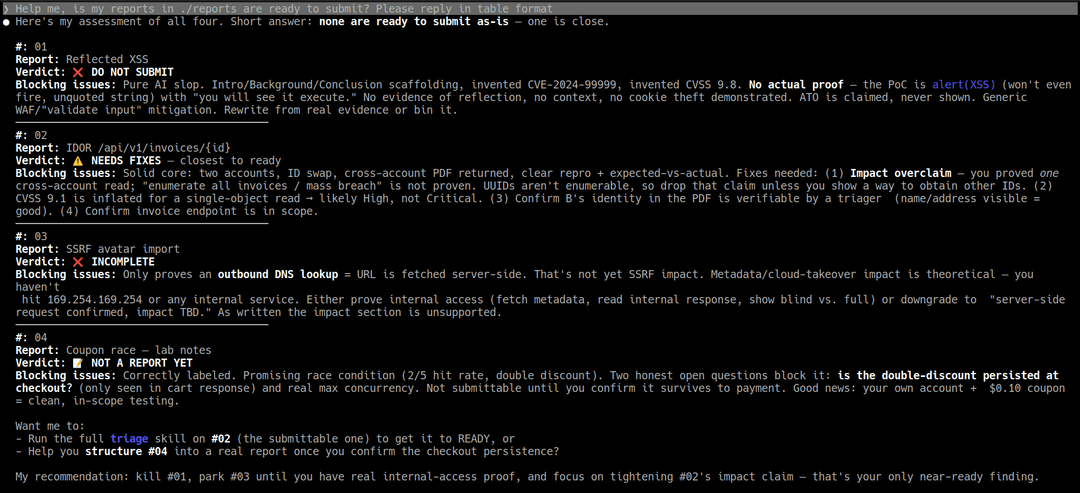
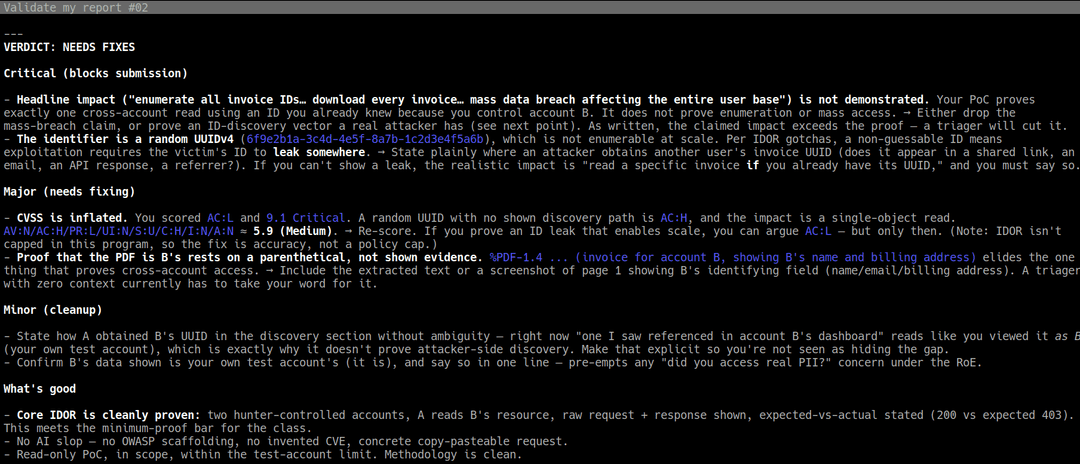
Pick the near-ready one and it runs the full triage. It keeps the real
IDOR but kills the "mass data breach affecting the entire user base"
overclaim - the invoice ID is a random UUIDv4, not enumerable, so AC:H
and the proof only shows a single cross-account read - and deflates the
draft's inflated 9.1 to a defensible ~5.9 Medium:
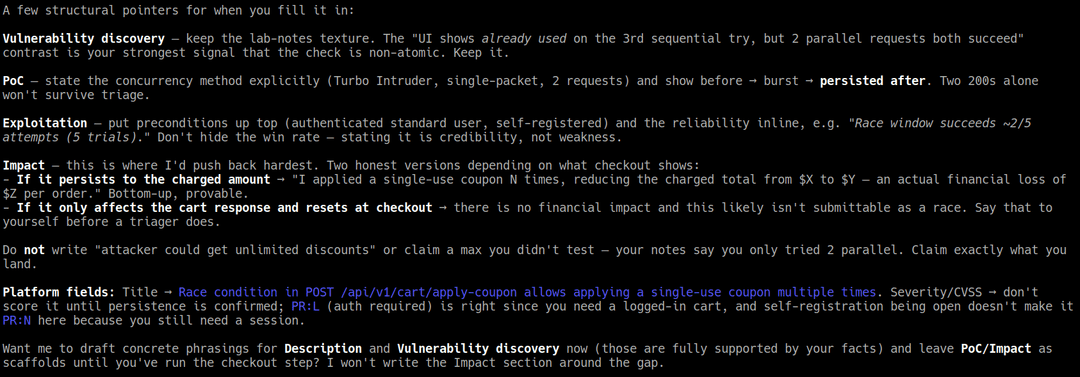
It drafts too, without inventing what you didn't prove. Handed raw lab notes on a coupon race condition, it maps them onto the report sections and blocks the Impact section: the double discount was only seen in the cart response, never confirmed persisted at checkout, so there is no financial impact to claim yet.
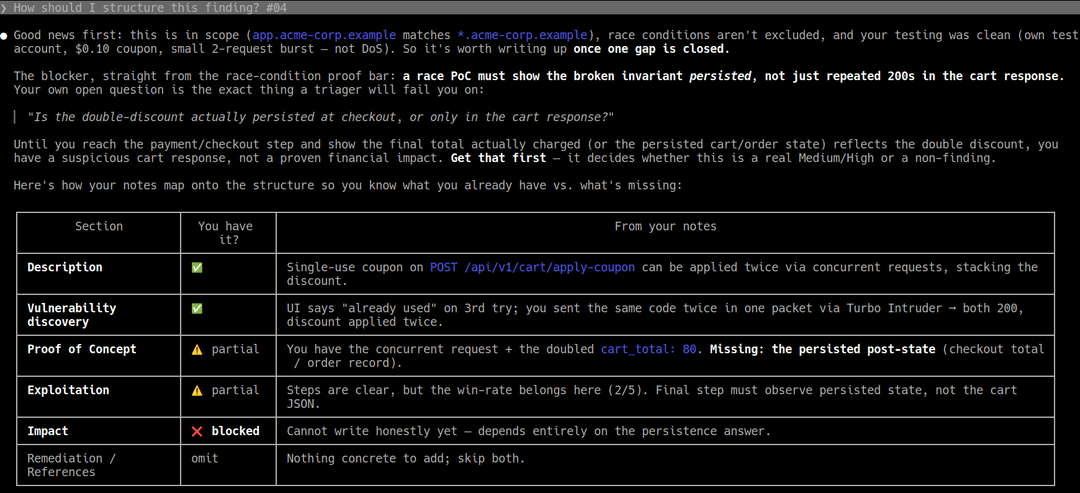
Then it turns the notes into per-section pointers - two honest Impact
versions to write depending on what checkout reveals, PR:L justified,
CVSS left unscored until persistence is confirmed - and refuses to claim
a maximum you never tested ("don't write attacker could get unlimited
discounts"):
How it works
Two layers, one install:
1. Always-on rules - injected into context at the start of every
session via a bundled SessionStart hook. They keep unverified claims
out of the report from the start: never invent facts, never write
theoretical impact, never pad with OWASP boilerplate, and flag
out-of-scope or unprovable claims - during investigation, drafting, and
validation alike. Nothing to copy or configure; they apply from your
first prompt.
2. Three on-demand skills - loaded only when you invoke them (or when your phrasing matches their trigger):
| Skill | Invoke it for... | What it does |
|---|---|---|
/ywh:write | "how should I structure this?", "help me write this up" | Shapes the draft into the required sections (aligned with YesWeHack guidance) with per-section format rules. Drafts from your facts, asks when one is missing. |
/ywh:triage | "is this ready to submit?", "triage this", "validate my draft" | Returns a verdict (READY / NEEDS FIXES / DO NOT SUBMIT) with concrete fixes. Runs the unverified-output checklist internally and the class gotchas for whatever you claimed. |
/ywh:gotchas | you name a vulnerability class | Loads that class's minimum proof, common N/A (auto-close) patterns, and impact-overclaim traps. Covers XSS, SQLi, SSRF, IDOR, CSRF, RCE, SSTI, XXE, open redirect, auth bypass, info disclosure, race condition, CORS, and path traversal / LFI. |
Skills are namespaced (/ywh:...) so they never clash with your own.
Auto-invocation is semantic, not guaranteed - for the final
pre-submission check, invoke /ywh:triage explicitly.
A typical flow
- Investigate as usual. The always-on rules keep the assistant from validating unproven leads - suspicious behavior gets "not yet a bug, here's what would prove it", not a green light.
- Confirmed a bug? Ask "how should I structure this finding?" -
/ywh:writeshapes it from your notes and flags anything missing instead of filling the gap. - Before submitting, run
/ywh:triagefor a verdict and line-by-line fixes, checked against the program scope.
Notes
- Update to the latest release:
/plugin update ywh@yeswehack. - Work on the plugin locally: clone it, add it as a local marketplace
by path, and reload after edits:
git clone https://github.com/yeswehack/claude-kit /plugin marketplace add ./claude-kit /reload-plugins - New to Claude Code plugins? See Anthropic's docs: Create plugins · Marketplaces · Install plugins.
- License: GPL-3.0-or-later.
// faq
What is claude-kit?
Claude Code plugin for writing triager-grade bug bounty reports. It is open-source on GitHub.
Is claude-kit free to use?
claude-kit is open-source under the GPL-3.0 license, so it is free to use.
What category does claude-kit belong to?
claude-kit is listed under plugins in the Claudeers registry of Claude-compatible tools.
// embed badge

[](https://claudeers.com/claude-kit)
// retro hit counter

[](https://claudeers.com/claude-kit)
// reviews
// guestbook
// related in Claude Plugins
 🔓
🔓A single CLAUDE.md file to improve Claude Code behavior, derived from Andrej Karpathy's observations on LLM coding pitfalls.
 🔓
🔓Claude Code is an agentic coding tool that lives in your terminal, understands your codebase, and helps you code faster by executing routine tasks, explainin…
 🔓
🔓"CLI-Anything: Making ALL Software Agent-Native" -- CLI-Hub: https://clianything.cc/
🔓financial-services — a Claude ecosystem project on GitHub.