
claude-code-merge-queue
The local merge queue for parallel Claude Code agents.
Install with your AI
Paste into Claude Code, Cursor, or any agent — it reads the repo and wires the tool into your project.
Install and set up claude-code-merge-queue (npm project) into my current project.
Found on https://claudeers.com/claude-code-merge-queue
Repo: https://github.com/funador/claude-code-merge-queue
Homepage/docs: —
Detected install method: npm → npm install claude-code-merge-queue
Category: mcp-servers. Platforms: cli, api.
Read the repo's README for exact setup and env vars, then install it and wire it into my project.

Claudeers Health Verdict:
active; community-verified: false. Confirm the source before running anything.
npm install claude-code-merge-queue
git clone https://github.com/funador/claude-code-merge-queue
// compatibility
| Platforms | cli, api |
|---|---|
| Operating systems | — |
| AI compatibility | claude |
| License | MIT |
| Pricing | open-source |
| Language | TypeScript |
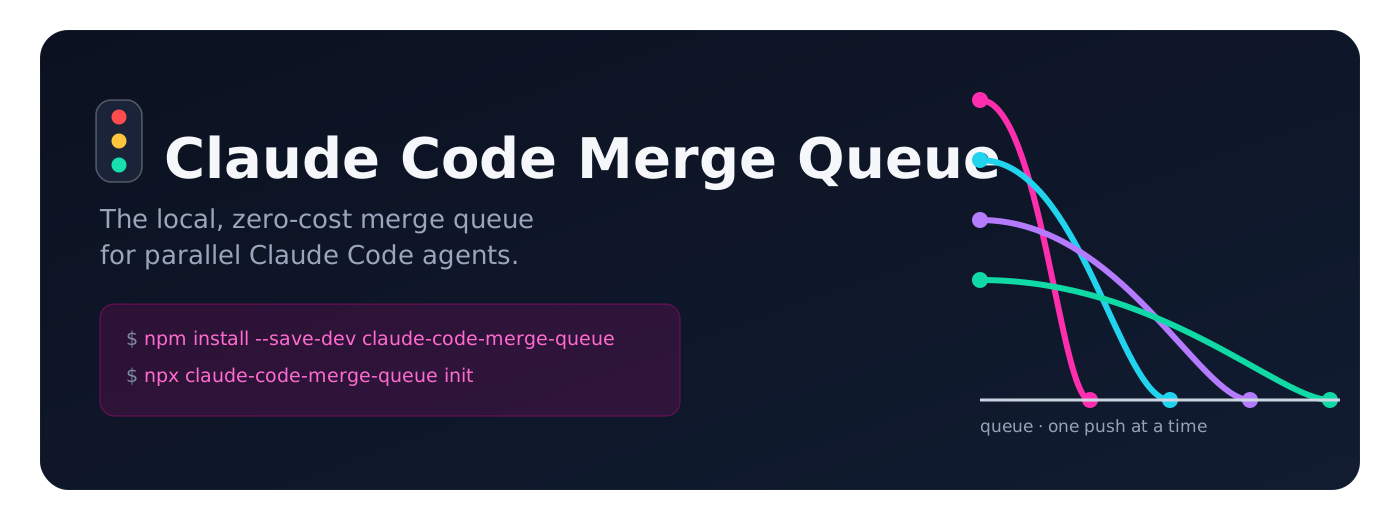
Claude Code Merge Queue 🚦
Claude Code already isolates your agents — --worktree (or isolation: "worktree" on a subagent) gives every session its own git worktree, natively,
no setup. That part's solved. Claude Code Merge Queue is the part that comes after: what
happens when four isolated agents all try to land, build, and test at the
same time.
- 🏁 Everyone pushes to the same branch, someone loses the race, and the rejected push turns into a rebase, which sometimes turns into another rejected push.
- 🔥 A full build is heavy. Four of them running at once turn your laptop into a space heater.
- 🎲 If your tests hit a shared database, concurrent runs race each other's resets. The failures look flaky. They are not flaky. They're just honest.
None of that is a skill issue. It's what happens when several fast, confident processes share one mutable thing with no traffic control.
Telling the agents to "please coordinate" doesn't fix it. An agent (or a teammate in a hurry) will violate a documented convention exactly once, at exactly the wrong moment, and mean nothing by it.
So don't ask nicely. Make the collision impossible. 🚦
The local, zero-cost merge queue for parallel Claude Code agents.
⚡ Quickstart
npm install --save-dev claude-code-merge-queue   # or: pnpm add -D / yarn add -D / bun add -d
npx claude-code-merge-queue init
This does the whole setup, not just the config file:
claude-code-merge-queue.config.mjs—integrationBranchauto-detected from your current branch,checkCommandauto-detected from package.json (check:push/check/ci/test, first match wins).CLAUDE.md(or appends to yours if you already have one) — the part that makes the whole thing hands-off. Claude Code reads it automatically, every session, and it tells the agent to land its own work once green, without being asked. See "The hands-off part" below..claude/settings.json— theWorktreeCreatehook wired in (created, or merged into your existing settings without touching anything else already there)..husky/pre-push— created or appended to, if you already have Husky. If you don't,inittells you so instead of silently writing to the untracked, not-shared-with-your-team.git/hooks/pre-push.package.jsonscripts —land,sync,promote,preview, andpreview:restoreadded, skipping any you've already defined yourself.claude-code-merge-queue-preflight.mjs+preland/presyncscripts — a self-contained safety net npm runs automatically beforeland/sync. If this tool's own name/bin ever changes again (it has once —lanekeeper→claude-code-merge-queue) and a lane hasn't rebased past that point yet, itspackage.jsonstill calls the old name, which no longer exists — a bare, confusingsh: lanekeeper: command not found. This script catches that case with an actual diagnosis ("this branch is stale relative to origin/<branch> — rebase first") instead. It's deliberately plain JS with zero dependency onclaude-code-merge-queueitself, so it keeps working across future renames too.
Commit everything it wrote, then you're running. Two steps, not a setup guide.
If init couldn't detect a checkCommand (no matching script in
package.json), every push is blocked until you set one — see 🧰 What's
in the box below. That's on purpose.
From here on: claude --worktree <name> to spin up an isolated lane —
Claude Code Merge Queue's hook takes it from there, and CLAUDE.md tells the agent the rest.
You show up to run claude-code-merge-queue promote when you actually want to ship. 🚀
🆚 vs. GitHub's Merge Queue
GitHub already ships a merge queue. Two things it costs you that this doesn't:
| GitHub Merge Queue | Claude Code Merge Queue | |
|---|---|---|
| Private repo | Enterprise Cloud only | Any plan, any repo |
| Cost per landing | GitHub Actions minutes, every queue attempt | $0 — runs on your own machine |
| Requires | A pull request | Nothing — direct rebase + push |
Same idea — serialize landings, test before merge, keep history clean — run locally instead of in someone else's billed cloud. 💸
🧰 What's in the box
| Command | What it does |
|---|---|
claude-code-merge-queue hook worktree-create | A Claude Code WorktreeCreate hook. Plugs Claude Code Merge Queue's numbered lanes into Claude's native worktree creation — doesn't reinvent it. |
claude-code-merge-queue build-lock -- <cmd> | Runs <cmd> — your build — serialized across every lane, machine-wide. |
claude-code-merge-queue land | Rebases and pushes your lane onto the integration branch through a FIFO queue, so two lanes are never mid-push at once. Agents run this themselves — see below. |
claude-code-merge-queue sync | Fast-forwards your main checkout so a dev server actually sees what just landed — and re-installs dependencies if the lockfile changed, so the node_modules every lane symlinks from never goes stale. |
claude-code-merge-queue promote | Ships the integration branch to production. Human-only — never in an agent's instructions, never automated. |
claude-code-merge-queue preview | Instantly mirrors a lane's live working tree — uncommitted changes included — onto the main checkout, so you can look at it without a build. |
claude-code-merge-queue port | Prints a lane's dev-server port, derived from its own directory name. |
claude-code-merge-queue prune | Removes already-landed sibling lane worktrees on demand — land already does this automatically, this is for "clean these up right now" instead of waiting for the next lane to land something. |
Plus 🔒 a pre-push hook that makes land non-optional: a direct git push
straight to the integration branch gets bounced, full stop. Not a lint
warning. Not a Slack reminder. Rejected — with the actual command to run
instead. The same hook also runs your actual checks (checkCommand —
lint/typecheck/test/build) before allowing a landing through at all; a
config with no checkCommand set fails every push by default rather than
landing unverified code silently.
Every one of those blocks has a real, deliberate way out — see "The emergency hatch" below — but it takes naming the specific branch you mean to push, not one generic flag.
And 🧪 a documented extension point (src/lib/ephemeral.ts +
examples/ephemeral-tmp-dir.example.ts) for the thing every setup guide
skips: if your tests hit a shared resource — a database, a queue, anything
stateful — concurrent lanes need their own throwaway copy of it, and a
crashed run's copy needs to clean itself up without anyone noticing it died.
⚙️ Configuration
Everything lives in one file — see
examples/claude-code-merge-queue.config.mjs for every
field with comments. The short version:
export default {
  branchPrefix: "lane/",               // lane/1, lane/2, ...
  worktreeSuffix: "-lane-",            // ../your-repo-lane-1
  portBase: 3000,                      // lane n gets portBase + n
  integrationBranch: "main",           // where agents land — see below
  productionBranch: null,              // set this for a two-stage model — see below
  protectedBranches: [],               // extra branches beyond the two above; most repos need none
  regenerableFiles: [],                // files a build tool rewrites — never block a rebase on these
  symlinks: [".env", ".env.local", "node_modules"],
  buildOutputDirs: ["dist", "build", ".next"], // preview never copies these onto your checkout
  checkCommand: "npm run check",       // what actually gates a landing — see below
  checksRequired: true,                // false = deliberately run with none; see below
};
Nothing here is hardcoded to any framework or branch model. 🧩 A malformed
config (empty branch names, a negative port, productionBranch equal to
integrationBranch, ...) fails loud with every problem listed, the moment
any command loads it — not a mysterious failure three steps later.
🚨 The emergency hatch
Every blocked push — the integration branch, productionBranch, anything
in protectedBranches — has a real way through it. One env var, no
prompts, no second factor to remember:
CLAUDE_CODE_MERGE_QUEUE_EMERGENCY_PUSH=1 git push origin HEAD:main
This is the one place that's honestly a convention, not a hard guarantee: it stops mistakes and stray pushes, not an adversarial agent that sets the var itself.
🙌 The hands-off part
Tests are the reviewer, not a human, at any point in this pipeline.
checkCommandgates landing. Nothing reachesintegrationBranchwithout passing it — the only correctness check most changes get.claude-code-merge-queue promoteis a release decision, not a code review. It means "this already-tested work should ship now," not "I read the diff." Your own CI on the production branch is a second automated checkpoint — still not a human one.- When something gets through anyway, the fix is a test, not a reviewer. Every miss becomes a permanent guardrail, not a one-off catch.
Not for every team — if you want a human looking at every change before it ships, this is missing that step on purpose.
🔁 The one idea underneath most of it
The build queue, the landing queue, and the ephemeral-resource pattern are all crash-safe the same way:
- Claim a resource.
- Tag the claim with your process ID.
- Let liveness — not a timeout — decide when a claim is stale.
queue-lock.ts does it for the build and landing queues; ephemeral.ts
does it for test resources. kill -9 any of them mid-claim, and the next
process notices the PID is dead and reclaims it.
The WorktreeCreate hook is a cousin of the same idea for a one-shot
script with no process to check liveness against: the claim IS the
worktree, and git worktree add failing on an already-taken path is the
atomicity guard.
No stale locks, no "just restart your laptop," no magic timeout number. ✅
🔍 Know the limits
Things a sharp reader should already know before they ask:
- One machine, not a fleet. The FIFO queue lives in local temp storage — it doesn't coordinate across laptops. Two machines landing at once just get git's ordinary non-fast-forward rejection (safe, not corrupting — the loser re-fetches and retries, same as any team without a queue does today).
- Not a security boundary. Every guardrail here stops mistakes and
convention drift, not a truly adversarial agent. Shell access always
means
git push --no-verify, deleting the hook, or editing the config on purpose — nothing local-only can stop that. - Guarantees a check ran — not that it's good. It enforces that
checkCommandexists and passed, with no way to know if that's a real test suite orecho ok. "Tests are the reviewer" is only as true as what's actually in them. - The
WorktreeCreatehook is the youngest piece of this stack — Claude Code shipped it Feb 2026. Losing it degrades gracefully: fall back togit worktree addby hand and you still keep the build queue, landing queue, preview, and ephemeral-resource pieces, none of which depend on it. - A slow
checkCommandis a real throughput ceiling, not a free lunch. The FIFO lock holds for its entire duration — one landing at a time, machine-wide. A 3–4 minute suite caps you well under 20 landings/hour flat-out, before any queue wait. - Rebase conflicts abort, they never guess.
git rebase --aborton any conflict, working tree left clean. Normally "you" here is the agent, not a human — CLAUDE.md tells it to resolve the conflict and re-runland, same as any other bug;checkCommandstill catches a bad resolution. - Auto-pruning checks for a live Claude Code session, via
lsof. A merged branch alone isn't enough — a brand-new, zero-commit lane is trivially "merged" too, so pruning also refuses to touch a worktree with a live Claude Code process in it. Deliberately narrower than "any process at all": an orphaned MCP server or stray build process can outlive the session that spawned it and otherwise keep an abandoned lane stuck forever (confirmed live). Missinglsoffails closed — treats liveness as unknown, never removes. - The
WorktreeCreatehook needs the host project's own real install. It runs vianpx claude-code-merge-queue hook worktree-create(nonode_modules/.binon PATH for a raw hook, unlike annpm runscript), and npx silently falls back to an ephemeral, unpinned copy if it can't resolve the package locally — which happened in production and masked a broken install for two lane-landings. The hook now refuses to run at all from npx's ephemeral cache, so a broken install fails loud immediately instead of limping along on a mismatched stand-in.
🧬 Where this came from
This is the extracted, generalized shape of tooling built to run several parallel Claude Code agents on one real production codebase without them tripping over each other. The names have been filed off; the mechanics haven't.
📄 License
MIT. Fork it, rename it, argue with the config shape — that's the point.
// faq
What is claude-code-merge-queue?
The local merge queue for parallel Claude Code agents. . It is open-source on GitHub.
Is claude-code-merge-queue free to use?
claude-code-merge-queue is open-source under the MIT license, so it is free to use.
What category does claude-code-merge-queue belong to?
claude-code-merge-queue is listed under mcp-servers in the Claudeers registry of Claude-compatible tools.
// embed badge

[](https://claudeers.com/claude-code-merge-queue)
// retro hit counter

[](https://claudeers.com/claude-code-merge-queue)
// reviews
// guestbook
// related in MCP Servers
 🔓
🔓f.k.a. Awesome ChatGPT Prompts. Share, discover, and collect prompts from the community. Free and open source — self-host for your organization with complete…
 🔓
🔓A cross-platform desktop All-in-One assistant for Claude Code, Codex, OpenCode, OpenClaw, Gemini CLI & Hermes Agent. Only official website: ccswitch.io
 🔓
🔓🪨 why use many token when few token do trick — Claude Code skill that cuts 65% of tokens by talking like caveman
 🔓
🔓An open-source AI agent that brings the power of Gemini directly into your terminal.