
claude-certified-architect-foundations-ccao-f
Comprehensive preparation hub for Anthropic Claude Certified Architect - Foundations (CCAO-F) certification. Includes full 5-domain deep dive, 25 scenario-ba…
Install with your AI
Paste into Claude Code, Cursor, or any agent — it reads the repo and wires the tool into your project.
Install and set up claude-certified-architect-foundations-ccao-f (git-clone project) into my current project.
Found on https://claudeers.com/claude-certified-architect-foundations-ccao-f
Repo: https://github.com/Jason-smithy/claude-certified-architect-foundations-ccao-f
Homepage/docs: —
Detected install method: git-clone → git clone https://github.com/Jason-smithy/claude-certified-architect-foundations-ccao-f
Category: mcp-servers. Platforms: cli, api, desktop, mobile.
Read the repo's README for exact setup and env vars, then install it and wire it into my project.

Claudeers Health Verdict:
active; community-verified: false. Confirm the source before running anything.
git clone https://github.com/Jason-smithy/claude-certified-architect-foundations-ccao-f
// compatibility
| Platforms | cli, api, desktop, mobile |
|---|---|
| Operating systems | — |
| AI compatibility | claude |
| License | MIT |
| Pricing | open-source |
| Language | — |
Anthropic Claude Certified Architect – Foundations (CCAO-F) Exam Preparation Hub
📌 Executive Exam Overview
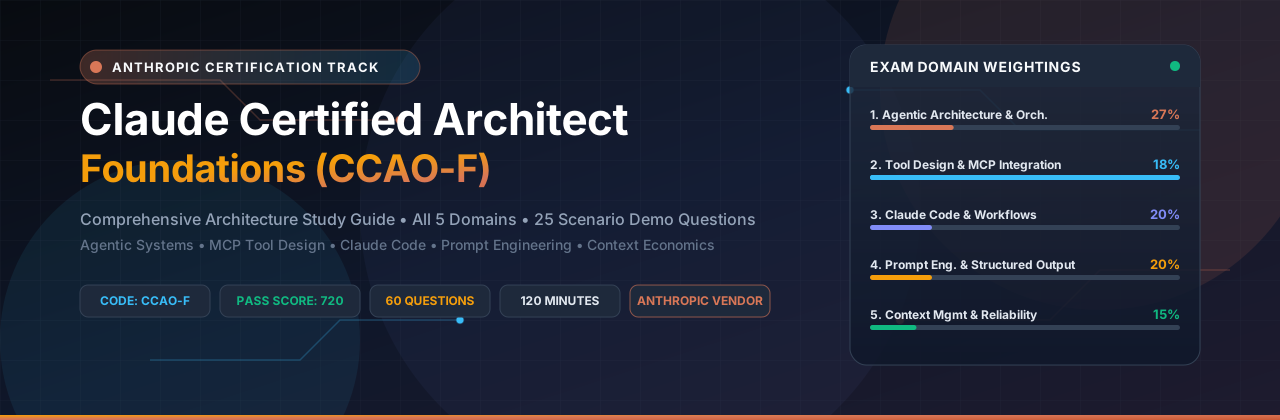
The Claude Certified Architect – Foundations (CCAO-F) is the official architecture accreditation from Anthropic. This certification validates that an enterprise architect or AI engineer can scope, architect, and deploy production-grade solutions powered by Claude. It benchmarks competence across model selection, deployment platform evaluation (Anthropic API, Amazon Bedrock, Google Cloud Vertex AI), agentic vs. single-shot architectures, Model Context Protocol (MCP) integration, developer tooling (Claude Code), context management economics, prompt engineering, and responsible AI guardrails.
🎯 Official Exam Specification Matrix
| Attribute | Official Specification |
|---|---|
| Certification Name | Claude Certified Architect – Foundations |
| Exam Code | CCAO-F (Anthropic Architecture Foundations) |
| Certifying Vendor | Anthropic |
| Target Audience / Role | Solutions Architects, AI Engineers, Lead System Architects, Technical Leads |
| Exam Level | Foundations (Level 100–200 Architecture & Engineering) |
| Number of Questions | 60 Multiple-Choice & Multiple-Response Questions |
| Exam Duration | 120 Minutes (~135 Minutes total seat appointment time) |
| Passing Score | 720 (Scaled scoring scale: 100 – 1,000) |
| Exam Fee | $125 USD |
| Credential Validity | 12 Months (with recertification path) |
| Delivery Modality | Online Proctored Exam or in-person Pearson VUE Testing Center |
| Prerequisites | Familiarity with Python/TypeScript, REST APIs, JSON Schema, LLM architectures |
| Official Portal | Anthropic Academy CCAO-F Certification Page |
| Recommended Practice Tests | CertsClub Claude Certified Associate / Architect Foundations Practice Questions |
📊 Exam Domain Breakdown & Weightings
┌─────────────────────────────────────────────────────────────────────────────────┐
│                    CCAO-F DOMAIN WEIGHT DISTRIBUTION                            │
├──────────────────────────────────────────────────────┬──────────┬───────────────┤
│ Domain Area                                          │ Weight   │ Est. Questions│
├──────────────────────────────────────────────────────┼──────────┼───────────────┤
│ 1. Agentic Architecture & Orchestration              │   27%    │  ~16 Questions│
│ 2. Tool Design & Model Context Protocol (MCP)        │   18%    │  ~11 Questions│
│ 3. Claude Code Configuration & Developer Workflows   │   20%    │  ~12 Questions│
│ 4. Prompt Engineering & Structured Output            │   20%    │  ~12 Questions│
│ 5. Context Management & Production Reliability       │   15%    │  ~9 Questions │
├──────────────────────────────────────────────────────┴──────────┴───────────────┤
│ Total: 100% | 60 Questions | 120 Minutes                                        │
└─────────────────────────────────────────────────────────────────────────────────┘
pie title CCAO-F Exam Domain Weightings
    "Domain 1: Agentic Architecture & Orchestration (27%)" : 27
    "Domain 2: Tool Design & MCP Integration (18%)" : 18
    "Domain 3: Claude Code & Workflows (20%)" : 20
    "Domain 4: Prompt Engineering & Structured Output (20%)" : 20
    "Domain 5: Context Management & Reliability (15%)" : 15
🗂️ Repository Architecture & Navigation Index
Explore the comprehensive study and architecture modules in this repository:
| Documentation Module | Core Content & Key Technical Highlights |
|---|---|
| 📖 DOMAINS.md | Exhaustive, section-by-section breakdown of all 5 domains with sub-topics, trade-off matrices, state management, and design patterns. |
| 📝 DEMO_QUESTIONS.md | Complete 25-Question Scenario Practice Set covering all 5 domains with verified answers, distractor rationales, and takeaways. |
| 🏗️ ARCHITECTURE_SCENARIOS.md | 5 Enterprise real-world blueprints: Multi-Agent Support, Document Extraction Pipeline, Claude Code Refactoring Agent, Multi-Cloud Deployment, Regulated RAG. |
| 🧭 STUDY_GUIDE.md | 4-Week vs 2-Week fast-track study plans, hands-on lab exercises, official learning paths, and exam day strategy. |
| 🔌 MCP_AND_TOOL_GUIDE.md | In-depth Model Context Protocol (MCP) guide: Transports (stdio, SSE), JSON-RPC 2.0 messages, Tool/Resource/Prompt primitives, Python & TS SDKs. |
| ⚡ CLAUDE_CODE_WORKFLOWS.md | Comprehensive Claude Code CLI guide: CLAUDE.md architecture, Agent SDK, hooks, subagents, automated headless CI/CD execution. |
🎯 Featured Demo Practice Questions (Front Page Previews)
Below are representative scenario questions highlighting each of the 5 official exam domains. Test your understanding, then click to expand the full architectural breakdown.
(For the complete bank of 25 questions, see DEMO_QUESTIONS.md.)
🔹 Demo 1: Agentic Architecture & Orchestration (Domain 1 — 27%)
Topic: Agent Loop Control & Runaway Prevention
Scenario:
An AI Architect is designing a customer support agent using Claude 3.5 Sonnet that uses tools to fetch account details, check transaction statuses, and issue refunds. During load testing, the agent occasionally enters an infinite loop when an external payment API returns a generic HTTP 500 error, continuously calling the tool with identical arguments until hitting system timeouts.
Question:
Which architectural pattern should the architect implement to most reliably prevent this runaway behavior while maintaining system resilience?
- A) Implement an exponential backoff retry loop directly inside the prompt instructions by telling Claude to wait 5 seconds before retrying.
- B) Wrap the tool execution in the application runtime with loop detection, enforce a deterministic
max_iterationscounter, and return a structured error status intool_resultupon repeated failures. - C) Switch the underlying model from Claude 3.5 Sonnet to Claude 3.5 Haiku, as Haiku has lower latency and smaller agent loops.
- D) Remove the payment API tool from the agent and require all payment queries to be answered using few-shot prompt examples.
🔍 Click to Reveal Correct Answer & Architectural Rationale
Correct Answer: B
Detailed Explanation:
- Why B is correct: In production agentic architectures, loop prevention and recursion limits MUST be enforced deterministically at the orchestrator/application runtime level, not purely in natural language prompts. Tracking iteration counts, detecting duplicate tool calls, and returning structured error payloads within
tool_resultallows Claude to recognize tool unavailability and transition to fallback logic or human escalation.- Why A is incorrect: LLMs cannot reliably track real-time sleep intervals or enforce deterministic timeouts through prompt instructions alone.
- Why C is incorrect: Changing model families does not solve the structural flaw of missing runtime boundary conditions.
- Why D is incorrect: Removing the tool destroys the functional capability of the agent; mock few-shot data cannot execute live account transactions.
💡 Architectural Takeaway: Never rely on LLM self-restraint for system safety. Always enforce hard runtime bounds (
max_iterations, loop detection, circuit breakers).
🔹 Demo 2: Tool Design & MCP Integration (Domain 2 — 18%)
Topic: Model Context Protocol (MCP) Transports & Remote Cloud Access
Scenario:
An organization wants to build an internal MCP server that allows developer workstations running Claude Code to query an internal PostgreSQL database located in a private AWS VPC. Developers work remotely from various corporate laptops.
Question:
Which MCP transport and architecture should the architect select?
- A)
stdiotransport running directly over an open public internet port. - B)
SSE(Server-Sent Events) transport hosted on an authenticated internal container behind an enterprise VPN / API Gateway with TLS encryption. - C) WebSockets without TLS authentication.
- D) Embed the raw database credentials in a static markdown file on each developer's desktop.
🔍 Click to Reveal Correct Answer & Architectural Rationale
Correct Answer: B
Detailed Explanation:
- Why B is correct: MCP supports two primary transports:
stdio(for local same-machine subprocesses) andSSE(for remote network services over HTTP/HTTPS). For remote cloud infrastructure access, SSE deployed behind an enterprise gateway with mutual TLS/OAuth is the standardized, secure architecture.- Why A is incorrect:
stdiocommunicates via standard OS input/output pipes between local child processes and cannot listen on network ports.- Why C is incorrect: WebSockets without TLS violates enterprise security standards.
- Why D is incorrect: Exposing raw credentials in static files creates a severe security vulnerability.
💡 Architectural Takeaway: Use
stdiofor local process tools and authenticatedSSEover HTTPS for distributed cloud MCP servers.
🔹 Demo 3: Claude Code Configuration & Workflows (Domain 3 — 20%)
Topic: Automated CI/CD Headless Execution
Scenario:
A DevOps engineer wants to integrate Claude Code into a GitHub Actions pipeline to automatically analyze code changes on pull requests, run linter checks, and comment recommendations.
Question:
How should the engineer configure the Claude Code CLI command for automated, non-interactive execution in CI/CD?
- A)
claude --interactive --auto-confirm - B)
claude --non-interactive -p "Analyze git diff against main, run lint, and summarize findings"with authenticatedANTHROPIC_API_KEYstored in repository secrets. - C)
claude run --gui-mode --headless - D) Pipe standard input from an infinite bash
yesloop intoclaude.
🔍 Click to Reveal Correct Answer & Architectural Rationale
Correct Answer: B
Detailed Explanation:
- Why B is correct: Claude Code provides a dedicated headless mode via
--non-interactive(or-p/- Why A, C, D are incorrect: They use invalid flags or fragile terminal piping that can hang pipelines or fail security controls.
💡 Architectural Takeaway: For CI/CD automation, run Claude Code with
--non-interactive -p "<prompt>"and secure secret management.
🔹 Demo 4: Prompt Engineering & Structured Output (Domain 4 — 20%)
Topic: Assistant Message Prefilling for Structured JSON Output
Scenario:
An application requires Claude to output raw JSON adhering to a strict schema: {"status": "APPROVED" | "REJECTED", "confidence": float, "reason": string}. However, Claude occasionally includes conversational filler before the JSON (e.g., "Here is the evaluation JSON:"), which causes the downstream JSON parser to crash.
Question:
What is the most robust and token-efficient method to guarantee Claude outputs ONLY valid JSON without preamble?
- A) Add "DO NOT INCLUDE PREAMBLE OR CONVERSATION" 10 times in the prompt.
- B) In the Messages API call, prefill the
assistantmessage with{or{"status":to force Claude to continue directly with the JSON payload. - C) Parse the output with regular expressions and guess missing brackets.
- D) Switch to a model that does not support conversational text.
🔍 Click to Reveal Correct Answer & Architectural Rationale
Correct Answer: B
Detailed Explanation:
- Why B is correct: In Anthropic's Messages API, prefilling the
assistantturn with an opening JSON bracket{or schema starter forces Claude to complete the JSON token sequence directly, eliminating 100% of conversational preamble.- Why A is incorrect: Negative prompt instructions are less reliable than API-level prefilling.
- Why C is incorrect: Regex guessing is brittle and prone to parsing errors.
- Why D is incorrect: All modern frontier LLMs support natural language conversation.
💡 Architectural Takeaway: Use Assistant Message Prefilling (
{) to eliminate preambles and enforce strict JSON generation.
🔹 Demo 5: Context Management & Reliability (Domain 5 — 15%)
Topic: Prompt Caching Strategy & Cost Optimization
Scenario:
A SaaS company provides a coding assistant for a codebase containing 40,000 tokens of documentation and boilerplate libraries. Thousands of users query the assistant every minute with short 50-token questions. Without caching, API costs are unsustainable.
Question:
How should the architect implement Anthropic Prompt Caching to achieve the maximum possible cost and latency reduction?
- A) Place a
cache_control: {"type": "ephemeral"}breakpoint at the end of the static 40,000-token documentation and system prompt block, placing dynamic user questions at the end of the messages array. - B) Place the dynamic user query at the beginning of the prompt and the 40,000-token documentation at the very end.
- C) Enable caching on every single user turn regardless of token length.
- D) Cache only outputs generated by the model.
🔍 Click to Reveal Correct Answer & Architectural Rationale
Correct Answer: A
Detailed Explanation:
- Why A is correct: Anthropic Prompt Caching matches prefixes. Placing the large, static 40,000-token documentation block at the beginning (with a
cache_control: {"type": "ephemeral"}breakpoint) ensures all subsequent user requests match the exact prefix. Cache read hits receive a 90% discount on input tokens and up to an 80% latency reduction.- Why B is incorrect: Placing dynamic, changing user questions at the beginning changes the prompt prefix on every request, causing 100% cache misses.
- Why C is incorrect: Caching has a minimum token threshold (1,024 tokens for Sonnet/Opus, 2,048 for Haiku); caching small 50-token prompts is not supported and adds write overhead.
- Why D is incorrect: Prompt caching operates on input prefixes, not generated output tokens.
💡 Architectural Takeaway: Structure prompts with static, heavy content first (system prompt, tools, docs) followed by a cache breakpoint; keep dynamic user text at the tail.
👉 Want to practice all 25 questions? Check out the full question bank in DEMO_QUESTIONS.md.
🚀 Recommended Preparation Resources & Practice Tests
1. Official Anthropic Academy Learning Path
Anthropic provides free curriculum courses designed to prepare architects for the CCAO-F credential:
- 🎓 AI Fluency: Framework & Foundations (Level 100): Ethical AI, system safety, collaboration fundamentals.
- 🎓 Claude 101 (Level 100): Core Claude capabilities, artifacts, Projects, and interface workflows.
- 🎓 Building with the Claude API (Level 100–200): Authentication, Messages API, system prompts, tool use, streaming, and evaluations.
- 🎓 Claude with Amazon Bedrock (Level 100–200): IAM security, Bedrock Converse API, VPC endpoints, Provisioned Throughput.
- 🎓 Claude on Google Cloud (Level 100–200): Vertex AI Model Garden, Service Accounts, Private Service Connect, regional quotas.
- 🎓 Introduction to Model Context Protocol (Level 200): Building MCP servers & clients, stdio/SSE transports, resources, tools, and prompts.
- 🎓 Claude Code in Action (Level 200): CLI workflows, project memory (
CLAUDE.md), hooks, and custom subagent orchestration.
🔗 Access the official portal: Anthropic Partner Skilljar Academy
2. High-Yield Practice Questions & Mock Exams
To test your readiness under realistic time and scenario constraints, practice with high-yield mock exams that reflect the latest Anthropic blueprints:
- 🌟 Recommended Practice Partner: CertsClub Claude Certified Associate / Architect Foundations Exam Preparation
- Realistic 60-question timed mock exams
- In-depth answer rationales for all multiple-choice and multi-select questions
- Scenario-based questions matching Pearson VUE / Online proctored exam difficulty
💡 Quick Architectural Cheatsheet
1. Model Family Selection Decision Matrix
┌─────────────────┬──────────────────────┬────────────────────────┬─────────────────────────┐
│ Model           │ Primary Use Cases    │ Strengths              │ Ideal Architecture Role │
├─────────────────┼──────────────────────┼────────────────────────┼─────────────────────────┤
│ Claude 3.5      │ Complex Reasoning,   │ Industry-leading       │ Primary Agent Brain,    │
│ Sonnet          │ Coding, Architecture,│ coding & vision,       │ Orchestrator, Deep      │
│                 │ Multi-Step Workflows │ fast token generation  │ Analysis & Tool Caller  │
├─────────────────┼──────────────────────┼────────────────────────┼─────────────────────────┤
│ Claude 3.5      │ High Volume, Low     │ Blazing fast speed,    │ Intent Classification,  │
│ Haiku           │ Latency, Cost Tuning,│ sub-second TTFT,       │ Routing, Filtering,     │
│                 │ Light Tool Calls     │ ultra-low token cost   │ Real-time Chatbots      │
├─────────────────┼──────────────────────┼────────────────────────┼─────────────────────────┤
│ Claude 3        │ Massive Synthesis,   │ Nuanced writing, deep  │ Specialized Executive   │
│ Opus            │ Highly Ambiguous     │ philosophical synthesis│ Summaries, Complex Math │
│                 │ Long-Form Context    │ across massive corpora │ Evaluation Judgments    │
└─────────────────┴──────────────────────┴────────────────────────┴─────────────────────────┘
2. Model Context Protocol (MCP) Core Anatomy
┌────────────────────────────────────────────────────────┐
│                      MCP HOST                          │
│  (e.g., Claude Code, Claude Desktop, Custom AI Server) │
│                                                        │
│   ┌────────────────────────────────────────────────┐   │
│   │                   MCP CLIENT                   │   │
│   └───────────────────────┬────────────────────────┘   │
└───────────────────────────┼────────────────────────────┘
                            │ JSON-RPC 2.0 (stdio / SSE)
    ┌───────────────────────┴────────────────────────┐
    ▼                                                ▼
┌─────────────────────────┐            ┌─────────────────────────┐
│     MCP SERVER A        │            │     MCP SERVER B        │
│  (Local Files / Git)    │            │  (Postgres DB / REST)   │
├─────────────────────────┤            ├─────────────────────────┤
│ • Tools (Execute)       │            │ • Tools (Execute)       │
│ • Resources (Read)      │            │ • Resources (Read)      │
│ • Prompts (Templates)   │            │ • Prompts (Templates)   │
└─────────────────────────┘            └─────────────────────────┘
3. Prompt Caching Economics & Latency Optimization
- Minimum Cacheable Threshold: 1,024 tokens (Claude 3.5 Sonnet / Opus) or 2,048 tokens (Claude 3.5 Haiku).
- TTL (Time to Live): 5-minute rolling window refreshed on cache hits.
- Pricing Multipliers:
- Cache Write (1.25x base input cost)
- Cache Read Hit (0.10x base input cost — 90% discount!)
- Breakpoint Placement: Place
cache_control: {"type": "ephemeral"}at static boundaries (System Prompts, Large Tool Definitions, RAG Documentation blocks).
🤝 Community & Contributions
Contributions, typo fixes, and additional scenario additions are welcome! Open a pull request or issue following the standard GitHub workflow.
📄 License
This repository is open-sourced under the MIT License. All trademarks and brand names belong to Anthropic PBC.
// faq
What is claude-certified-architect-foundations-ccao-f?
Comprehensive preparation hub for Anthropic Claude Certified Architect - Foundations (CCAO-F) certification. Includes full 5-domain deep dive, 25 scenario-based demo questions with detailed explanations, enterprise architecture blueprints, Model Context Protocol (MCP) guide, and Claude Code developer workflows.. It is open-source on GitHub.
Is claude-certified-architect-foundations-ccao-f free to use?
claude-certified-architect-foundations-ccao-f is open-source under the MIT license, so it is free to use.
What category does claude-certified-architect-foundations-ccao-f belong to?
claude-certified-architect-foundations-ccao-f is listed under mcp-servers in the Claudeers registry of Claude-compatible tools.
// embed badge

[](https://claudeers.com/claude-certified-architect-foundations-ccao-f)
// retro hit counter

[](https://claudeers.com/claude-certified-architect-foundations-ccao-f)
// reviews
// guestbook
// related in MCP Servers
 🔓
🔓f.k.a. Awesome ChatGPT Prompts. Share, discover, and collect prompts from the community. Free and open source — self-host for your organization with complete…
 🔓
🔓A cross-platform desktop All-in-One assistant for Claude Code, Codex, OpenCode, OpenClaw, Gemini CLI & Hermes Agent. Only official website: ccswitch.io
 🔓
🔓🪨 why use many token when few token do trick — Claude Code skill that cuts 65% of tokens by talking like caveman
 🔓
🔓An open-source AI agent that brings the power of Gemini directly into your terminal.