
claude-capability-bridge-skill
A procedural Agent Skill that teaches custom-provider models how to discover, use, verify, and recover from Claude Desktop/Cowork-style tools and workflows
Install with your AI
Paste into Claude Code, Cursor, or any agent — it reads the repo and wires the tool into your project.
Install and set up claude-capability-bridge-skill (claude-skill project) into my current project.
Found on https://claudeers.com/claude-capability-bridge-skill
Repo: https://github.com/Abolfazlshahi/claude-capability-bridge-skill
Homepage/docs: https://t.me/pythash
Detected install method: claude-skill → # copy this skill into .claude/skills/claude-capability-bridge-skill/
Category: skills. Platforms: cli, api, desktop, web.
Read the repo's README for exact setup and env vars, then install it and wire it into my project.

Claudeers Health Verdict:
active; community-verified: false. Confirm the source before running anything.
# copy the skill dir into your project:
# .claude/skills/claude-capability-bridge-skill/   (or ~/.claude/skills/claude-capability-bridge-skill/ for all projects)
git clone https://github.com/Abolfazlshahi/claude-capability-bridge-skill
// compatibility
| Platforms | cli, api, desktop, web |
|---|---|
| Operating systems | — |
| AI compatibility | claude |
| License | MIT |
| Pricing | open-source |
| Language | Python |
Claude Capability Bridge Skill
Teach custom-provider models the workflow knowledge needed to operate agentic tools reliably.

Detect Runtime → Discover → Remediate → Route → Execute → Verify → Recover
What problem does this solve?
A model can have access to the same browser, filesystem, shell, MCP tools, connectors, and other runtime capabilities as a strong native agent and still use them poorly.
The missing piece is often procedural knowledge: first identifying the actual runtime and execution boundary, then choosing the right interface, preserving state, diagnosing missing capabilities, and gathering enough evidence to say done.
This Skill turns those behaviors into reusable procedures for Claude Code CLI, Claude Desktop/Cowork-style, and other Agent Skills-compatible runtimes.
Core invariant: capability exposed ≠ capability understood ≠ task completed ≠ task verified.
Runtime-first architecture
Before routing a tool or launching a project, the bridge establishes the operating profile:
HOST: CLI / Desktop / Cowork / Cloud / Remote / Other
EXECUTION: local / cloud / remote / mixed
PROVIDER: first-party / third-party / unknown
CAPABILITIES: shell / files / Git / browser / Chrome / MCP / GUI / etc.
             ↓
       discover relevant capability
             ↓
       classify missing capability
             ↓
       repair only when possible
             ↓
       route → execute → verify
CLI is treated as a first-class profile rather than a Desktop variant. Browser/Chrome availability is checked separately from shell or project execution, and provider restrictions remain a separate axis.
See references/runtime-detection-and-profiles.md, references/claude-code-cli-operating-model.md, and references/capability-remediation.md.
Before vs After
| Without the bridge | With the bridge |
|---|---|
| May assume the wrong host or execution location | Detects runtime and execution boundary first |
| May see tools without knowing when to use them | Discovers the live capability surface relevant to the task |
| Can choose a plausible but wrong tool | Selects the narrowest authoritative surface |
| May stop at “not connected” | Classifies the missing capability and attempts justified remediation |
| May invent arguments or rely on stale assumptions | Reads current contracts and invalidates stale observations |
| May confuse a running process with a working app | Verifies readiness, rendered state, and critical behavior |
| May claim success from partial evidence | Reports verified, blocked, failed, and unknown states separately |
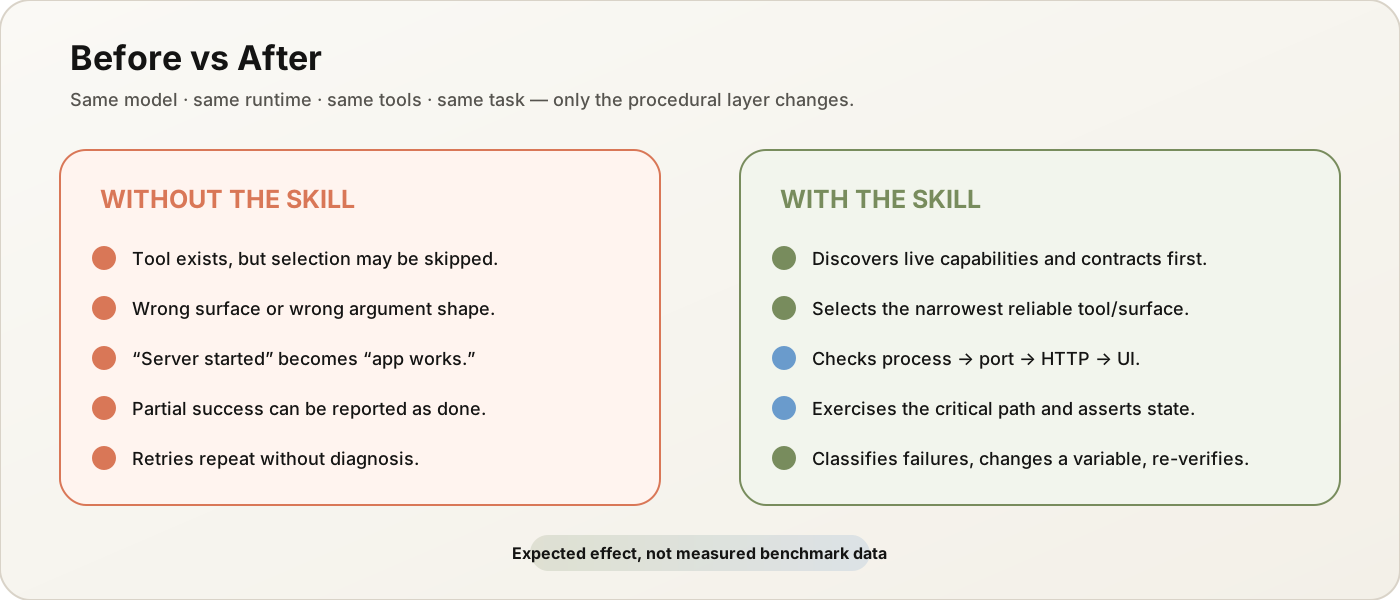
Honesty note: this table describes intended behavior, not measured performance. Empirical claims belong in the benchmark results.
How it works
1. Runtime detection
2. Execution/provider profile
3. Capability discovery + safe probing
4. Missing-capability classification/remediation
5. Authoritative tool/surface selection
6. Short observable execution loops
7. Direct verification
8. Recovery / fallback
9. Evidence-backed report
The main SKILL.md stays compact. Detailed procedures are progressively loaded from references/ only when a task enters that capability family.
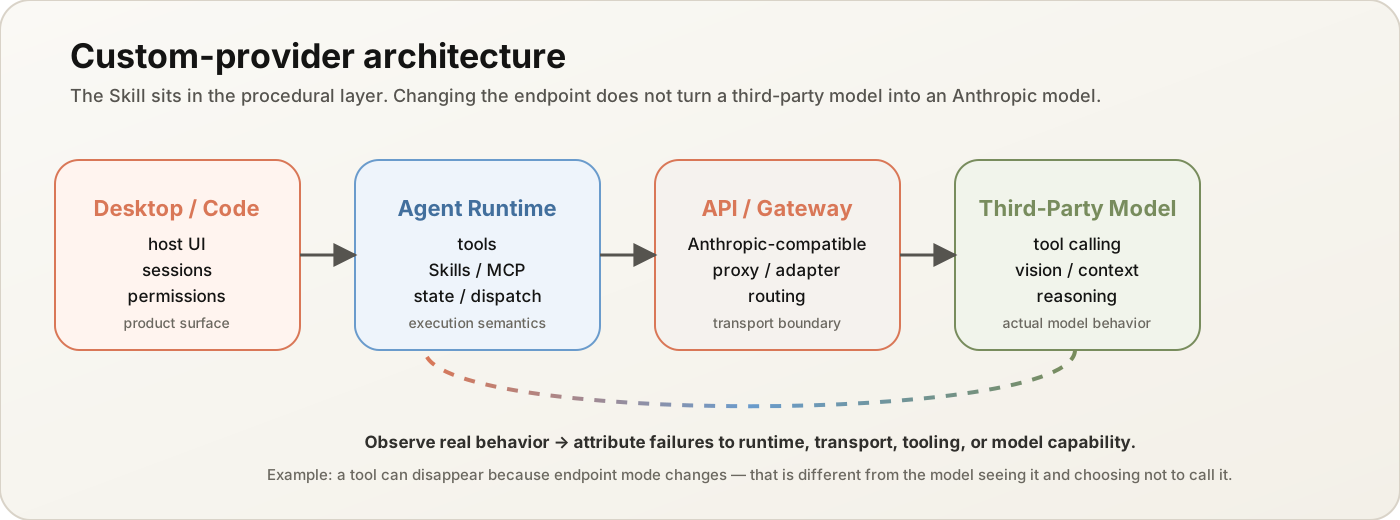
Custom-provider support
A custom endpoint or gateway can be transport-compatible without making the underlying model behaviorally equivalent to an Anthropic model.
| Layer | Question |
|---|---|
| Model | Can the model reason, use required modalities, and emit reliable tool calls? |
| Skill | Does it have the procedural knowledge required by the workflow? |
| Runtime | Are tools, context, permissions, and dispatch exposed? |
| Transport / provider | Does the gateway preserve the required protocol features? |
| Environment | Do files, processes, browser state, network, and services actually exist? |
The bridge explicitly distinguishes provider/runtime limits from procedural failures. A provider-unsupported browser integration should not trigger endless local setup attempts.
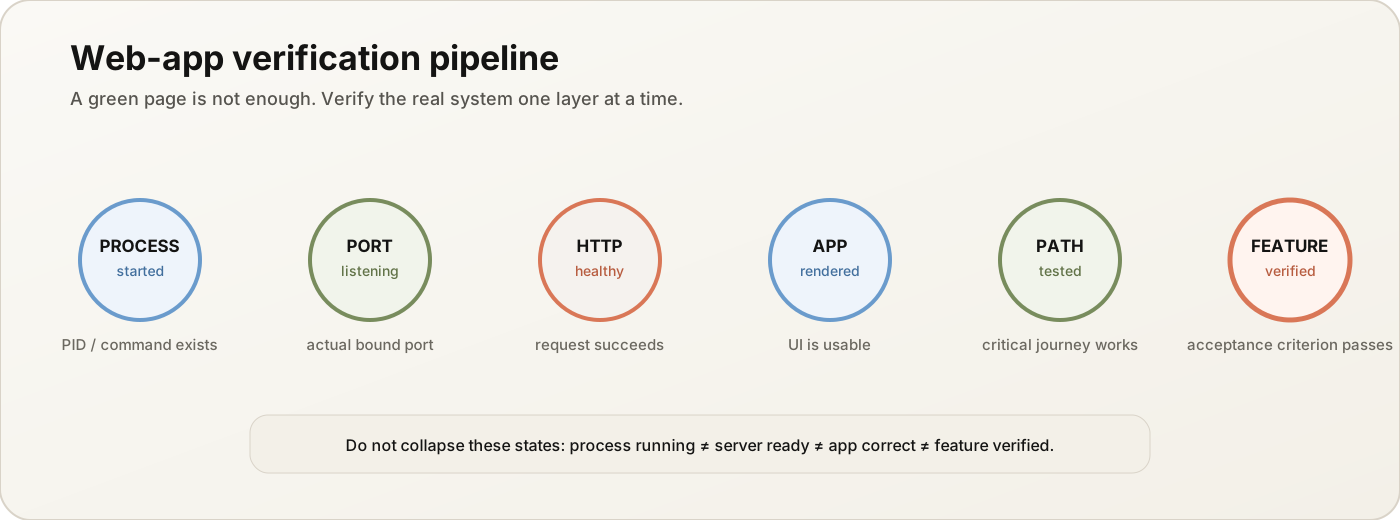
Web-app verification
The bridge is especially useful when an agent builds or repairs a web app and must prove that the real user flow works.
project recognition
   ↓
launch contract
   ↓
process running
   ↓
port listening / HTTP ready
   ↓
browser surface selected
   ↓
critical user journey exercised
   ↓
feature behavior verified
So:
process running ≠ server ready ≠ page correct ≠ feature works
A server-side template opened with file:// is not equivalent to running the application.
Capability coverage
| Area | What the bridge teaches |
|---|---|
| Runtime detection | CLI/Desktop/Cowork/cloud/remote classification and execution profiles |
| Browser & Chrome | surface selection, localhost testing, browser context separation |
| Capability remediation | classify → repair → re-probe → fallback instead of “not connected” |
| Computer use | GUI escalation and short observable action loops |
| MCP & connectors | schema-first use, mutation/read-back, trust boundaries |
| Projects & files | project knowledge vs live filesystem vs Git state |
| Shell & code | deterministic commands, servers, tests, readiness |
| Skills & Plugins | progressive disclosure, host controls, invocation boundaries |
| Artifacts & interactive apps | creation vs rendered/behavioral verification |
| Subagents & long-running work | bounded delegation and context isolation |
| Scheduled / remote work | fresh execution context and local/cloud boundaries |
| Security | permissions, authorization, prompt injection, least privilege |
| Evidence & recovery | direct proof, failure classification, bounded retries |
Always-on bootstrap
A portable Skill cannot universally force its own invocation. For Claude Code, the repository includes a practical bootstrap path for host-owned persistent context and SessionStart hooks:
CLAUDE.md reminder
        +
SessionStart hook (when configured)
        ↓
bridge protocol is present before complex work
        ↓
Skill supplies the detailed procedure when invoked
Concrete examples live under bootstrap/ and references/claude-code-bootstrap-kit.md.
The bootstrap does not create tools, bypass permissions, or make a third-party provider support an unsupported host feature.
Evaluation & benchmarking
The repository deliberately does not claim that the Skill improves every model. Effectiveness should be demonstrated empirically.
For forgetting and runtime-first behavior, compare:
CONTROL: no bridge
TREATMENT A: bridge Skill only
TREATMENT B: bridge Skill + always-on bootstrap
Keep model, host, tools, provider config, workspace, task wording, and success criteria constant. Grade the trajectory and final state separately.
Useful metrics include runtime identification before host-specific routing, tool-selection accuracy, schema-valid call rate, recovery quality, verification depth, false-success rate, unnecessary retries, and safety/authorization failures.
See benchmarks/README.md, benchmarks/behavioral-benchmark.md, and evals/evals.json.
No fake percentages: until paired runs are recorded, improvement is an engineering hypothesis, not experimental data.
Installation
This repository is a distribution/project repository; the actual Skill name is claude-capability-bridge.
python3 scripts/package_skill.py
This produces:
dist/claude-capability-bridge/
Install that generated directory using your host's Agent Skills mechanism.
When the host exposes Skills as slash commands:
/claude-capability-bridge
Validate locally with:
python3 scripts/validate_skill.py
Repository structure
claude-capability-bridge-skill/
├── SKILL.md
├── references/
├── benchmarks/
├── evals/
├── scripts/
├── tests/
├── bootstrap/                 # optional Claude Code host bootstrap examples
├── assets/
├── i18n/
└── LICENSE
The project follows progressive disclosure:
metadata → SKILL.md → relevant reference → execution → verification
Design boundaries
The Skill can teach
runtime awareness · capability discovery · tool routing · schema discipline · workflow sequencing · state tracking · verification · recovery · security boundaries · evidence-based reporting
The Skill cannot create
browser runtime · computer-use runtime · MCP server · filesystem mount · network access · permissions · provider protocol compatibility · missing model capabilities · host hook registration
That boundary is a core design rule.
Validation
Run repository checks locally:
python3 scripts/validate_skill.py
python3 scripts/package_skill.py
bash -n bootstrap/session-start.sh
python3 -m json.tool bootstrap/settings.json.example
For strict Agent Skills conformance, validate the generated package with the official skills-ref validator when available.
GitHub Actions runs the structural, packaging, Agent Skills, evaluation, and benchmark-definition checks.
Documentation map
| Document | Purpose |
|---|---|
SKILL.md | Main runtime-first procedural bridge |
Runtime detection | Host/execution/provider profiling |
CLI operating model | CLI-first routing and browser/provider boundaries |
Bootstrap kit | Always-on Claude Code context/hook path |
Capability remediation | Diagnose and repair missing integrations |
Custom Provider | Endpoint, gateway and provider boundaries |
Web App Verification | End-to-end web-app verification |
Browser Workflows | Browser / Chrome procedures |
MCP & Connectors | Structured integration workflows |
Evaluation | Controlled behavioral attribution |
References | Full reference map |
Telegram
Project updates, releases, experiments and more:
Language versions
| Language | README |
|---|---|
| English | README.md |
| 简体中文 | README_ZH.md |
| Español | README_ES.md |
| हिन्दी | README_HI.md |
| العربية | README_AR.md |
| Français | README_FR.md |
| فارسی | README_FA.md |
License
Claude Capability Bridge Skill is released under the MIT License.
The goal
Don't simulate agentic competence. Detect the real runtime, use the right surface, verify the real outcome, and recover safely.
GitHub · Issues · Discussions · Telegram · MIT License
// faq
What is claude-capability-bridge-skill?
A procedural Agent Skill that teaches custom-provider models how to discover, use, verify, and recover from Claude Desktop/Cowork-style tools and workflows. It is open-source on GitHub.
Is claude-capability-bridge-skill free to use?
claude-capability-bridge-skill is open-source under the MIT license, so it is free to use.
What category does claude-capability-bridge-skill belong to?
claude-capability-bridge-skill is listed under skills in the Claudeers registry of Claude-compatible tools.
// embed badge

[](https://claudeers.com/claude-capability-bridge-skill)
// retro hit counter

[](https://claudeers.com/claude-capability-bridge-skill)
// reviews
// guestbook
// related in Claude Skills
 🔓
🔓An agentic skills framework & software development methodology that works.
 🔓
🔓 🔓
🔓💫 Toolkit to help you get started with Spec-Driven Development
 🔓
🔓AI coding assistant skill (Claude Code, Codex, OpenCode, Cursor, Gemini CLI, and more). Turn any folder of code, SQL schemas, R scripts, shell scripts, docs,…