
beatdeck
Talks as beats, not slides: a fixed 1920×1080 React stage where one click is one beat. Offline, deterministic, presenter view, and a Claude Code skill.
Install with your AI
Paste into Claude Code, Cursor, or any agent — it reads the repo and wires the tool into your project.
Install and set up beatdeck (claude-plugin project) into my current project.
Found on https://claudeers.com/beatdeck
Repo: https://github.com/borjaperfra/beatdeck
Homepage/docs: —
Detected install method: claude-plugin → /plugin install beatdeck@borjaperfra/beatdeck
Category: skills. Platforms: cli, api, web.
Read the repo's README for exact setup and env vars, then install it and wire it into my project.

Claudeers Health Verdict:
active; community-verified: false. Confirm the source before running anything.
/plugin marketplace add borjaperfra/beatdeck
/plugin install beatdeck@borjaperfra/beatdeck
git clone https://github.com/borjaperfra/beatdeck
// compatibility
| Platforms | cli, api, web |
|---|---|
| Operating systems | — |
| AI compatibility | claude |
| License | NOASSERTION |
| Pricing | open-source |
| Language | TypeScript |
beatdeck
Try it: the demo deck · the Kernel Panic showcase — click or → to advance, O for the overview, P for the presenter window.
Talks as beats, not slides. A fixed 1920×1080 React stage where one click is one beat. Motion is
authored, the state is { scene, beat }, every beat rebuilds from the URL, and the build runs with Wi-Fi off.
It comes with a presenter window, an overview and a debug panel, plus a Claude Code skill that writes the talk
with you.
npx degit borjaperfra/beatdeck my-talk && cd my-talk
npm run init -- --title "My talk" --author "Your Name" --lang en   # --theme light for bright rooms, --demo to keep the demo
npm install
npm run dev          # http://127.0.0.1:5173
init turns the copy into a clean talk project: it removes the showcase, the plugin files, this README and
beatdeck's CI, renames the package, writes title, author, language and theme into the deck, and leaves a blank
two-scene starter (title, questions) plus reference/, a content audit, a runbook and a CI workflow for the
talk. --demo keeps the demo deck instead.
Why
Slides are pages: you flip them. A talk that feels like a live system, with a diagram that grows, a counter that runs or a crash that cuts to black, is a sequence of beats inside a few scenes. beatdeck makes that the model:
- One click = one beat. Clickers (PageDown/PageUp), arrows, space, number keys and mouse all work.
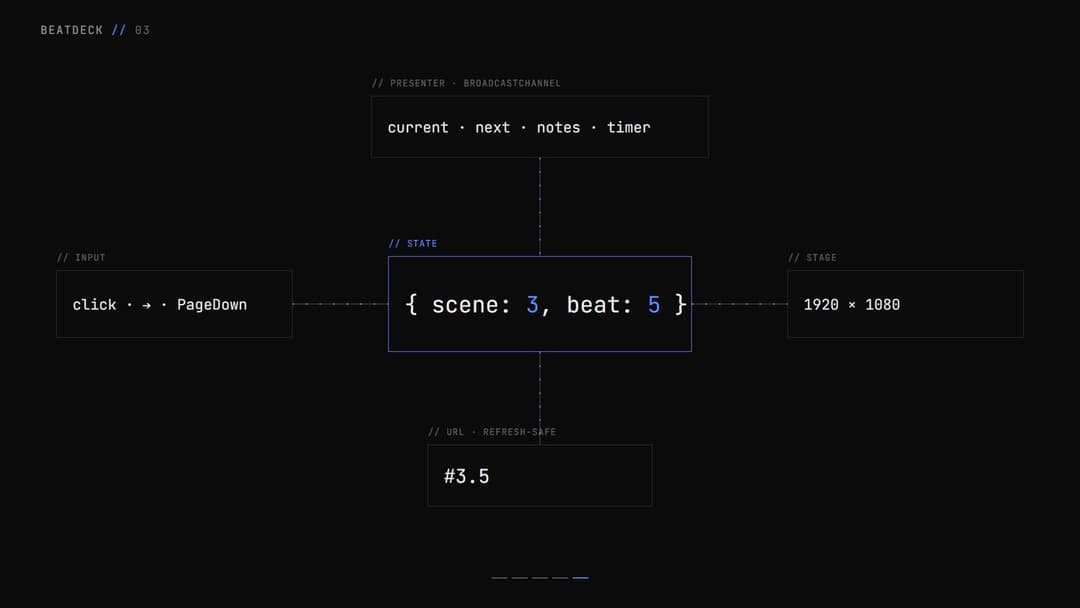
- Deterministic. The whole state is
{ scene, beat }plus the beat's automatic sub-state.#3.4in the URL always renders the same frame, whether you got there going forwards, going back, jumping or refreshing. - Automatic motion only where you want it. A beat can run a GSAP timeline (a boot log, a counter, a cascade). Everything else waits for the speaker.
- One stage. Fixed 1920×1080, scaled with black letterbox. Nothing reflows on the projector.
- Offline. Fonts, images and QR codes are all bundled or computed locally.
npm run buildfails if anything references the network. - Operator tools. A presenter window (P) with current/next beat, notes and a timer, synced over
BroadcastChannel. An overview (O) to jump anywhere. Blackout (B). A debug panel with
?debug=1.
How a deck looks
deck/
  deck.config.ts     title, speaker, QR target, timings
  scenes.ts          the beat map: scenes → beats (+ source refs and speaker notes)
  timeline.ts        automatic beats: initialLive(pos) + timeline(pos, host)
  index.tsx          defineDeck({...}) + the Stage (layer order) + theme
  scenes/*.tsx       one layer per scene
import { Reveal, Scene, useScene } from 'beatdeck';

function Idea_() {
  const { here, b } = useScene();
  return (
    <>
      <Reveal on={here} x={150} y={150}><h1 className="t-statement">Slides are pages.</h1></Reveal>
      <Reveal on={here && b >= 1} x={150} y={360}><h1 className="t-statement">Talks are beats.</h1></Reveal>
    </>
  );
}
export const Idea = () => <Scene index={1}><Idea_ /></Scene>;
Built in: Reveal, Scene, CountUp, Typewriter, Terminal (real commands and output, character-exact,
with highlights and labels), NodeBox + Arrow (diagrams that draw themselves), Plot + Zone / Series /
Marker / PlotLabel (charts), QR (computed locally).
The demo in deck/ (7 scenes, 24 beats) uses every pattern: an automatic boot, a strike-through, a diagram
built node by node, terminal output with highlights, a chart, a self-counting number, and a locally generated
QR code. A new talk starts from a blank two-scene deck instead (init --demo keeps this one).
Commands
npm run dev | dev server at http://127.0.0.1:5173/#1.1 |
npm run build | typecheck + bundle + offline check → dist/ (self-contained, any static server) |
npm run present | build and open the production build locally |
npm run shot -- 3 4.2 | quick frames of a few beats (a scene, a beat, a range) from the dev server → artifacts/shot/, with the same text/layout audit. |
npm run verify | every beat walked forwards, walked back and reloaded from its URL, frames pixel-compared, reduced motion, QR decoded, presenter + overview, contact sheet → artifacts/verify/. Fails on any mismatch, console error or remote request. Uses Chrome or Edge if installed, else Playwright's Chromium (npx playwright-core install chromium). |
Updating a talk
The engine is copied into each talk, so a talk keeps working even if beatdeck changes. To take a newer version:
npm run upgrade                  # latest; or: npm run upgrade -- --ref v0.4.0   (--dry-run to preview)
npm install && npm run verify
upgrade replaces the engine (src/beatdeck/, the skill, the scripts, the base themes), updates engine
dependencies and adds new scripts. It never touches deck/, index.html or docs/. Engine files you edited
are backed up to .beatdeck-backup/; shared config you edited (vite.config.ts, tsconfig.json, …) is left as
is, with the new version beside it as *.beatdeck-new. .beatdeck.json records the version.
Talks created before upgrade existed (≤ 0.3.0) bootstrap it once (--clean also removes what early copies
carried over from this repo: the showcase and its non-MIT assets, the plugin files, beatdeck's CI):
npx degit borjaperfra/beatdeck/scripts .beatdeck-tmp && node .beatdeck-tmp/upgrade.mjs --clean && rm -rf .beatdeck-tmp
Keys
→ ↓ PageDown, click, Space (fullscreen) next · ← ↑ PageUp previous · 1–9 scene · Home / End ·
F fullscreen · O overview · P presenter window · B blackout. URL flags: ?view=presenter, ?debug=1,
?capture=1 (verification), ?reduced=1 (reduced motion).
The skill
skills/building-a-beatdeck/ teaches an agent the whole workflow: collect the source (it ships a PPTX
extractor), write a content audit so nothing is lost or invented, design the beat map, apply a theme, build
the scenes, then run npm run verify and look at every frame before calling it done.
Claude Code (plugin):
/plugin marketplace add borjaperfra/beatdeck
/plugin install beatdeck@beatdeck
Any agent that reads SKILL.md: copy skills/building-a-beatdeck/ to ~/.claude/skills/ (or your
agent's skills folder). Inside a scaffolded deck it is already there, and AGENTS.md points to it.
Then ask for something like "Turn talk.pptx into a beatdeck" or "Add a scene where the architecture grows to three servers".
Themes
themes/neutral.css is the default: near-black stage, off-white Inter + JetBrains Mono, one accent (--accent),
hairlines. themes/light.css is for bright rooms. To brand a deck, copy the theme and change the tokens. Fonts
must be local (@fontsource* packages or .woff2 files).
Showcase: Kernel Panic
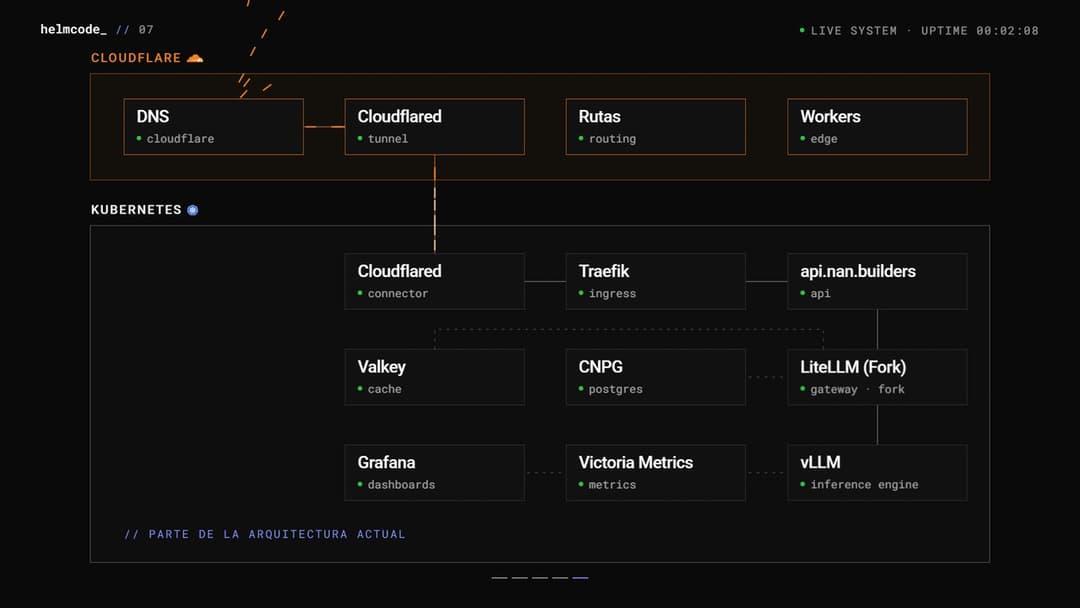
examples/kernel-panic/ is the production talk beatdeck was extracted from. Escalando inferencia by Cristian
Córdova, KERNEL PANIC #01, Madrid. It has 47 beats, a particle field that survives scene changes, an SVG
architecture that grows from one GPU to Cloudflare + Kubernetes, and a 520 ms kernel panic that cuts to
absolute black.
npm run example:kernel-panic
Its assets are not MIT; see examples/kernel-panic/ASSETS-CREDITS.md.
Stack
React 18, TypeScript, Vite, GSAP for timelines, SVG for diagrams, Canvas 2D for particles, CSS for type. No
backend, no CDN, no remote fonts. The engine is in src/beatdeck/ and never imports from the deck.
License
MIT for the code and docs. Third-party assets in the showcase keep their own terms.
// faq
What is beatdeck?
Talks as beats, not slides: a fixed 1920×1080 React stage where one click is one beat. Offline, deterministic, presenter view, and a Claude Code skill.. It is open-source on GitHub.
Is beatdeck free to use?
beatdeck is open-source under the NOASSERTION license, so it is free to use.
What category does beatdeck belong to?
beatdeck is listed under skills in the Claudeers registry of Claude-compatible tools.
// embed badge

[](https://claudeers.com/beatdeck)
// retro hit counter

[](https://claudeers.com/beatdeck)
// reviews
// guestbook
// related in Claude Skills
 🔓
An agentic skills framework & software development methodology that works.
 🔓
 🔓
AI coding assistant skill (Claude Code, Codex, OpenCode, Cursor, Gemini CLI, and more). Turn any folder of code, SQL schemas, R scripts, shell scripts, docs,…
 🔓
💫 Toolkit to help you get started with Spec-Driven Development