
architecture-drawer
Skill for Claude Code & Codex: describe your system architecture in text → get an editable PowerPoint diagram (native shapes, not a flat image).
Install with your AI
Paste into Claude Code, Cursor, or any agent — it reads the repo and wires the tool into your project.
Install and set up architecture-drawer (claude-plugin project) into my current project.
Found on https://claudeers.com/architecture-drawer
Repo: https://github.com/Andy1314Chen/architecture-drawer
Homepage/docs: —
Detected install method: claude-plugin → /plugin install architecture-drawer@Andy1314Chen/architecture-drawer
Category: skills. Platforms: cli, api.
Read the repo's README for exact setup and env vars, then install it and wire it into my project.

Claudeers Health Verdict:
active; community-verified: false. Confirm the source before running anything.
/plugin marketplace add Andy1314Chen/architecture-drawer
/plugin install architecture-drawer@Andy1314Chen/architecture-drawer
git clone https://github.com/Andy1314Chen/architecture-drawer
// compatibility
| Platforms | cli, api |
|---|---|
| Operating systems | — |
| AI compatibility | claude |
| License | MIT |
| Pricing | open-source |
| Language | Python |
architecture-drawer
English · 简体中文
A skill for Claude Code, Codex, Open Code, Pi Agent, and other AI coding agents: turn a text description of your system architecture into an editable PowerPoint architecture diagram.
What it is
Turn text descriptions of an architecture into editable PPT diagrams: the agent generates an SVG from your description, auto-validates the layout, then exports to native PowerPoint shapes.
vs. direct image generation
| This project | Nano Banana / GPT-Image etc. | |
|---|---|---|
| Output | Editable PPT (every shape draggable, recolorable, retextable) | Flattened image |
| Control | High (code-generated, precisely adjustable) | Low (prompt-driven, hard to reproduce) |
| Iteration | Fine-tune directly in PPT | Regenerate from scratch |
| Cost | Low | High (per-image billing) |
Showcase
All diagrams below were generated entirely from text descriptions by the skill, then scored by the 13-dimension evaluator (each scored ≥76/100). They double as the regression suite under evals/.
vLLM — High-Throughput LLM Inference Serving (PagedAttention)
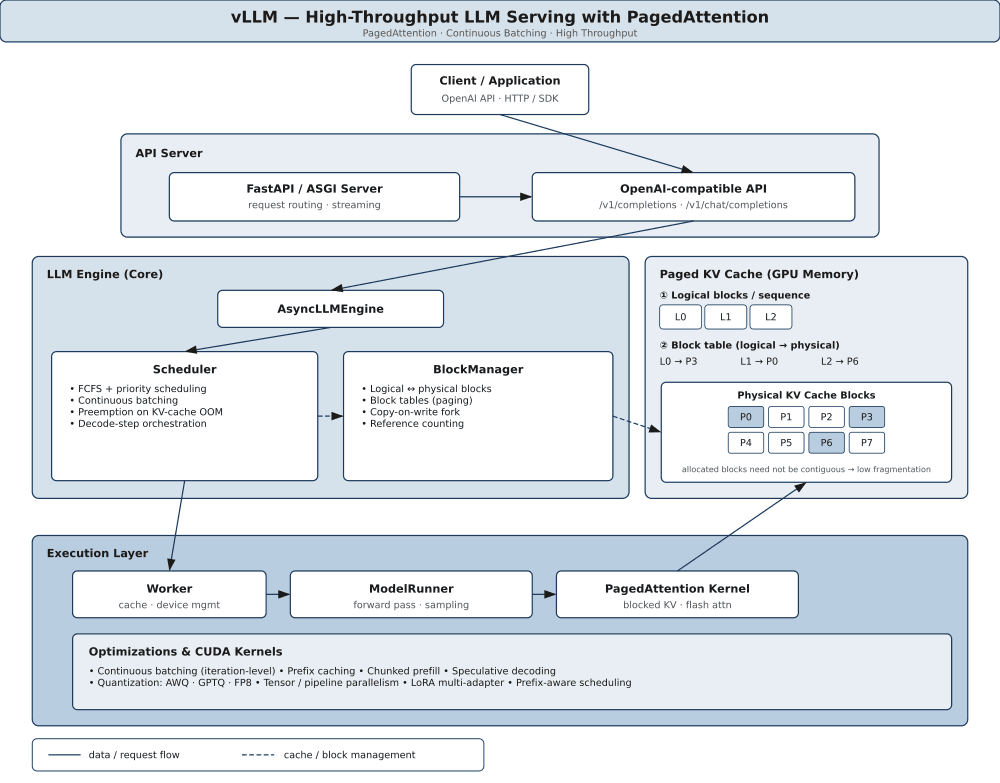
Six-layer request pipeline (client → API server → engine → paged KV cache → execution → optimizations). Solid edges = data flow; dashed = cache/block management. Scheme S1 Monochrome Blue.
MLIR AI Compiler — Multi-Stream Execution Pipeline
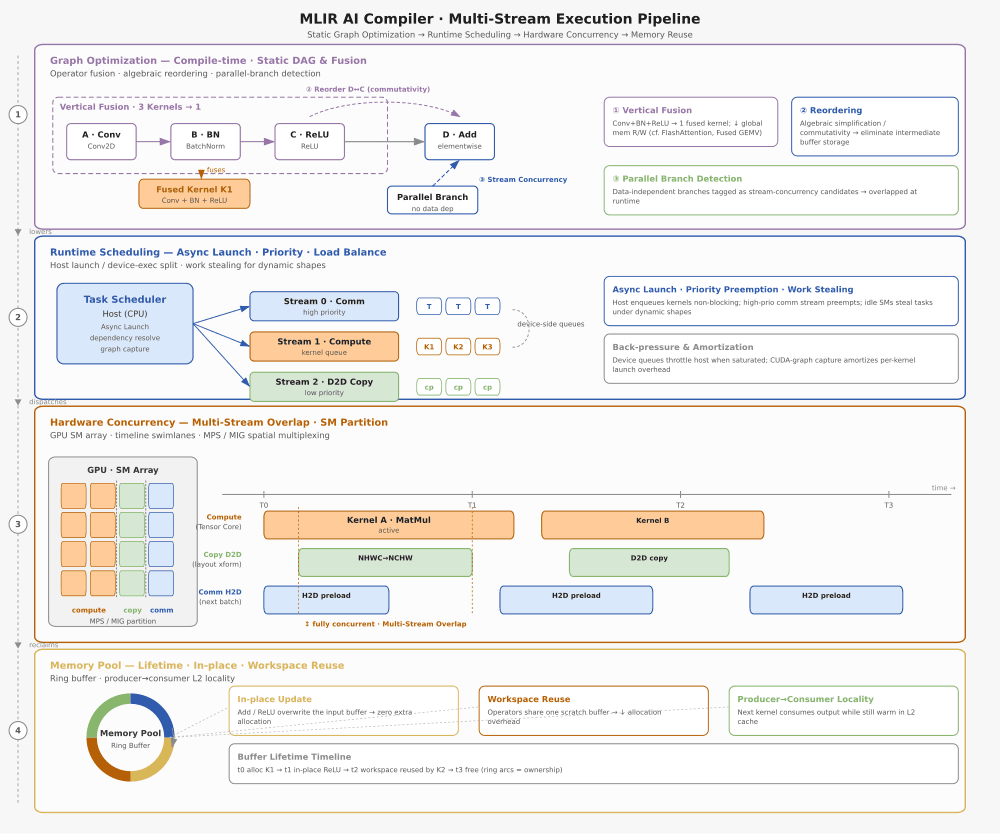
A 4-layer × multi-column matrix (graph optimization → transformation → lowering → codegen) with vertical-fusion grouping and a concurrent multi-stream overlap timeline. 8-accent categorical palette.
Agent Infrastructure — Layered Architecture
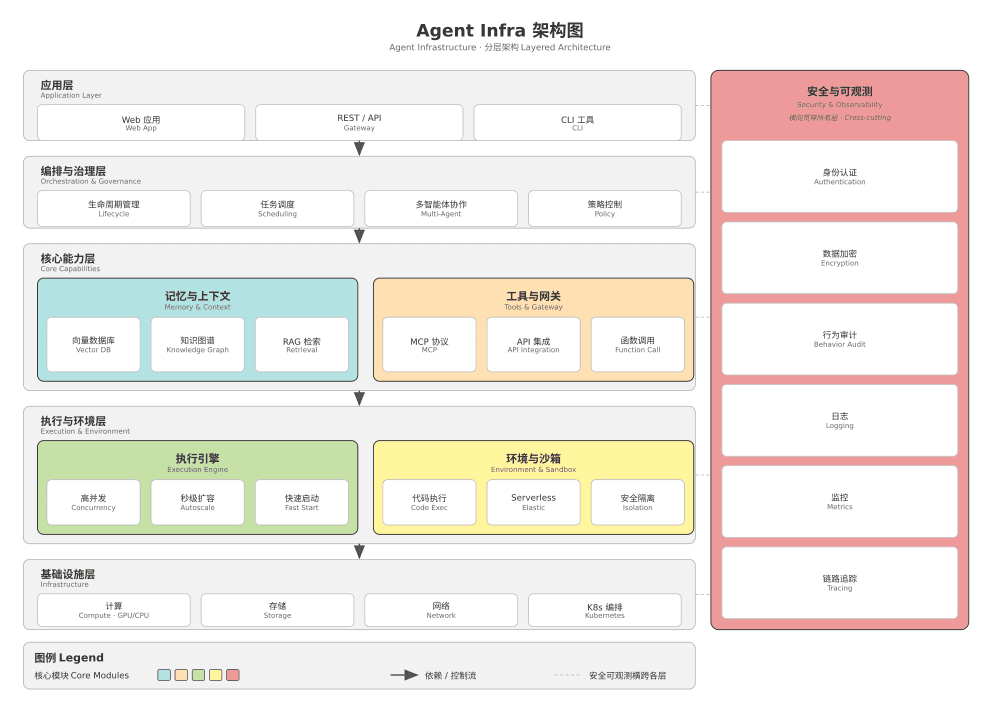
Five horizontal layers (application → orchestration → core capabilities → execution → infrastructure) with a cross-cutting security/observability band. Bilingual CN/EN labels. Neutral grays + 5 colored core modules.
Best Practices
- Start with a clear text description. Before coding, describe the architecture in prose—how many layers, what components each layer has, how they connect, and any special annotations. A crisp text spec (like the specs in
evals/*/input.md) is the single biggest predictor of a quality diagram. For open-source projects, you can use the system architecture description from DeepWiki. - Let the skill generate. Submit the text description to the skill and let it generate the initial
gen.pyand SVG. The evaluator automatically catches overlaps, dangles, and crossings. - The skill auto-reviews the score. If the score is ≥80, the diagram is structurally sound. If <80, the agent can automatically fix layout issues via
auto_refineor multi-round LLM correction (--llm-iter). - Export to PPTX for final polish. Run
svg_to_pptx()to get an editable PowerPoint file. Tweak colors, fonts, arrows, and layout there to match your brand or publication style—these belong in the presentation layer, not the generator code.
Suggested workflow: first discuss with DeepWiki or your agent to produce a clear text description of the system architecture, then use this skill to quickly generate a PPTX diagram, and finally fine-tune colors, labels, and other details directly in PPT.
Install (Claude Code)
This repo is a plugin marketplace. Add it and install the plugin:
/plugin marketplace add Andy1314Chen/architecture-drawer
/plugin install architecture-drawer@architecture-drawer
Or from the CLI:
claude plugin marketplace add Andy1314Chen/architecture-drawer
claude plugin install architecture-drawer@architecture-drawer
Scope with --scope project (shared via version control) or --scope local (gitignored). Default is user.
Codex CLI
Codex CLI fully supports the Agent Skills directory structure.
Copy the skill directory into Codex's skills folder (usually ~/.codex/skills/):
cp -r plugins/architecture-drawer/skills/architecture-drawer ~/.codex/skills/architecture-drawer
Or install project-scoped (recommended):
mkdir -p .codex/skills
cp -r plugins/architecture-drawer/skills/architecture-drawer .codex/skills/
Once installed, ask Codex naturally — the workflow in SKILL.md is consumed automatically:
> Draw the architecture of vLLM and export to PPTX
Other agent platforms (Gemini CLI, Cursor, Copilot)
Each skill is a standalone Agent Skills spec directory. Copy it into your platform's skills location (typically .agents/skills/):
| Platform | Default skills path |
|---|---|
| Gemini CLI | ~/.gemini/skills/ |
| Cursor (@rules) | .cursorrules or cursor/skills/ |
| Copilot CLI | Per-platform instructions |
cp -r plugins/architecture-drawer/skills/architecture-drawer .agents/skills/architecture-drawer
Dependencies
The agent generates a gen.py that imports three pure-Python modules (svg_utils.py, evaluator.py, svg2pptx.py) co-located in the skill. You don't write this code — the agent does. Install these once so generated diagrams can render and export:
| Dependency | Required by | Install |
|---|---|---|
python-pptx >= 1.0 | PPTX export (svg2pptx.py) | pip install python-pptx |
rsvg-convert | PNG rasterization (rasterize_svg) | apt install librsvg2-bin / brew install librsvg |
pytest >= 8 | Running the test suite | pip install pytest |
Repository layout
architecture-drawer/
├── .claude-plugin/marketplace.json              # Claude Code marketplace registry
├── plugins/architecture-drawer/
│   ├── .claude-plugin/plugin.json               # plugin manifest
│   └── skills/architecture-drawer/
│       ├── SKILL.md                             # agent-consumable workflow (spec-compliant)
│       ├── scripts/                             # svg_utils.py · evaluator.py · svg2pptx.py
│       ├── references/design_specs.md           # 4 preset color schemes (S1–S4)
│       ├── evals/                               # 7 regression cases (gen.py each)
│       └── assets/
├── tests/                                       # pytest: score thresholds + SVG golden snapshots
│   ├── conftest.py
│   ├── test_regression.py
│   ├── test_skill_spec.py                       # Agent Skills spec compliance
│   └── golden/*.svg                             # snapshot baselines
└── examples/                                    # minimal demo of the generate-evaluate-export loop
Community
Thanks to the LINUX DO community. The project gained wider reach, discussion, and real-world feedback after being shared there, and those conversations have helped me keep finding issues and improving architecture-drawer.
References & acknowledgments
The geometry/connection detection draws on several open-source projects (their reference docs and validators were studied): ink-graph, fireworks-tech-graph, svg-animations, svg-design, and svg2pptx (the architectural blueprint for the PPTX export module). See the full credits in SKILL.md.
License
MIT — see LICENSE.
// faq
What is architecture-drawer?
Skill for Claude Code & Codex: describe your system architecture in text → get an editable PowerPoint diagram (native shapes, not a flat image).. It is open-source on GitHub.
Is architecture-drawer free to use?
architecture-drawer is open-source under the MIT license, so it is free to use.
What category does architecture-drawer belong to?
architecture-drawer is listed under skills in the Claudeers registry of Claude-compatible tools.
// embed badge

[](https://claudeers.com/architecture-drawer)
// retro hit counter

[](https://claudeers.com/architecture-drawer)
// reviews
// guestbook
// related in Claude Skills
 🔓
🔓An agentic skills framework & software development methodology that works.
 🔓
🔓 🔓
🔓💫 Toolkit to help you get started with Spec-Driven Development
 🔓
🔓AI coding assistant skill (Claude Code, Codex, OpenCode, Cursor, Gemini CLI, and more). Turn any folder of code, SQL schemas, R scripts, shell scripts, docs,…