
aoci-code
A persistent, Git-versioned map of your whole codebase and database schema that coding agents read before they touch anything. Local-first MCP server + CLI i…
Install with your AI
Paste into Claude Code, Cursor, or any agent — it reads the repo and wires the tool into your project.
Install and set up aoci-code (release-binary project) into my current project.
Found on https://claudeers.com/aoci-code
Repo: https://github.com/aoci-spec/aoci-code
Homepage/docs: —
Detected install method: release-binary → inspect the README
Category: mcp-servers. Platforms: cli, api, web, mobile.
Read the repo's README for exact setup and env vars, then install it and wire it into my project.

Claudeers Health Verdict:
unknown; community-verified: false. Confirm the source before running anything.
Grab the latest release asset from GitHub.
# download a build from https://github.com/aoci-spec/aoci-code/releases
git clone https://github.com/aoci-spec/aoci-code
// compatibility
| Platforms | cli, api, web, mobile |
|---|---|
| Operating systems | — |
| AI compatibility | claude |
| License | NOASSERTION |
| Pricing | open-source |
| Language | Go |
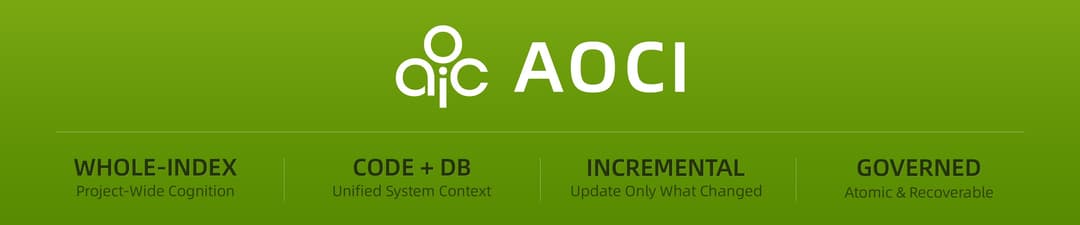
AOCI-CODE
A persistent, Git-versioned map of your entire codebase — written by your coding agent, governed by a local MCP server. Agents read it once and know the system, instead of re-reading the repo on every task.
🇺🇸 English | 🇨🇳 简体中文
What it does
Build large systems without losing the plot. In Codex, Claude Code, Cursor, OpenCode, and similar agents, your agent starts every task already knowing the whole system: what each file is for, what it depends on, and what must not break. It stops searching and re-reading the codebase for every request. People who are not professional developers can keep iterating on their own systems; professional developers can hand the whole system to an agent and keep their attention on architecture and design.
Take over an existing system in one step. Point the agent at an existing codebase of up to about 500,000 lines and ask it to build the index. It reports how well it knows each area, then picks up development from there. The practical limit is the size of the index, not the line count: a 700,000-line commercial system is developed this way today, with an index of about 300K tokens.
Change people, agents, or conversations without starting over. The index lives in the repository next to the code and is versioned by Git. When a project changes hands, switches agents, or opens a new conversation, one read of the index picks up where things left off.
After the first index, maintenance is automatic. The MCP server detects code changes and issues the entries that need updating. The agent fills them in as it finishes each task, so the index matches the current code and you never stop to maintain it.
What it looks like
One line per file, written by the model from the actual source. This is a real entry from this repository's own index:
atomic.go[CG9L]: F:Provides durable replace CAS, create CAS, atomic writes, and no-clobber recovery moves | R:code:internal/fs/atomic_exchange_linux.go,code:internal/fs/atomic_exchange_windows.go,code:internal/fs/lock.go | A:AtomicWrite,AtomicWriteCAS,AtomicCreateCAS,AtomicMoveCAS | S:Native publication never degrades to an overwriting rename; on a race, unsafe type, or unverifiable bytes, preserve third-party state
F is what the file is responsible for, R is what you have to read along with it, A is what callers depend on, and S is what you cannot infer from the code but must not get wrong. The tag [CG9L] places the file by layer, domain, importance, and size. A few hundred lines like this cover a whole system, and an agent can read them in one pass. The entry format explains each field.
What to expect
The first index takes a while. The agent reads every managed file and writes one entry per file: about an hour per 200,000 lines of code, depending on the model and the agent's speed. It runs in batches and resumes where it stopped if interrupted.
Have a database? Index it too. MySQL and PostgreSQL are supported, and openGauss 6.0.5 with constraints. Build the code index first, then the database index. With code and table-level knowledge delivered together, the agent understands the system more completely.
Local only: read-only on your system, no Internet, no stored credentials. AOCI-CODE reads your source code and database table structures, never business data. It writes its index files and its own state inside the project directory, plus the status page's registration in your user cache directory. It never reaches the Internet and uploads nothing: the only connections it opens are to the database you declare, for catalog metadata, and to its own loopback status page. Database credentials are referenced by environment-variable name and never stored. The index text is written locally by your own agent through the model channel you already use; AOCI-CODE adds no new data exit.
Quick start
Give your agent the following instruction to download AOCI-CODE and wire it up. After you restart the agent, send the second instruction to build the index.
AOCI-CODE project: https://github.com/aoci-spec/aoci-code

Download the latest release package for this operating system and CPU architecture from
https://github.com/aoci-spec/aoci-code/releases, and follow the installation instructions
on the Release page to verify it. If no compatible release package exists, or if I
explicitly request the latest source, build it from the official repository.

After extracting the package, place aoci (aoci.exe on Windows) at a stable absolute path.
Then use that absolute path to do the following for my project:

1. Run init to initialize AOCI and integrate MCP for the current host; if this host does
   not write project configuration (Cursor, for example), give me the configuration I
   need to paste myself
2. Run scan

   scan takes its file inventory from Git, so do not add the cognition assets
   init writes (aoci.txt, aoci.meta.txt, aoci.code.txt, AGENTS.md) to .gitignore
   or .git/info/exclude — an ignored asset is silently skipped and the index
   cannot be built. Leave the host-config ignore init writes for itself as it is.

3. Tell me to restart the agent so the newly written MCP server takes effect

Stop after those three steps and do not build the index yet — I will tell you to continue
after the restart.
After restarting the agent, send this one:
First confirm the AOCI MCP server is connected, then build the AOCI index for this project. When it is complete, give me the AOCI panel link.
The agent starts the panel in the background with aoci ui --detach --json and hands you the link. AOCI panel covers what it shows and its other commands.
Why the restart: the index is written through AOCI's MCP tools, and the session that ran init has not loaded the MCP server init just wrote. A host that loads MCP servers dynamically may not need a restart; Host integration explains how to tell.
If your project has a database (PostgreSQL and MySQL are supported, plus constrained openGauss 6.0.5), index it as well. Declare the source as described under Database Cognition, provide the connection-string environment variable in the host environment (AOCI stores no credentials), then send:
Build the AOCI database index for this project.
If the context has been compacted, or you want the agent to rebuild its picture of the system, send this:
Using only AOCI, establish whole-framework cognition of this project, tell me your mastery of each area as a percentage, and whether you can take over development.
How it works
AOCI (AI-Oriented Cognition Infrastructure) is the method and protocol: a layer between coding agents and software systems. Models reason, agents plan and execute, and AOCI keeps an up-to-date description of the system, covering code, configuration, tests, and database structure, for agents to read before they act. AOCI-CODE is this project: the aoci CLI, the MCP server, and the index they maintain.
AOCI-CODE distills what actually matters for understanding and changing a system into a dense, plain-text index that combines symbols and meaning. When model context is limited, an agent reads the index first, gets most of the project's key information in one pass, and then starts the task. That cuts repeated searching and re-learning, and it carries understanding across tasks and sessions.
- Not a one-time summary. The index evolves with the system and stays in the project, where you can diff, review, version, and roll it back with Git.
- More than "where files are." It records responsibilities, strong relationships, public contracts, transaction boundaries, compatibility constraints, and other things that are hard to infer from code structure.
- Portable. The index is stored with the project, not tied to a model, an agent, or a session. While it is aligned with the code, any agent and any later session can reuse it without rebuilding its understanding from scratch.
- Code and databases together. The model can build a separate table-level index for database tables. Delivered together, the two give the agent a fuller picture of the system.
The index is a set of governed plain-text files stored with the project:
- Root (
aoci.txt) declares what makes up the current index and is its activation entry point. - Meta (
aoci.meta.txt) holds the tag dictionary, the FRAS rules, and the authoring constraints. - Code (
aoci.code.txt) holds the model-authored entries for code and other repository assets. - Database (
aoci.database.txt) holds optional table-level entries when Database Cognition is enabled.
Root, Meta, and the participating object Volumes together form the Whole-Index. The workflow on top of them has three stages:
- Build the index under governance. The model reads source code and accepted evidence. AOCI-CODE governs Managed Scope and the entries the model writes for every managed object with the
indexrole. - Read before acting. The agent reads the project rules, the live guide, and the current Whole-Index, then checks source and other evidence for the task at hand.
- Maintain after verified change. Once code and tests are stable, the project rules and the MCP workflow have the agent update the affected entries and bring the index back to
aligned.
Because these files are plain text in the repository, Git versions them. While the index stays aligned with the current system version, any agent and any later session can read and reuse the same Whole-Index.
Manual integration
Get AOCI-CODE from the canonical source or use a signed package from GitHub Releases. Before using a prebuilt binary, follow the basic, recommended, or full verification level in the installation guide, and report which level completed. Give this README and the verified binary's stable absolute path to a coding agent you trust, such as Codex, Claude Code, Cursor, or OpenCode. The agent can follow the in-project instructions to initialize AOCI, integrate MCP, and build the first index.
How long the first index takes depends on repository size. A normal integration is four steps: prepare the binary, have the agent or yourself initialize the target repository, ask the host to "build the index," and verify alignment. After that you do not need to end every request with "maintain the index." The project rules and the MCP workflow have the agent maintain the index incrementally whenever managed objects change.
Requirements
- A verified release package or a checkout of the canonical AOCI-CODE source repository.
- For source builds only: the Go toolchain declared by
go.mod,make, and the other tools the repository requires. - A supported MCP host, such as Codex, Claude Code, Cursor, or OpenCode.
- Normal read and write access to the target repository.
AOCI-CODE integrates with the MCP host, not with a model-provider API. DeepSeek and other models can use AOCI-CODE when the agent or host running them supports standard stdio MCP and can follow the tool contract; a model name alone does not establish compatibility.
The signed-package route and executable verification commands are in the installation guide. The source-build route is below.
Current RC: use a verified package or build from source
[!IMPORTANT] AOCI-CODE v0.1.0-rc17 is the current release candidate. It is Fair Source/source-available software under FSL-1.1-MIT; see LICENSE. Build from canonical source or use a signed package from the v0.1.0-rc17 GitHub Release after following the release verification procedure.
The signed Release binary identifies itself as aoci version 0.1.0-rc17. A
source build identifies the exact checkout instead and may report a development
version such as v0.1.0-rc17-1-g<short-commit> (plus -dirty when applicable),
together with its Git commit. These are different build inputs, not a version
conflict.
To download with GitHub CLI, authenticate first, then download the tagged Release assets:
gh auth login
gh release download v0.1.0-rc17 --repo aoci-spec/aoci-code
For an anonymous download, open the v0.1.0-rc17 Release page in a browser and download the archive and verification assets you need.
To build from source, clone the canonical repository, build the binary, and keep the resulting path stable:
git clone https://github.com/aoci-spec/aoci-code.git
cd aoci-code
mkdir -p build
make build
./build/aoci --version
On Windows, build the same source in PowerShell:
git clone https://github.com/aoci-spec/aoci-code.git
Set-Location .\aoci-code
New-Item -ItemType Directory -Force .\build | Out-Null
make build
.\build\aoci.exe --version
Then give this README to an agent you already trust with the project and ask:
Read this AOCI-CODE README and use the built aoci binary at its stable absolute path
to initialize AOCI for the current project, integrate MCP, and run scan. Stop there and
tell me to restart the agent; I will ask you to build the index afterwards.
The agent should identify the project root, use a stable absolute path to the built binary, run the initialization that fits the current host, and tell you clearly when a host restart or real human approval is required. The binary can stay in the AOCI-CODE checkout or move to a shared tools directory, as long as the MCP configuration points at the correct absolute path.
Manual initialization
To initialize AOCI yourself, run the following from the target repository root, or pass an explicit path through --repo:
AOCI=/absolute/path/to/aoci-code/build/aoci
"$AOCI" --repo . init --locale en-US --agent codex
"$AOCI" --repo . scan
init writes the locale configuration, the managed AGENTS.md rules block, the Git boundaries, and an empty index skeleton. Configuration and prompting vary by host; see Host integration. It does not invent business meaning from filenames, directories, or an AST.
For a new repository, the first scan establishes the managed Baseline. For a project that already has a governed Baseline, adding, removing, or changing managed scope goes through the formal Scope Change workflow; scan --force is not a shortcut for redefining governance facts. --force also cannot erase unresolved drift, receipts, or recovery boundaries.
Windows PowerShell
$Aoci = (Resolve-Path "C:\path\to\aoci-code\build\aoci.exe").Path
& $Aoci --repo . init --locale en-US --agent codex
& $Aoci --repo . scan
Confirm that $Aoci points to a stable absolute path.
Have the agent build the first index (important)
Once initialization and scan are done, check whether the agent session already exposes the AOCI tools; refresh or restart it if not. Then enter the following in the agent for the target project:
First confirm the AOCI MCP server is connected, then build the AOCI index for this project. When it is complete, give me the AOCI panel link.
The agent starts the panel in the background with aoci ui --detach --json and hands you the link. AOCI panel covers what it shows and its other commands.
The host reads the project's AOCI rules and live guide, inspects source code, tests, configuration, and relevant evidence, and then writes FRAS candidates for every managed object whose role is index. You do not need to orchestrate Plan, Stage, Check, Diff, CAS, or Apply yourself.
Once the first index is complete, send ordinary development requests as usual, for example:
Add priorities to tasks, including the frontend, backend, database, and test changes.
You do not need to append "maintain the AOCI index at the end." The project rules and MCP have the agent check for index changes once code and tests are stable, then update the affected entries through the formal workflow. When the project uses automation.mode=auto, AOCI-CODE interrupts you only when real human approval is required, an external action must be performed, recovery cannot be proven, a safety check fails, or a third-party concurrency conflict is found. Other automation modes follow their own runtime contracts.
Verify alignment
After onboarding completes, run:
"$AOCI" --repo . verify
"$AOCI" --repo . check
The index and the current managed source should converge back to aligned. If they do not, consult the live guide first; do not duplicate the internal state machine in a wrapper script:
"$AOCI" --repo . index agent guide --agent codex --json
Run basic diagnostics
"$AOCI" --repo . capabilities
"$AOCI" --repo . doctor
To confirm which AOCI the host is actually connected to, read what the server reports about itself rather than what is on disk. In any aoci_overview check_only response or any aoci_maintain response, cognition_receipt.mcp_service_version is the running version and runtime_repository_root is the repository it governs. The matching binary path is the command in the project's .mcp.json or the equivalent host configuration: .codex/config.toml, opencode.json, or .cursor/mcp.json. Replacing bytes on disk does not change a running MCP process, so recheck against those facts after an upgrade or a rollback.
For a one-off walkthrough, use examples/minimal-repository in the repository.
Developers: build the AOCI-CODE CLI from source
If you are developing AOCI-CODE itself, run the fast quality gate during ordinary development and before a commit:
make fast
Run the following when you need Full Confidence verification and an executable:
make full
./build/aoci --version
make full is the Full Confidence gate and already includes make build. make check is only a compatibility alias for the same full gate, so there is no need to run both. Use make release-check for stable-release rehearsals. If you only need a direct build, run:
mkdir -p build
CGO_ENABLED=0 go build -o build/aoci ./cmd/aoci
The AOCI-CODE CLI is a CGO-free, single-binary Go program. The make build target uses Go's native executable suffix: build/aoci on Linux and macOS, and build/aoci.exe on Windows. Before a release or delivery, rely on the actual binary's --version and capabilities output and on the formal Release Manifest, not on a version string in the README.
What appears after initialization
A typical repository contains these index files:
aoci.txt                    Root: declares the current CognitionSet and participating Volumes
aoci.meta.txt               Meta: tag dictionary, FRAS rules, and authoring constraints
aoci.code.txt               Code: model-authored entries for code and repository assets
aoci.database.txt           Database: optional table-level entries; absent by default
.aoci/
├── config.json             Team policy, Locale, Scope, and budgets
├── baseline.json           Governed Baseline for source, index, and database bindings
├── curation.json           Optional file-level include/exclude decisions
└── ...                     Drafts, Ledger, transactions, and recovery evidence; normally not committed to Git
Initializing a new project creates the Root, Meta, and an empty Code Volume; Database is absent by default. AOCI-CODE does not generate business meaning for the repository or the database on its own.
aoci init --agent <name> additionally writes host integration configuration
(.mcp.json, .claude/settings.json, .codex/config.toml, or opencode.json)
whose command and repository paths are machine-bound absolute paths. Add those
files to the repository's .gitignore and do not commit them: a committed copy
breaks on every other machine, and because the installers detect an existing
entry by key presence, re-running init there silently keeps the broken paths.
How a development task runs
The two diagrams below show the workflow as you experience it, not AOCI's internal implementation.
New project: build a simple system first, then bring in AOCI
flowchart TD
    I["The user proposes a product idea and requirements"] --> S["Use the agent's existing capabilities to build a simple new system"]
    S --> Q["Integrate AOCI MCP"]
    Q --> V["The agent builds the Whole-Index and verifies aligned"]
    V --> N["The user continues with ordinary development requests"]
    N --> M["The agent completes code, tests, and incremental index maintenance"]
    M --> N
A new system does not need AOCI-CODE from the first line of code. Build a prototype with the agent's existing capabilities first; roughly 10,000–30,000 lines is a good point to bring it in (not a hard threshold). Teams that want cross-session continuity earlier can integrate sooner.
Existing project: index the repository, then iterate
flowchart TD
    R["Existing repository, tests, configuration, and optional Schema"] --> B["Build AOCI-CODE from canonical source<br/>Request index generation"]
    B --> E["The agent inspects the existing system and writes the first index"]
    E --> V["Verify, Check, and Guide converge to aligned"]
    V --> T["The user submits an ordinary development task"]
    T --> C["The agent modifies code and runs quality checks"]
    C --> U["MCP guides the agent through index maintenance"]
    U --> G["The index and the current system return to aligned"]
    G --> T
After the first index is complete, both flows work the same way day to day: you describe the business or engineering requirement; the agent combines the Whole-Index with current evidence, does the development and verification, and updates the changed objects through MCP as it closes the task. You do not need to learn the internal Plan, Stage, Diff, CAS, or Baseline commands, or repeat the maintenance requirement in every prompt.
If a complete batch is rejected before any formal write begins, the index is unchanged. If the workflow is interrupted after formal writes begin, the system keeps the immutable intent, the write evidence, and the recovery state, then either resumes from a provable postimage or rolls back to the exact preimage. A third-party byte conflict fails closed; AOCI-CODE never overwrites an external modification to "finish the write."
The final state is always one of applied, repair_required, or stopped. stopped is not success, and it does not necessarily mean nothing was written; inspect failed_step, the formal-write evidence, and the recovery action the guide returns.
Who does what: the model and AOCI-CODE
The model owns meaning
The host model reads source code, tests, configuration, documentation, and whatever evidence it needs, then decides:
- what an object is actually responsible for;
- which files, modules, or database objects are strong relationships that must be considered to change it safely;
- which APIs, commands, formats, or observable contracts it exposes;
- which transaction, authorization, concurrency, caching, deployment, compatibility, or historical constraints cannot be inferred from ordinary structure alone.
AOCI-CODE does not assemble FRAS from filenames, paths, extensions, ASTs, or templates, and it does not silently rewrite what the model wrote.
AOCI-CODE owns governance
AOCI-CODE is responsible for:
- establishing Safe Inventory, Managed Scope, and the current Baseline;
- delivering the current Whole-Index and confirming its identity;
- generating a deterministic plan, target set, and source SHA-256 values;
- validating candidate structure, the tag dictionary, relationship identities, scope, ownership, budgets, and affected range;
- preserving the binding among check, diff, and review content;
- committing a complete batch with cross-process locks, CAS, and atomic writes;
- advancing the Baseline, appending the ledger, and preserving recovery evidence after a post-write failure;
- proving the current governance state again through Verify, Check, and the guide;
- deriving Lineage, Relations, Impact, Snapshot, and Evolution observations from authoritative assets without creating a second source of truth.
All-green machine results mean only that the encoded structural and governance contracts hold; they do not mean that every statement the model wrote is correct.
How the index is organized
An AOCI index has two layers: the index rules and the index entries. The product supports two physical layouts, and they are not one file format.
Volumes v1 layout
A Volumes project separates responsibilities:
aoci.txtis only the Root. It declares the Volumes that take part in the current CognitionSet.aoci.meta.txtholds Meta: the tag dictionary, the FRAS rules, budgets, and the authoring contract.aoci.code.txtholds the entries for code objects.aoci.database.txtholds the entries for database objects when Database Cognition is enabled.
Code and Database Volumes share the same FRAS line structure, but they have independent object identities, evidence bindings, ownership, and lifecycles. Root, Meta, and the object Volumes together form the Whole-Index; reading only the aoci.txt Root is not enough to claim you have read the whole system.
Think of it as a map:
- The index rules are the map's legend and coordinate system.
- The index entries are the markers that describe each location.
- Root is the catalog and version entry point for the current map set.
- A Volume is a separate sheet governed by the same protocol but with its own evidence source and lifecycle.
What the index header looks like
Root and Meta each open with machine-read header lines. This is what aoci init writes for a new en-US project named my-service, starting with the Root, which is the activation entry point:
#AOCI-ROOT-MANIFEST: 1
#Format-Version: cognition-volumes/v1
#Locale: en-US
#Project: my-service
#Global-Invariants: -
#Volume: id=meta kind=meta path=aoci.meta.txt format=meta-v1 depends=- state=enabled
#Volume: id=code kind=code path=aoci.code.txt format=object-fras-v2 depends=meta state=enabled
Each #Volume: line declares one participating Volume with its identity, kind, path, format, dependency, and activation state. A Volume that is not declared here is not part of the current CognitionSet, whatever else the working tree contains. Enabling Database Cognition adds one more line, #Volume: id=database kind=database path=aoci.database.txt format=table-fras-v2 depends=meta state=enabled.
Meta then opens with the rules that govern every entry:
#AOCI-META-VOLUME: 1
#Object-Protocol: repository-cognition-object/v2
#FRAS-Discipline: 2
#FRAS-v2-Limits-Authority: machine-contract
#S-Admission: non-inferable-and-error-preventing
#S quota: C9-8≤600 C7-4≤200 C3-1≤50
#Object-Kinds: code=file database=table
#FRAS-v2-Limits-Authority: machine-contract is the load-bearing line: the field limits belong to the binary, not to this text, so a project cannot widen them by editing its own Meta. #S-Admission and #S quota govern the S field specifically: what may be recorded there at all, and how many characters each importance band may spend. The tag dictionary follows immediately after these lines; it is shown in full further below.
The Code Volume opens with a single line, #AOCI-CODE-VOLUME: 1, and everything after it is directory sections and entries.
These are the values a new project starts from, not fixed protocol constants. Each repository's own Root and Meta are authoritative afterwards: an older project may carry a custom tag dictionary, and a project initialized with --locale zh-CN writes #Locale: zh-CN and localizes the #S quota: key accordingly.
What the index rules define
| Rule | Purpose |
|---|---|
| Tag dictionary | Compact tags for an object's architectural layer, functional domain, importance, technical characteristics, and size |
| FRAS fields | How each entry records responsibility, strong relationships, public interfaces, and key constraints |
| Relationship rules | How relationships between objects are referenced, so descriptions are neither ambiguous nor unverifiable |
| Scope and ownership | Which objects enter the index with the index role and which Volume owns each object |
| Length and budgets | Information density, so source code or an ordinary summary is not copied into the index |
| Validation rules | The structural and governance conditions a candidate entry must satisfy before it enters the formal index |
In Volumes v1, the project's Meta Volume stores these rules; in the Legacy layout, they live in the monolithic header. Projects may use different tag dictionaries, while the basic FRAS structure stays the same.
This README only explains how to read these rules. For the concrete, executable rules, defer to the current project's Meta or Legacy header, the AOCI guide, and the formal specification.
What one entry records (FRAS)
Once the rules are in place, the model writes one entry for every managed object with the index role. The observe role takes part only in change observation, and the exclude role marks what is deliberately left out; neither owns a formal entry. AOCI uses FRAS to organize the four kinds of information that matter most in an entry:
- F — Function: what the object is responsible for.
- R — Relations: which other objects you must also consider to understand or change it safely.
- A — API: which interfaces, commands, formats, or observable contracts it exposes.
- S — Non-obvious constraints: important information that F, R, and A do not cover but that you need to understand or change the object safely, such as key constraints, exceptions, boundaries, and special semantics. S should not repeat the first three fields.
For example, inside the ===.../internal/fs/=== directory section, an entry uses the basename:
atomic.go[CG9L]: F:Provides durable replace CAS, create CAS, atomic writes, and no-clobber recovery moves | R:code:internal/fs/atomic_exchange_linux.go,code:internal/fs/atomic_exchange_windows.go,code:internal/fs/lock.go | A:AtomicWrite,AtomicWriteCAS,AtomicCreateCAS,AtomicMoveCAS | S:Native publication never degrades to an overwriting rename; on a race, unsafe type, or unverifiable bytes, preserve third-party state
The directory section and the basename resolve to a code object identity. For cross-Volume or system projections, it expands to a canonical identity such as code:internal/fs/atomic.go. A database object uses its own canonical identity, such as database://primary/public/orders.
The entry has two parts:
atomic.go [CG9L]
└─ object ─┘ └ tags ┘

F: Core responsibility
R: Strong relationships that must be understood together
A: External interface or contract
S: Important additional information beyond F, R, and A
| Field | Question answered | Example content |
|---|---|---|
| F — Function | What is this object's core responsibility? | Provide durable replace CAS, create CAS, atomic writes, and no-clobber recovery moves |
| R — Relations | What must be inspected together when modifying it? | atomic_exchange_linux.go, atomic_exchange_windows.go, lock.go |
| A — API | What can external callers depend on? | AtomicWrite, AtomicWriteCAS, AtomicCreateCAS, AtomicMoveCAS |
| S — Non-obvious constraints | What important information beyond F, R, and A must be added? | Native publication must not degrade to an overwriting rename; preserve third-party state and fail closed on failure |
Compact tags give each object coordinates for architectural layer, functional domain, importance, optional technical characteristics, and size. The tag dictionary is defined by the project's Meta Volume or Legacy header. The program validates the dictionary and the structure; it does not decide business meaning.
S is not a synopsis, an ordinary summary, or a repetition of F, R, and A. It adds important information the first three fields do not cover and that affects understanding or engineering correctness, for example:
- a Redis access failure must fall back to the database;
- a particular table must not enter AutoMigrate;
- a legacy compatibility branch must not be removed by ordinary cleanup;
- the original file must be preserved after a write failure.
The model writes this from actual source code and evidence. AOCI-CODE validates the entry's structure, binds it to the source file, and governs how it enters the formal index.
Reading the starter tag dictionary
The following excerpt is copied verbatim from the current en-US Volume Meta template (textassets/en-US/templates/volume-meta.txt.tmpl). It is a starter dictionary, not a universal vocabulary: each repository's formal Meta remains authoritative. The starter declares no D dictionary; D remains an optional axis and may be used only when the current formal Meta declares it.
Show the governed starter dictionary
#Canonical-Tag-Authoring: compact A+B+C+[D]+E; dotted form is read compatibility only
#Code canonical identity example: code:path/to/file.go
#Code Entry example: file.go[EG7T]: F:Runs the example application | R:code:config/load.go | A:main | S:Exits non-zero when the config file is missing; it never falls back to built-in defaults
#[Tag dictionary: code]
#A Layer: C-SharedFoundation E-EntryBoundary A-ApplicationOrchestration D-DomainLogic K-AlgorithmComputation M-Middleware P-Persistence I-IntegrationAdapter R-RuntimeFoundation L-LibrarySDK F-DeclarativeConfiguration O-OperationsDelivery T-TestValidation S-DocumentationSpecification X-DevelopmentTooling Z-Other
#B Module: G-CrossDomain U-UserInteraction B-CoreBusiness D-DataState I-IdentityAccess N-NetworkProtocol M-MessageEvent S-SecurityPrivacy C-ConfigurationPolicy O-Observability R-ReliabilityRecovery P-PerformanceResource W-WorkflowScheduling A-AnalyticsIntelligence H-HardwareDevice L-Localization V-BuildRelease Q-QualityAssurance E-ExtensionPlugin Z-Other
#C Importance: 9-highest 8-very-high 7-high 6-above-average 5-medium 4-below-average 3-low 2-very-low 1-lowest
#E Scale: L-large>400 M-medium200-400 S-small100-200 T-tiny<100
#[Tag dictionary: database]
#A Layer: E-EntityMaster T-TransactionFact R-RelationMapping M-DetailDependent C-ReferenceDictionary S-StateStorage H-HistoryVersion L-LogAudit Q-QueueOutbox A-AggregateProjection K-KeyValueConfiguration B-DocumentLargeObject Z-Other
#B Module: G-CrossDomain B-CoreBusiness I-IdentityAccess T-OrganizationTenant U-UserExperience F-FinanceBilling K-ContentKnowledge C-ConfigurationPolicy W-WorkflowTask M-MessageEvent N-ExternalIntegration S-SecurityPrivacy O-ObservabilityAudit R-ReliabilityRecovery P-PerformanceResource A-AnalyticsIntelligence H-HardwareDevice L-Localization V-BuildRelease Q-QualityTesting E-ExtensionPlugin Z-Other
#C Importance: 9-highest 8-very-high 7-high 6-above-average 5-medium 4-below-average 3-low 2-very-low 1-lowest
#E Scale: L-large>400 M-medium200-400 S-small100-200 T-tiny<100
Under the starter code dictionary, [CG9L] means C SharedFoundation, G CrossDomain, 9 highest importance, and L large scale; no D value is present. This explains how to read the existing entry, not how the model should assign tags. The model still chooses tags from the current project Meta, based on source and accepted evidence.
Cognition Volumes
AOCI-CODE maintains one logical Whole-Index, while each kind of index has its own file, ownership, and lifecycle.
| Volume | Responsibility |
|---|---|
| Root | Declares the composition, dependencies, and activation entry point of the current CognitionSet; published last so partial assets cannot be mistaken for the complete set |
| Meta | Stores the tag dictionary, FRAS rules, quotas, and the model-authoring contract |
| Code | Stores the entries for code, tests, configuration, documentation, and operations assets |
| Database | Stores optional table-level entries and binds them to accepted schema evidence |
Each object has exactly one valid owner. Placing an object in the wrong Volume creates an ownership conflict. AOCI-CODE repairs it only when the machine can prove the incorrect owner, the correct owner, and the current object facts; it does not guess ownership from similar names.
The Code Volume, the Database Volume, and scope can evolve together, but they share one governed commit boundary. Applying one domain must not discard another domain's existing Baseline projection. A Volume apply, the Baseline update, and the related scope projections are published as one consistent transaction result or enter provable recovery. They never leave a half-complete state in which "the file succeeded but another Volume has no baseline."
Host integration
aoci init always writes managed agent rules, but host integration differs:
- Codex gets project-level MCP configuration and, with
--hooks, a context-compaction prompt plusSessionStart(compact). It still installs no file-edit hook. - Claude Code can install a
PreToolUsehook. - OpenCode V1 gets a strict project-level
opencode.json. - Cursor only returns a reference configuration snippet; nothing is written to the project.
After configuration, check whether the current host session already exposes the AOCI tools. Refresh or reopen that project session only if it has not loaded the new server. A new session normally reads the rules and the Whole-Index once. While the index identity remains valid and no known host compaction has occurred, later tasks reuse what the model already has; the whole index is not injected again mechanically.
| Host | Current integration | Boundary |
|---|---|---|
| Codex | Project-level stdio MCP; optional --hooks compaction prompt and SessionStart(compact) | Requires review and trust through Codex /hooks; installs no file-edit hook |
| Claude Code | Project-level MCP; optional thin PreToolUse guard | The hook only provides a pre-write reminder or stale guard; it is not the agent runtime |
| OpenCode V1 | Strict project-root opencode.json via --agent opencode | Continue immediately if tools are loaded; otherwise refresh or reopen the project session |
| Cursor | Returns an MCP reference configuration snippet | Does not write project configuration; you complete the integration manually for the host |
| Other MCP hosts | Connect to the standard stdio server | Require manual configuration and host-specific validation |
aoci --repo /absolute/path/to/repository init --agent codex
aoci --repo /absolute/path/to/repository init --agent codex --hooks
aoci --repo /absolute/path/to/repository init --agent claude --hooks
aoci --repo /absolute/path/to/repository init --agent opencode
aoci --repo /absolute/path/to/repository init --agent cursor
Codex --hooks limits a compaction handoff to receipt identity, unfinished
write or recovery state, and an immediate reload instruction; it must not retain
or summarize Whole-Index or Overview/Attestation bodies. A PreCompact hook
cannot inject into, or delete history from, the host compaction input, so it
cannot enforce this alone. Review and trust the installed project hook through
Codex /hooks before relying on it.
Legacy output retains Levels 0–4 for compatibility with existing hosts and reports. The current cognition-state/v2 expresses how usable the model's picture of the system is as Levels 0–3, and separates strict proof and governance facts into independent dimensions:
| State | Meaning |
|---|---|
delivery_verified | The current index is loaded and host delivery is confirmed; the strict challenge may still be incomplete |
model_cognition_usable | The model knows the system framework well enough for the task |
strict_attestation_verified | The current index identity, entry sequence, count, and challenge have all passed strictly |
governance_aligned | The index, the Baseline, and the governance state are currently aligned |
current_system_cognition_reliable | The model's picture of the complete current system can be used without qualification as the system-level prior |
These dimensions do not substitute for one another. Attestation proves only delivery coverage and identity consistency for the current material; it does not mean the agent has fully understood every possible future task. Only current_system_cognition_reliable=true permits an unqualified claim of complete current-system understanding.
AOCI panel
aoci ui serves a read-only panel on this machine, so you can see the state of the index without asking an agent:
- the index header and the Code / Database Volumes verbatim (
===section lines kept as they are, filterable, copyable as a whole); the "All" tab is the complete index exactly as an agent receives it through Overview - index tokens against the budget, and the Overview chunk plan
- how much code the index covers: files, lines, tokens, and the compression ratio; how many database tables
- governance state and drift, Managed Scope, host integrations, and the running
aoci mcpprocesses - the commands and prompts to give the agent next, with copy buttons
The page switches between Chinese and English; the refresh interval is selectable (30 s by default).
| Command | What it does |
|---|---|
aoci ui --open | Start in the foreground and open the browser; Ctrl+C stops it |
aoci ui --detach --json | Start in the background, detached from this shell, print the link, and return at once; a panel already running for this repository is reused |
aoci ui --stop | Stop this repository's background panel |
aoci ui --also /path/to/other | Show another repository on the same page |
Several aoci mcp servers in one WSL? On Linux and WSL the panel discovers every aoci mcp process of the current user and its repository, switches between them with tabs at the top, and marks a server whose binary was replaced on disk.
Boundaries: it binds loopback addresses only (any other bind is refused), answers GET and HEAD only, takes no lock, appends nothing to the ledger, and changes no byte of the repository. It is a separate process unrelated to aoci mcp; the MCP server still opens no socket. A background panel's registration lives in the user's cache directory, never in the repository.
Common CLI commands
| Command | Purpose |
|---|---|
aoci init | Installs the repository contract and the initial Volumes layout, with no business meaning in it |
aoci scan | Establishes the Baseline for first-time integration; scope changes under an existing managed Baseline enter Scope Change |
aoci status --deep | Legacy-only deep status; not the Cognition Volumes maintenance route |
aoci ui | Local read-only panel: the index verbatim, covered source and compression ratio, chunk plan, drift, running servers, and recommended input; --detach starts it in the background and prints the link, --stop ends it; loopback only |
aoci verify | Reports Missing, Orphan, Stale, and Unbaselined facts |
aoci check | Runs the aggregated governance gate |
aoci index agent guide | Enters the deterministic host-agent workflow |
aoci capabilities | Shows the capabilities the current binary provides |
aoci doctor | Diagnoses the repository and host integration |
aoci database | Explicitly configures and validates PostgreSQL/MySQL/openGauss schema evidence |
aoci database source access | Read-only check of whether the external environment has provided a database credential reference; does not return the credential value |
aoci database cognition bootstrap | Adds Database Cognition to an aligned Code-only Volumes project |
aoci cognition plan | Read-only preview of a bootstrap or Legacy-to-Volumes migration plan |
aoci cognition bootstrap | Governs only an uninitialized repository or the exact zero-entry Legacy minimal skeleton that an older init wrote; it never targets an initialized Volumes v1 repository (a Volumes skeleton with zero entries is built through aoci scan, then the guide and no-argument aoci_maintain), and a mature Legacy project should use migration |
aoci cognition migration | Governs Legacy migration snapshots, mapping, approval, application, recovery, or rollback |
aoci cognition system lineage | Derives the origin and binding chain of important index objects |
aoci cognition system relations | Derives the narrow relation projection: Volume containment and dependencies plus resolved model-authored R relationships |
aoci cognition system impact | Finds the code objects a database change may reach along explicit formal R relationships |
aoci cognition system snapshot | Outputs a read-only snapshot projection of the current CognitionSet |
aoci cognition system evolution | Compares a historical snapshot supplied by the caller with the current projection |
aoci mcp | Starts the stdio MCP server |
Common combinations:
# Initialization and first Baseline
aoci --repo . init --locale en-US --agent codex
aoci --repo . scan

# Verification and governance gates for Cognition Volumes
aoci --repo . verify --json
aoci --repo . check --json

# Live Guide; do not duplicate the state machine in a wrapper
aoci --repo . index agent guide --agent codex --json

# Capabilities and diagnostics
aoci --repo . capabilities
aoci --repo . doctor

# Database Evidence, Access, and Cognition lifecycle
aoci --repo . database --help
aoci --repo . database source access --source primary --json
aoci --repo . database cognition status
aoci --repo . cognition plan --help

# Derived System Cognition observations
aoci --repo . cognition system lineage
aoci --repo . cognition system relations

# MCP stdio Server
aoci --repo . mcp
Plan, Stage, Check, Diff, Apply, Curation, Scope Change, Bootstrap, Migration, and recovery commands still exist. Follow the guide the running binary returns; do not copy the internal state machine into scripts.
About "read-only" commands
For verify, check, index score, and index inventory, “read-only” means that the formal index and Baseline are not modified; it does not mean strictly zero filesystem writes. When Ledger is enabled, all four commands may append to the local Ledger, and verify also attempts to write Verify History. An audit-write failure does not change existing exit codes or governance criteria.
If a strict zero-file-write operation is required, use an isolated copy; the current public CLI does not expose a blanket switch that disables every Ledger and Verify History write. System Cognition commands do not create a second formal state, but ordinary CLI calls still follow the current version’s runtime contract for Ledger and local history records.
MCP server
aoci mcp needs no resident daemon and exposes exactly nine tools over stdio:
| Category | Tools |
|---|---|
| Reads | aoci_rules, aoci_overview, aoci_get_entries, aoci_search |
| Maintenance | aoci_maintain, aoci_update_entry, aoci_remove_entry |
| Supporting evidence | aoci_header, aoci_report |
In MCP mode, stdout is reserved for JSON-RPC; logs and diagnostics go to stderr. The tool descriptions, JSON schemas, and machine-state values the running binary provides are authoritative; this README is only a starting point.
The current release provides the System Cognition capabilities through the existing CLI and governance kernel. They do not add a tenth MCP tool or change the names, purposes, or stdio contract of the existing nine.
Long-running sessions and Whole-Index delivery
At the start of a new conversation, an agent normally loads one complete Overview to get a picture of the system that matches the current repository, index version, and AOCI service identity. While the model can still rely on that picture, it does not need to reload before every task or tool call.
Within the same conversation, the model decides whether to load again based on its own state, except after a known host context compaction. A compacted handoff may preserve only receipt identity, unfinished write or recovery state, and an immediate reload instruction; it must not retain or summarize Whole-Index or Overview header, entry, chunk, challenge, or attestation bodies. Index content or a receipt copied into that handoff cannot prove that the model's current picture is reliable.
// faq
What is aoci-code?
A persistent, Git-versioned map of your whole codebase and database schema that coding agents read before they touch anything. Local-first MCP server + CLI in Go: a governed repository index of code knowledge that gives Claude Code, Codex, Cursor, and opencode long-term context, memory, and code intelligence.. It is open-source on GitHub.
Is aoci-code free to use?
aoci-code is open-source under the NOASSERTION license, so it is free to use.
What category does aoci-code belong to?
aoci-code is listed under mcp-servers in the Claudeers registry of Claude-compatible tools.
// embed badge

[](https://claudeers.com/aoci-code)
// retro hit counter

[](https://claudeers.com/aoci-code)
// reviews
// guestbook
// related in MCP Servers
 🔓
🔓f.k.a. Awesome ChatGPT Prompts. Share, discover, and collect prompts from the community. Free and open source — self-host for your organization with complete…
 🔓
🔓A cross-platform desktop All-in-One assistant for Claude Code, Codex, OpenCode, OpenClaw, Gemini CLI & Hermes Agent. Only official website: ccswitch.io
 🔓
🔓🪨 why use many token when few token do trick — Claude Code skill that cuts 65% of tokens by talking like caveman
 🔓
🔓An open-source AI agent that brings the power of Gemini directly into your terminal.