
aisync
aisync — AGENTS.md, but for live coordination between AI tools. One standup for all your AI coding tools: shared rules, a hash-chained journal, file claims a…
Install with your AI
Paste into Claude Code, Cursor, or any agent — it reads the repo and wires the tool into your project.
Install and set up aisync (git-clone project) into my current project.
Found on https://claudeers.com/aisync
Repo: https://github.com/MaxonT/aisync
Homepage/docs: https://maxont.github.io/aisync/
Detected install method: git-clone → git clone https://github.com/MaxonT/aisync
Category: automation. Platforms: cli, api, desktop, web.
Read the repo's README for exact setup and env vars, then install it and wire it into my project.

Claudeers Health Verdict:
unknown; community-verified: false. Confirm the source before running anything.
git clone https://github.com/MaxonT/aisync
// compatibility
| Platforms | cli, api, desktop, web |
|---|---|
| Operating systems | — |
| AI compatibility | claude |
| License | MIT |
| Pricing | open-source |
| Language | Python |
aisync: one standup for all your AI coding agents
Claude Code, Codex and Cursor share rules, a journal and file claims, and hear what the others did mid-session.
English · 中文 · Website · Demo status board
[!NOTE] Your AI tools are coworkers who never talk. aisync is their standup. Every tool works out of one local hub (
~/.ai-sync/, a git repo). Before editing, an agent claims files, and an overlapping claim exits with code 3, so the agent stops before it collides. Every decision, blocker and commit goes into one hash-chained journal. Hooks tell a running Claude Code, Codex or Cursor session what the other tools just did, and stay silent when nothing changed.
If aisync keeps your agents from stepping on each other, a star helps other people find it.
Install
Give it to your AI. It reads the page, does a dry run first and asks before it changes anything:
Read https://maxont.github.io/aisync/install and install aisync for me.
Or in a terminal. It installs with uv, pipx or pip and never edits your shell config:
curl -fsSL https://maxont.github.io/aisync/install.sh | bash
Needs Python 3.11+ and git, on macOS or Linux. Nothing else: aisync uses only the standard library.
After your first successful command, the CLI asks once: Star MaxonT/aisync on GitHub? [y/N]. The default is no, it never asks again, and it stays silent in CI, pipes and scripts. A yes stars the repo through your own gh login (or prints the link if gh is missing). Set NO_STAR_PROMPT=1 to skip the question.
See it
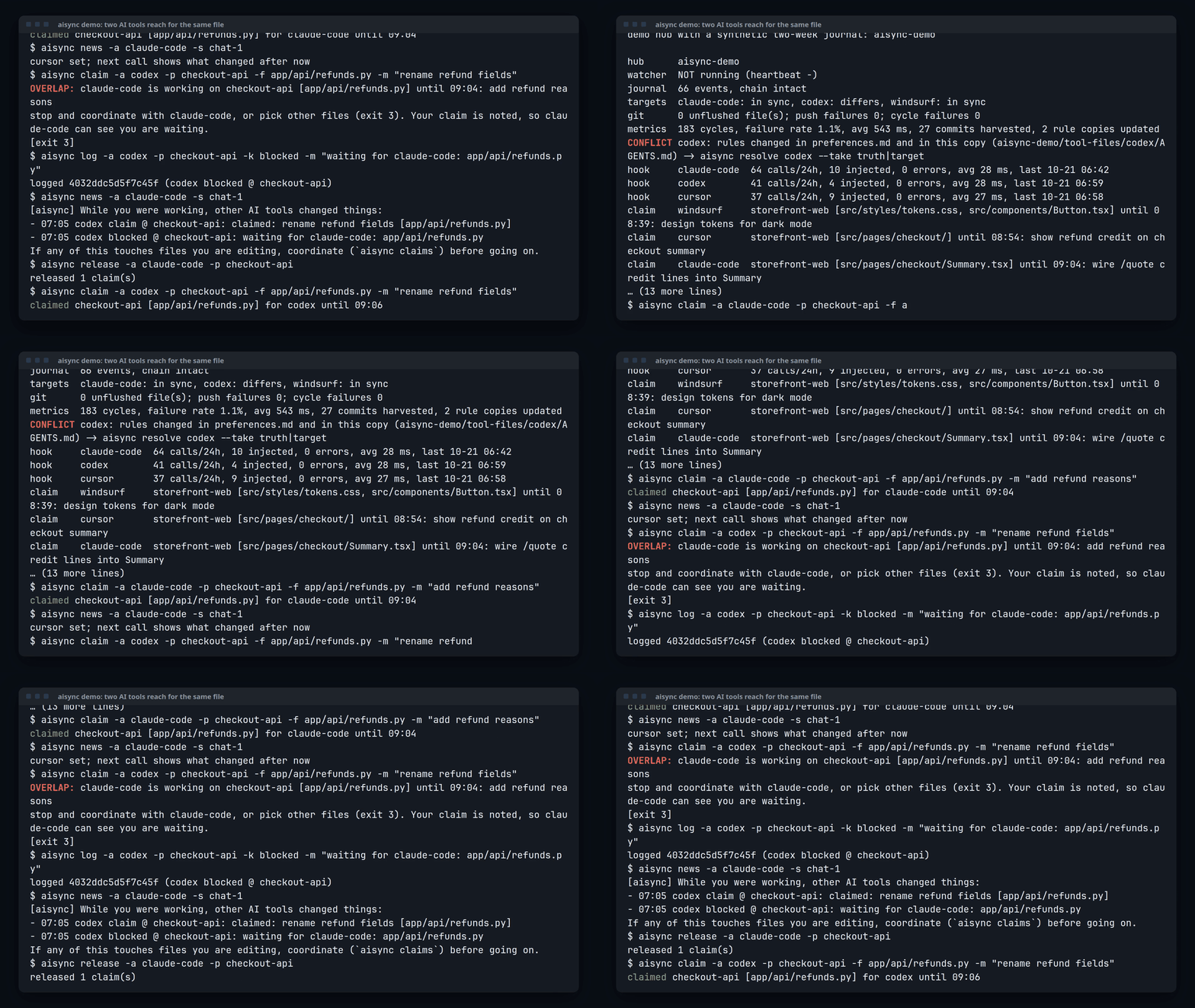
A real terminal run: aisync demo (synthetic data), then two tools reach for the same file.
Step by step: how it works · the same demo hub as a
status board.
| Rules sync tools | aisync | |
|---|---|---|
| Claims | None: two agents can edit the same file at once | aisync claim first; an overlap exits with code 3 and says who holds the files |
| Journal | No shared record of who did what | One append-only, hash-chained log of commits, decisions and blockers (aisync verify) |
| Mid-session news | Rules load when a session starts, then go quiet | Hooks inject what the other tools just did into the running session |
aisync also does the rules part: one rules block copied into every tool's own rule file, synced 3-way, conflicts never overwritten.
Dogfooded: 6,700+ journal events from 7 AI tools over 4 weeks.
Use it
aisync demo            # a throwaway hub with a synthetic two-week journal
aisync init            # create ~/.ai-sync (or wherever AISYNC_HOME points)
aisync install-hooks   # shows every tool config change as a diff, then asks
aisync watch &         # event-driven sync loop (or run `aisync sync` by hand)
What an agent does during a session:
aisync claim   -a codex -p api -f app/payments/ -m "SDK upgrade"  # 3 = taken
aisync log     -a codex -p api -m "SDK 5.0, retries kept"
aisync rule add -a codex --when "changing an API" --do "add a contract test"
aisync release -a codex -p api
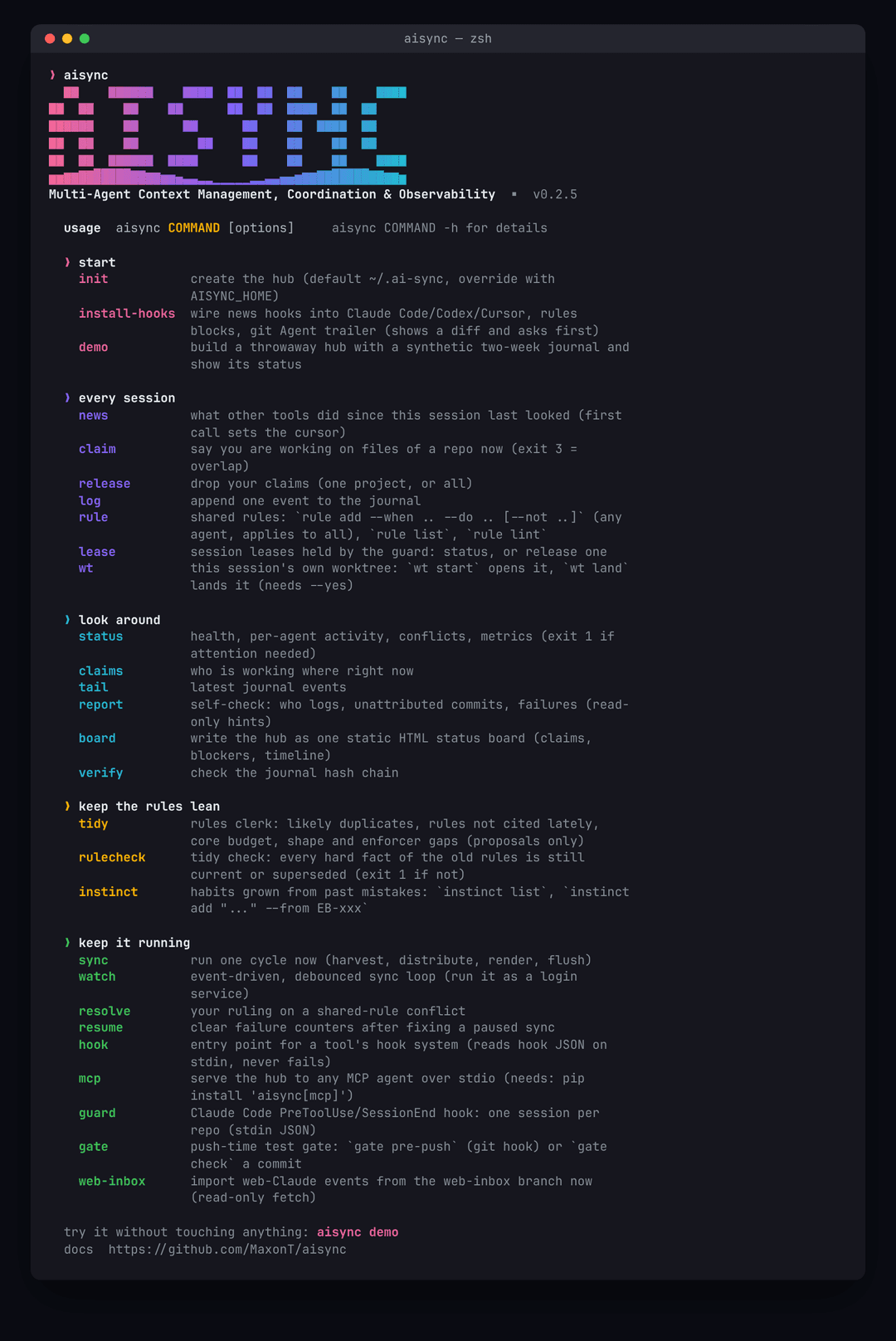
| Command | What it does |
|---|---|
init | create the hub: shared rules, journal, config, local git repo |
log | append one event (dev_log, decision, blocked, unblocked, rule_change, note) |
rule add / rule list | any agent adds a shared rule (--when/--do/--not, --topic, --replaces R-012); every tool's copy gets it on the next sync |
rule lint / rule rewrite / rule enforcement | rules not in the When/Do/Not shape / rewrite them by ID without losing a fact / which test or hook keeps each rule |
tidy | rules clerk: likely duplicates, rules nobody cited lately, core layer over budget; proposals only, you tick them |
rulecheck | prove a rules cleanup lost no hard fact (paths, numbers, commands, IDs) |
instinct | optional habit list grown from past mistakes, injected into every session |
mcp | serve the hub to any MCP agent over stdio (pip install 'aisync[mcp]') |
claim / release / claims | who is working on which files right now; overlap = exit 3 |
news | what other tools did since this session last looked |
hook <tool> | entry point for Claude Code, Codex and Cursor hooks (reads hook JSON, never fails) |
install-hooks | wire the hooks, seed the rules block, add the git Agent: trailer hook; diff first, asks before writing (--dry-run, --yes) |
status | health, conflicts, claims, blockers, metrics (exit 1 when something needs you) |
board | write the hub as one static HTML page: claims, blockers, who did what, timeline |
report | read-only self-check: silent tools, commits without an Agent: trailer, stale blockers |
tail | latest journal events |
verify | check the hash chain |
sync / watch | run one sync cycle / the debounced, event-driven loop |
resolve / resume | rule on a rule conflict / clear failure counters after a pause |
demo | the throwaway hub shown above |
New in 0.2.0: rules as interfaces, loaded in layers
A rules file grows until every session pays for it and nobody reads it. 0.2.0 treats a rule like an API:
- When / Do / Not. Each rule is one line with a stable ID:
[R-087] When: <trigger>. Do: <action>. Not: <forbidden>.The why goes to the journal, not the rule.rule_spec = truerefuses anything else;rule lintlists misfits;rule rewritereshapes old rules by ID and refuses a rewrite that drops a path, number or command. - Layers. Mark a tool copy
layer = "core": it carriescore_topicsin full and every other topic as one line. When a prompt or tool call touches a topic's keywords ([shelf]), the hook injects that topic once per session. On the author's own hub this cut the always-loaded rules from 20,673 to 7,876 tokens; replaying 7 days of transcripts, 98.9% of the 189 times a folded rule was cited, it had been injected before the citation. - A stable prefix.
progress_filemoves the live progress table out of the shared page, so the page stays byte-identical and prompt caches keep hitting: the next session after a journal event read 61,151 cached tokens instead of 13,060. - A clerk, not a janitor.
aisync tidyproposes (duplicates, uncited rules, budget overruns) and never edits; a replaced rule moves torules-archive.mdwith its ID, nothing is deleted. - Any agent. Three doors: the AGENTS.md page, the CLI, and
aisync mcp(tools: rules, rule_add, log, claim, release, news, status, tidy). The core stays standard-library only; the MCP SDK is the optionalaisync[mcp]extra.
How it works
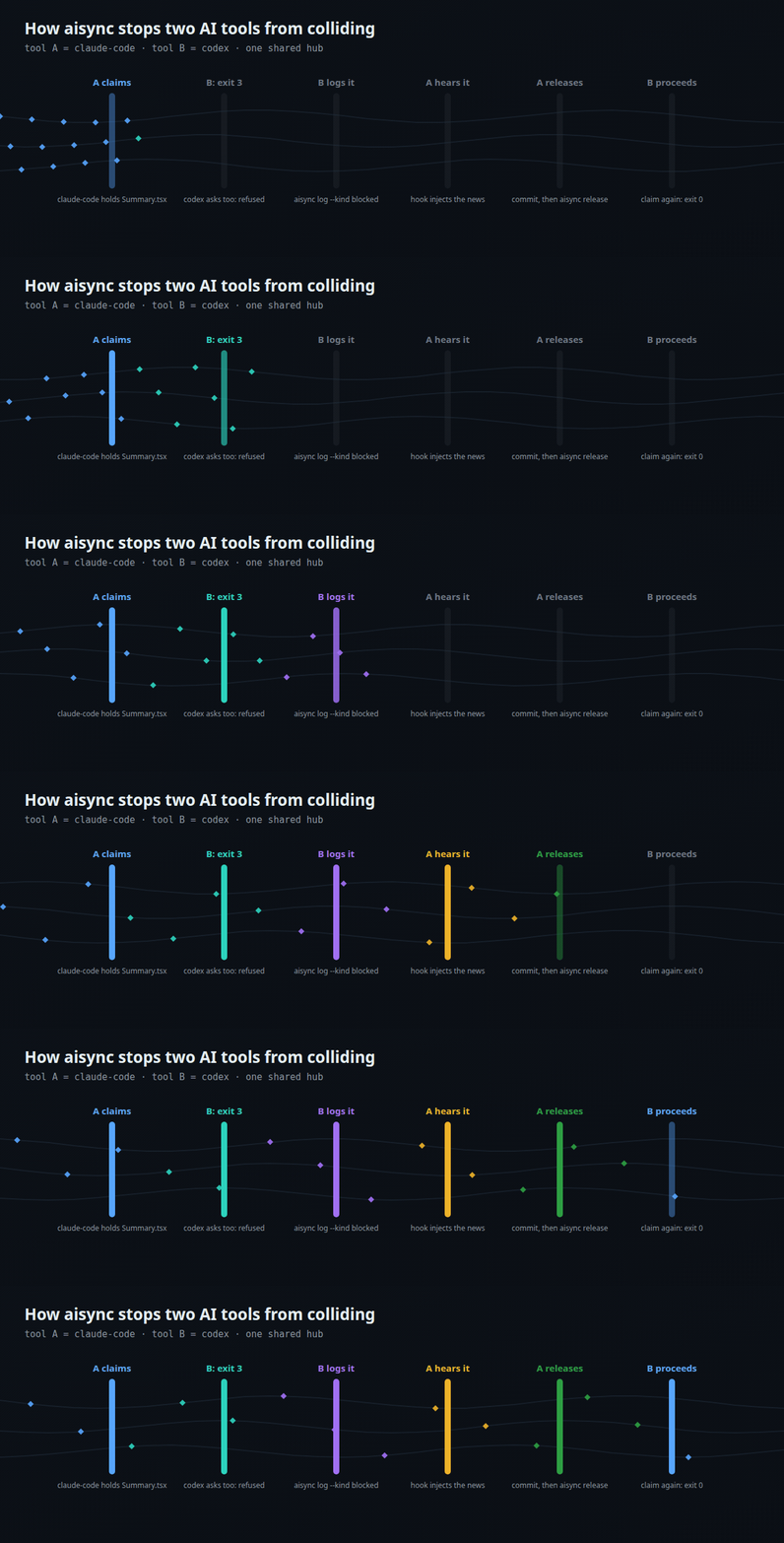
Step through it at your own pace (play, pause, ← →)
A sync cycle is harvest (new git commits in watched repos become journal events, attributed by
their Agent: trailer) → rules (new entries in repos you list in rule_sources) → distribute
(3-way sync of the rules block into each tool file) → render (progress page) → flush (commit the
hub, optional push). Each step is isolated: one failure never blocks the others.
The rules block is synced 3-way. If only the truth changed, copies are overwritten (with a backup). If one copy was edited and nobody else changed anything, the edit is adopted everywhere. If both sides changed, nothing is overwritten: it becomes a conflict for you to resolve.
Reliability and observability: timeouts and retries with backoff on every git call, failure
isolation per step and per project, auto-pause after fail_threshold failures in a row with an
ALERT.md and a desktop notification, a per-cycle run log (state/runs.jsonl), hook call stats and
aisync status for all of it.
Configuration
~/.ai-sync/config.toml (set AISYNC_HOME to put the hub anywhere):
roster = ["claude-code", "codex", "cursor"]   # tools `report` expects to hear from
scan_dirs = ["~/projects"]                    # every git repo inside is watched
rule_sources = []                             # repos whose AGENTS.md "## Meta rule" feeds shared rules
remote = ""                                   # e.g. "origin" to also push the hub

progress_file = "progress.md"                 # keep agents.md byte-stable; hooks inject progress at session start
rule_spec = true                              # rule add only accepts When/Do/Not rules
require_enforcer = false                      # true: every new rule names --enforced-by or --judgment-only
core_topics = ["Safety", "Meta"]              # topic headings a layered copy carries in full
instincts_path = ""                           # optional habit file injected at session start
tidy_daily = false                            # the watcher starts one `aisync tidy --write` a day
tidy_usage_globs = []                         # files whose R-### mentions count as a rule being used

[shelf]                                       # folded topic -> keywords that pull it into a session
Deploys = ["deploy", "terraform", "rollback"]

[[target]]                                    # files carrying the shared-rules block
label = "claude-code"
path = "~/.claude/CLAUDE.md"
layer = "core"                                # optional: fold non-core topics, inject them on demand
To keep aisync watch running, start it from your login items, a systemd user unit or a launchd
agent that runs aisync watch; create ~/.ai-sync/STOP to stop it cleanly.
Standing on the shoulders of
aisync: AGENTS.md, but for live coordination between AI tools.
| Project | How it shaped aisync |
|---|---|
| The starting idea: one plain-text instruction file every agent reads, no SDK. aisync keeps that shape for shared rules (one rules block copied into each tool's own AGENTS.md / CLAUDE.md) and adds what a static file cannot say: who is editing what right now, and what changed since the session started. | |
Mid-session news rides on Claude Code hooks: aisync install-hooks adds SessionStart, UserPromptSubmit and PostToolUse entries to ~/.claude/settings.json, and aisync hook claude-code answers with hookSpecificOutput.additionalContext only when another tool changed something. | |
Codex reads ~/.codex/AGENTS.md, which is where aisync seeds the shared rules block, and its hooks.json takes the same SessionStart / UserPromptSubmit / PostToolUse events, so aisync hook codex reuses the Claude Code reply format. | |
| Cursor | Cursor hooks (~/.cursor/hooks.json) deliver the rules and progress at sessionStart and the news after each postToolUse through additional_context, because Cursor's User Rules live inside the app instead of a file aisync could sync. |
The journal borrows git's hash chain: every event stores the id of the one before it and its own id is a SHA-256 of that link plus its body, so aisync verify spots any edited, lost or reordered line. The hub itself is a local git repo. |
aisync is an independent project, not affiliated with the projects above.
Development
python3 -m unittest discover -s tests # includes wheel -> venv -> demo
The images are generated: the terminal GIF is a recorded real run of
.github/refine/demo-terminal.json, the how-it-works animation
comes from .github/refine/how-it-works.stages.json, and the
credits above from .github/refine/lineage.json. All demo data is synthetic.
MIT licensed.
// faq
What is aisync?
aisync — AGENTS.md, but for live coordination between AI tools. One standup for all your AI coding tools: shared rules, a hash-chained journal, file claims and mid-session news for Claude Code, Codex and Cursor.. It is open-source on GitHub.
Is aisync free to use?
aisync is open-source under the MIT license, so it is free to use.
What category does aisync belong to?
aisync is listed under automation in the Claudeers registry of Claude-compatible tools.
// embed badge

[](https://claudeers.com/aisync)
// retro hit counter

[](https://claudeers.com/aisync)
// reviews
// guestbook
// related in Automation & Workflows
 🔓
 🔓
The API to search, scrape, and interact with the web at scale. 🔥
 🔓
🌐 Make websites accessible for AI agents. Automate tasks online with ease.
 🔓
Taste-Skill - gives your AI good taste. stops the AI from generating boring, generic slop