
agentic-mercy-10x
My complete Claude Code agentic workspace - 200+ curated skills, 9-agent specialist mesh, 3-act /invoke orchestration, enforcement hooks. Clone + one command…
Install with your AI
Paste into Claude Code, Cursor, or any agent — it reads the repo and wires the tool into your project.
Install and set up agentic-mercy-10x (release-binary project) into my current project.
Found on https://claudeers.com/agentic-mercy-10x
Repo: https://github.com/AjayIrkal23/agentic-mercy-10x
Homepage/docs: —
Detected install method: release-binary → inspect the README
Category: mcp-servers. Platforms: cli, api, desktop, web.
Read the repo's README for exact setup and env vars, then install it and wire it into my project.

Claudeers Health Verdict:
active; community-verified: false. Confirm the source before running anything.
Grab the latest release asset from GitHub.
# download a build from https://github.com/AjayIrkal23/agentic-mercy-10x/releases
git clone https://github.com/AjayIrkal23/agentic-mercy-10x
// compatibility
| Platforms | cli, api, desktop, web |
|---|---|
| Operating systems | — |
| AI compatibility | claude |
| License | NOASSERTION |
| Pricing | open-source |
| Language | JavaScript |
⚡ agentic-mercy-10x
A complete operating system for Claude Code — it routes every prompt to exactly the right expertise.
One git clone turns a stock Claude Code install into a disciplined engineering team that plans its work, routes each task to the right specialist, enforces your standards at write-time, and proves it's done with real output — not a confident guess.
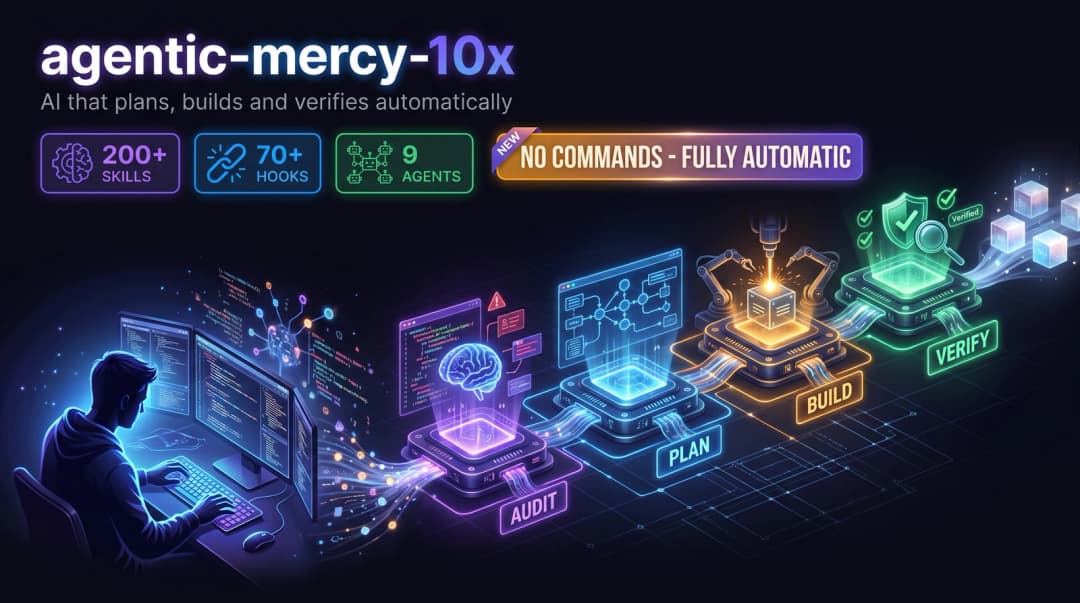
The whole workbench in one frame: a raw prompt goes in, verified software comes out, and every stage is gated.
Why · Never-miss routing · 218 skills · The /invoke corps · Codebase intelligence · Model autopilot · Install
Migrating from v1? See the release notes for the full story.
🩸 Why Agentic Mercy
AI coding agents are brilliant and undisciplined. Turned loose on a real codebase, the same failures repeat on every task. Agentic Mercy closes each one — permanently, and by default:
| 😖 A stock agent | ⚡ agentic-mercy-10x |
|---|---|
| Forgets your standards halfway through a task | Injects the right standard on every write |
| Reads whole files, burns tokens, still misses the caller | A symbol index + dependency graph answer in one call |
| Codes first, understands never | Gates the work: no code until there's a plan |
| Says "Done!" — it never ran | Runs the real flow and captures the real output |
| Leaves dead code and rotted docs in its wake | Sweeps orphans and syncs docs on every task |
| Ships the SQL-injection you never saw | Semgrep + OWASP gate the diff and say BLOCK |
| Burns premium-model spend on a one-line fix | Routes each task to the cheapest capable model |
The system stands on six promises. Each one is enforced by code, not vibes:
- 🎯 Never-miss routing. One smart router reads your intent once and hands the work the exact skills and specialists it needs — backed by 1,973 protected triggers, a deduped session manifest, and a priority budget so nothing routable is ever silently dropped.
- 🧰 218 curated skills. Standards, testing, security, forensics, and design craft — with 128 upstream packs provenance-locked and hash-verified at install, so vendored skills update cleanly and never drift.
- 🎼 A thirteen-act specialist corps. Auditor, architect, planner, test-author, engineer, refactorer, debugger, designer, cleaner, adversarial reviewer (Santa Method), doc-writer, verifier, and security sentinel — composed on demand through one parametric
/invokecommand. - 🧠 Self-healing codebase intelligence. The workspace auto-indexes the repo you're in — symbols, dependencies, docs — with zero background daemons. The agent never works blind.
- 💸 Model cost autopilot. The right model per task: Sonnet by default, Opus only where it earns its keep. One policy file decides.
- 🛡️ Safety-railed end to end. Atomic hooks that fail open, session telemetry, one-command rollback, and a manifested archive of everything the workspace keeps.
[!WARNING] This is opinionated on purpose. The hooks enforce real gates — TDD advisories, a per-directory documentation tree, dead-code sweeps, security scans, skill-routing, and model-routing. They nudge (and sometimes block) you toward one disciplined way of working. That is the entire point. Skim What the hooks enforce so nothing surprises you.
🎯 Never-miss routing
The right skill or specialist shows up at the right moment without you asking. A single router sits between your prompt and the work. It classifies your intent once into a task profile, ranks skills by the files you're touching, packs the highest-signal set into a priority budget, and dedups anything the session already acknowledged.
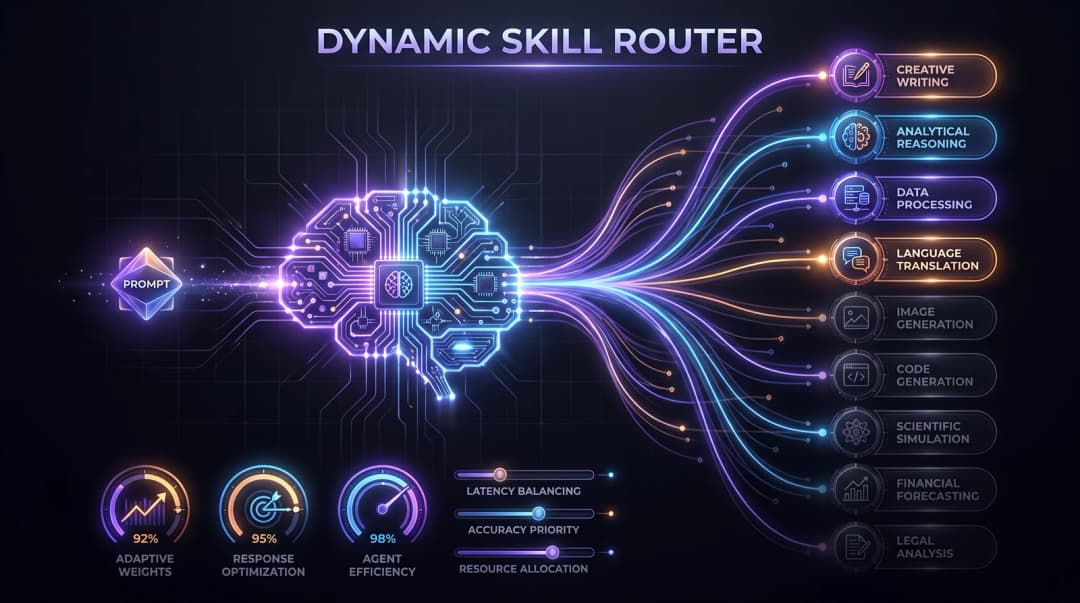
One classify-once router selects only the skills your prompt actually needs. Its trigger surface is a checksum-guarded floor of 1,973 verbatim rules — nothing routable ever slips through.
| Piece | What it does |
|---|---|
| Classify-once task profile | Your intent and the paths you touch are read a single time; every downstream decision reuses that read |
| Ranked selection into a priority budget | Only the highest-signal skills load, priority-ordered and deduped against the session manifest |
Trigger floor (hooks/trigger-floor.json) | 1,973 verbatim entries, checksum-guarded, with a never-remove doctrine enforced in CI — the guarantee that nothing routable is missed |
| Self-tuning weights | A weight-updater learns which skills actually helped and re-ranks future routing; floor rules stay weight-independent |
| One source of truth | Every route and command composition lives in hooks/autonomous-skill-router.config.json |
And you often don't type a command at all: a plain-English prompt like "fix this bug and clean up after" is auto-classified, and the matching specialist chain fires on its own.
🦸 Eight superpowers, 218 skills
Every skill in the workspace exists to give a developer one of eight superpowers. This is the full roster — the actual inventory, not a teaser — of what 10x's your day.
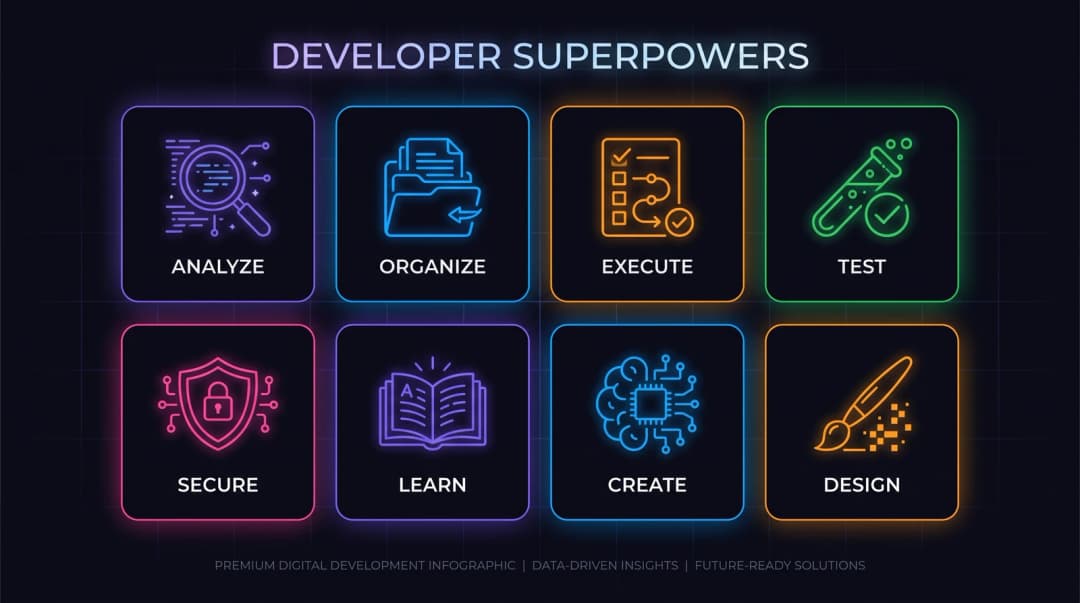
Eight capability lanes drawn from 218 skills. 128 of them are upstream-locked and hash-verified byte-for-byte at install, so vendored packs update cleanly.
🔬 ① ANALYZE — see the whole codebase in one call
The agent queries a pre-built index instead of reading files blindly. This is where the token savings come from.
| Skill / tool | What it 10x's |
|---|---|
codebase-intel-first | Doctrine: build a structural model of the code, then read only what matters |
jcodemunch-token-saver | Symbol index — find a function, its callers, and its blast radius in one call, not twenty file reads |
graphify | Dependency graph — "who depends on X?" and "how do A and B connect?" answered instantly |
project-structure-map · project-reference-linkage | Layer boundaries plus the cross-module wiring an unfamiliar repo hides |
lean-ctx | Compressed I/O · 10 read modes · re-reads a file in ~13 tokens |
caveman | Output compression — ~75% fewer tokens, full technical accuracy |
🗂️ ② ORGANIZE — a codebase that stays clean
| Skill | What it 10x's |
|---|---|
frontend-structure-standards · backend-standards-always-follow · service-layer-standards | Domain-first frontend folders and clean route/controller/service/schema backend boundaries |
scaffold-standards · domain-scaffold-patterns | New domain? Get the exact file tree emitted first, then write the logic |
api-contract-standards · api-and-interface-design | Stable envelopes and typed contracts across the frontend/backend seam |
dead-code-and-change-audit | Continuous hygiene — no orphaned imports, stale refs, or half-refactors survive |
🗺️ ③ EXECUTE — never vibe-code again
| Skill | What it 10x's |
|---|---|
plan-mode-gate · workflow-orchestrator | Hard pre-flight: no code until there's a checked plan |
source-driven-development | Every decision grounded in official docs, not stale memory |
sequential-thinking (doctrine) | Externalize all reasoning — plan, audit, debug, decide |
ponytail · doubt-driven-development | The simplest solution that works, then an adversarial self-review |
incremental-implementation · subagent-driven-development | Ship in safe slices and fan out independent work |
🧪 ④ TEST — prove it works, don't claim it
| Skill | What it 10x's |
|---|---|
test-driven-development · golang-testing | Red, green, refactor; table-driven Go tests |
webapp-testing · browser-testing-with-devtools | Real-browser DOM, console, network, and visual checks |
verification-loop · eval-harness | A finish line the agent has to actually cross |
systematic-debugging · debug-investigation | Reproduce, find root cause, minimal fix — no fix without a cause |
🛡️ ⑤ SECURE — ship without holes
| Skill / agent | What it 10x's |
|---|---|
owasp-security · security-and-hardening | OWASP Top 10 (2025), ASVS, and LLM/agentic threats baked into every review |
security-sentinel (agent) | A Semgrep + OWASP pass on the diff, returning a BLOCK / PASS verdict |
backend-error-handling | Safe logging, secret redaction, client-safe error mapping |
📖 ⑥ LEARN — never forget, never re-derive
| Skill / system | What it 10x's |
|---|---|
memory (MCP) + memory protocol | Patterns, decisions, and fragile-area gotchas persist across sessions |
dox-doc-tree | A CLAUDE.md + AGENTS.md in every directory — read root to target, then edit |
update-docs · CODEX.md | Docs and ADRs stay synced to the change, gate-enforced, in a living decision log |
🎼 ⑦ CREATE — a whole team of specialists in a box
| Skill / agent | What it 10x's |
|---|---|
Thirteen-act specialist corps + parametric /invoke | Audit · spec · plan · test · implement · refactor · debug · design · clean · review · docs · verify · security — composed on demand |
forensic-hotspot-finder · forensic-change-coupling | Which files cause the most bugs; what quietly changes together |
forensic-complexity-trends · forensic-debt-quantification | Is quality trending up? What does the debt cost in dollars? |
🎨 ⑧ DESIGN — UI that doesn't look AI-generated
| Skill / engine | What it 10x's |
|---|---|
impeccable · taste-skill · ui-ux-pro-max · huashu-design | Anti-slop craft: tokens, typography, hierarchy, motion |
frontend-ui-engineering · design-extract | Production UIs; extract a design system from any live URL |
| Higgsfield asset engine | Bespoke image / video / 3D / audio — real assets, never placeholders |
🎼 One command, a whole team
Type /invoke audit spec plan impl design and a whole cross-functional team wakes up in order — an auditor, an architect, a planner, an engineer, a designer — each a clean-context specialist that hands its artifact to the next.
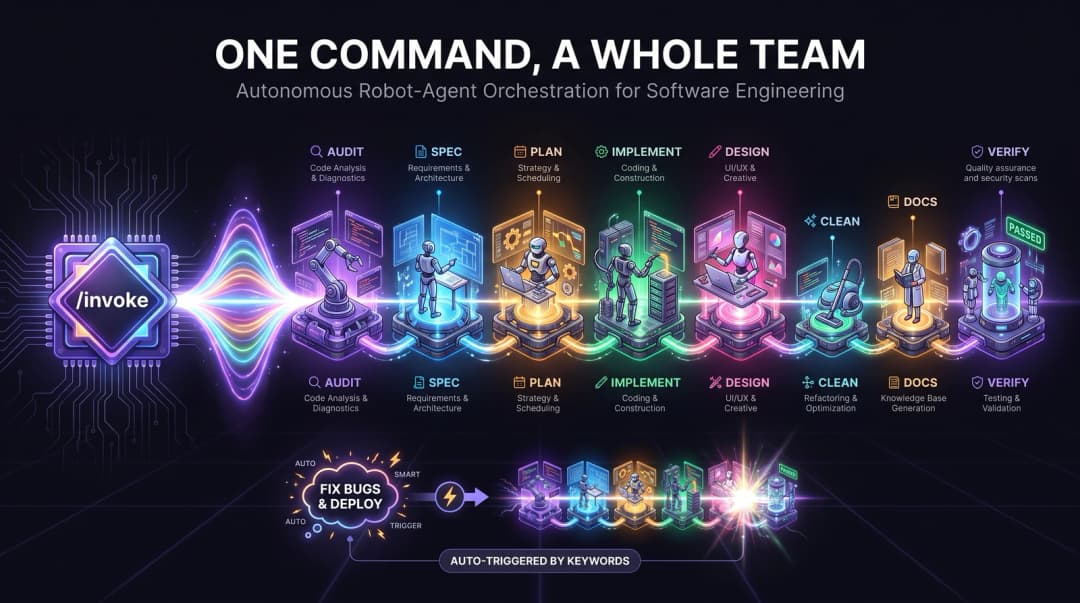
One parametric /invoke composes the thirteen-act specialist corps. Twenty-four command files back it; a plain-English prompt triggers the matching chain automatically.
Every invocation runs the same three acts — which is why they compose so cleanly:
flowchart LR
    subgraph ACT1["🎬 ACT 1 · INTEL"]
      direction TB
      I["Symbol index<br/>+ dependency graph<br/>produce a codebase brief"]:::a1
    end
    subgraph ACT2["🎬 ACT 2 · DISPATCH"]
      direction TB
      D["audit · spec · plan · impl<br/>debug · design · security<br/>run in dependency order"]:::a2
    end
    subgraph ACT3["🎬 ACT 3 · AUTO-CLOSE"]
      direction TB
      C["clean · docs · verify<br/>then the stop-gates"]:::a3
    end
    I ==> D ==> C

    classDef a1 fill:#0EA5E9,stroke:#0369A1,color:#fff
    classDef a2 fill:#6E56CF,stroke:#4B3B9C,color:#fff
    classDef a3 fill:#22C55E,stroke:#15803D,color:#052e16
Compose the acts freely: /invoke audit spec plan test impl refactor review clean runs the whole spine; /invoke debug runs one act. Twenty-four command files back the surface, and any command name resolves through the invoke translator.
The specialist corps
| Agent | Act | Owns |
|---|---|---|
🔬 audit-specialist | AUDIT | Forensic hotspots, coupling and churn, dead code, repo-health — cited findings. |
📐 spec-architect | SPEC | Requirements into typed contracts, acceptance criteria, an explicit Not-Doing list. |
🗺️ planning-director | PLAN | A spec into a dependency-ordered, file-pathed, per-task-TDD plan. |
⚙️ implementation-engineer | IMPLEMENT | Executes the plan task-by-task with TDD (runs on Opus by directive). |
🐞 debug-detective | DEBUG | Reproduce, demonstrate root cause, minimal fix. No fix without a cause. |
🎨 frontend-uiux-designer | DESIGN | Anti-slop UI via a six-skill design stack (runs on Opus). |
🧹 deadcode-reaper | CLEAN | Removes only what this session's diff orphaned; delete-safe. |
📖 docs-sync-agent | DOCS | Syncs docs and the per-directory CLAUDE.md tree to the change. |
✅ qa-verifier | VERIFY | Runs the real flow and captures real output — evidence, not assertions. |
🕵️ security-sentinel | SECURITY | A Semgrep + OWASP pass on the diff, returning a BLOCK/PASS verdict. |
GSD, Figma, and Vercel helper agents round out the roster.
🎬 What happens when you hit Enter
Every task runs the same disciplined spine — understand · build · auto-close · prove — with gates that don't let sloppiness through. This is the full lifecycle, from the moment you open a project to the moment the agent is allowed to say "done":
flowchart TD
    A(["🖥️  cd project && claude"]):::start --> S0

    subgraph S0["①  SESSION START · dispatch.py fires as your session opens"]
      B["🧠 Active-repo symbol index + dep-graph verified<br/>🗂️ Memory + CODEX working-log loaded<br/>📚 dox doc-tree root verified<br/>🧾 Skill manifest primed · ponytail + caveman on"]:::hook
    end

    S0 --> P(["⌨️  Your prompt"]):::start

    subgraph S1["②  UNDERSTAND"]
      AU["🔬 <b>AUDIT</b><br/>hotspots · coupling · churn · dead code<br/><i>cited findings, never vibes</i>"]:::agent
      SP["📐 <b>SPEC</b><br/>typed contracts · acceptance criteria<br/><i>plus an explicit Not-Doing list</i>"]:::agent
      PL["🗺️ <b>PLAN</b><br/>dependency-ordered · exact file paths<br/><i>a TDD cycle per task</i>"]:::agent
    end

    P --> AU --> SP --> PL

    subgraph S2["③  BUILD"]
      IM["⚙️ <b>IMPLEMENT</b><br/>task-by-task · test-first · atomic commits"]:::agent
      DB["🐞 <b>DEBUG</b><br/>reproduce, demonstrate root cause, minimal fix"]:::agent
    end

    PL --> IM
    IM -->|"tests red / bug"| DB
    DB -->|"root cause + fix"| IM

    subgraph S3["④  AUTO-CLOSE · runs every time, no exceptions"]
      CL["🧹 <b>CLEAN</b><br/>removes only what <i>this</i> diff orphaned"]:::agent
      DX["📖 <b>DOCS</b><br/>syncs docs + the per-dir CLAUDE.md tree"]:::agent
      VF["✅ <b>VERIFY</b><br/>runs the real flow · captures real output"]:::agent
    end

    IM --> CL --> DX --> VF

    subgraph GATES["🚧  STOP-GATES · the session cannot end until…"]
      G["Docs synced ✔   Security scanned ✔   Review passed ✔"]:::gate
    end

    VF --> G --> DONE(["🎉  Done — with evidence, not assertions"]):::done

    classDef start fill:#6E56CF,stroke:#4B3B9C,color:#fff,font-weight:bold
    classDef hook fill:#0EA5E9,stroke:#0369A1,color:#fff
    classDef agent fill:#1E293B,stroke:#6E56CF,color:#E2E8F0
    classDef gate fill:#F59E0B,stroke:#B45309,color:#1E293B,font-weight:bold
    classDef done fill:#22C55E,stroke:#15803D,color:#052e16,font-weight:bold
You don't run those stages by hand. One parametric /invoke <acts…> command composes them, and a plain-English prompt triggers the matching chain automatically.
🧠 Self-healing codebase intelligence
Every superpower rests on the agent never working blind — and that costs you nothing. An event-driven state machine keeps four surfaces fresh (jcodemunch symbols, jdocmunch docs, graphify dependencies, and the dox tree) for the active repo only, using detached single-shot builders with a debounced reindex. There are zero daemons, and by construction it cannot touch any other repo.
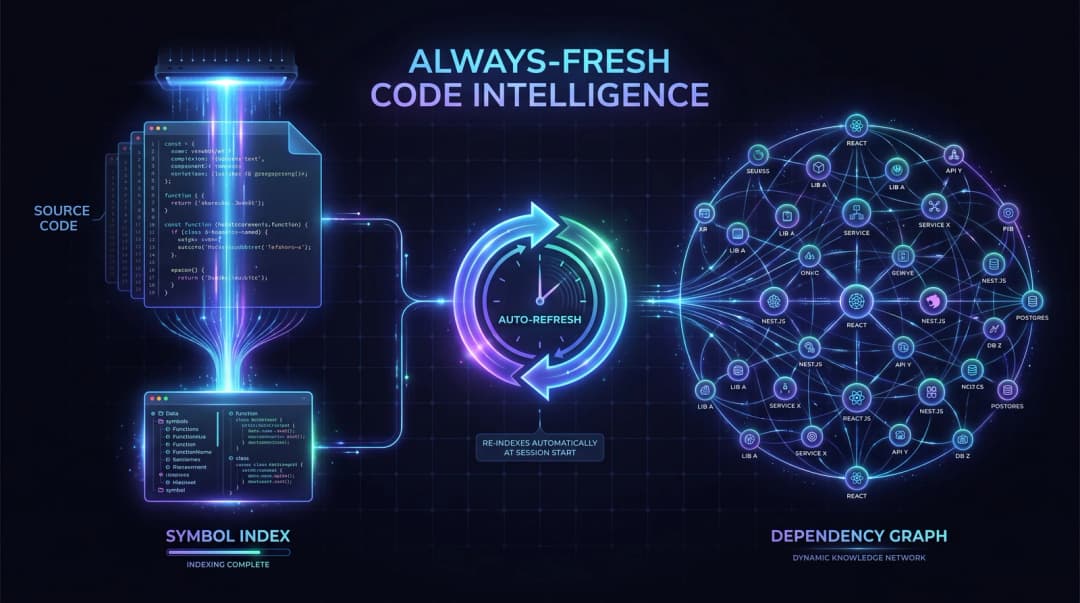
Symbol index plus dependency graph, refreshed on session and write events — active repo only, single-shot builders, no always-on watchers.
Why it matters: a stock agent re-derives structure with grep on every task and still misses cross-module edges. Here it's a one-call lookup against an always-current map — which is exactly where the token savings come from.
🛡️ Hooks — where the enforcement lives
Skills are advice. Hooks are the enforcement. Eight per-event dispatch.py orchestrators drive the lifecycle, and every hook stays its own isolated module with a type, an enabled flag, a priority, and a token budget. One link crashing can't take down its event.
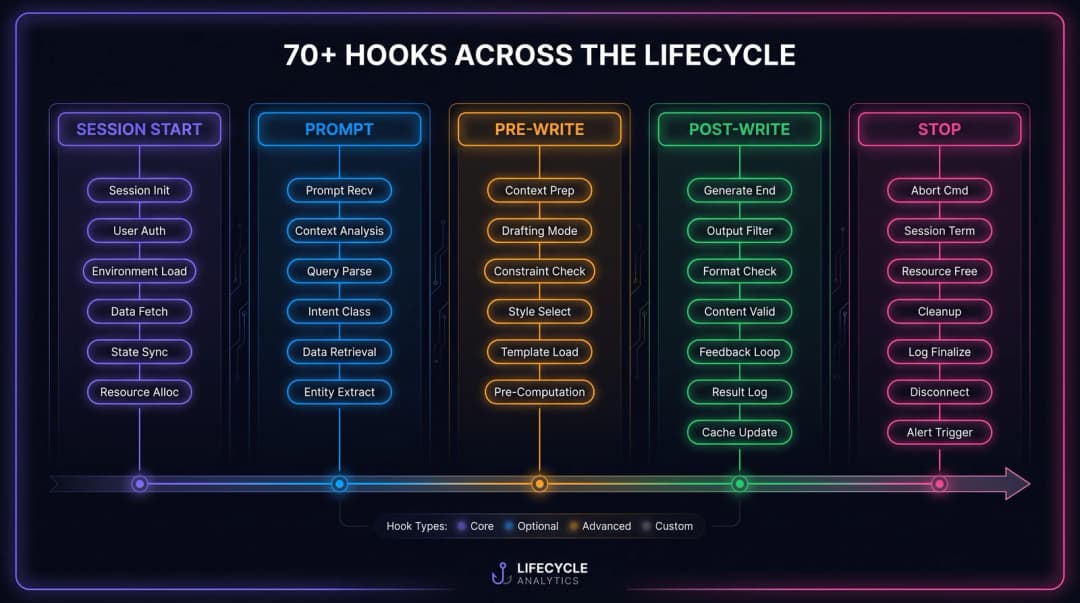
Five lifecycle phases, each driven by one of eight event dispatchers; every hook stays an isolated file, and a link-doctor synthetically fires every one.
Some links don't just advise — they gate. A risky change runs a gauntlet, and a session can't even end until the closing gates pass:
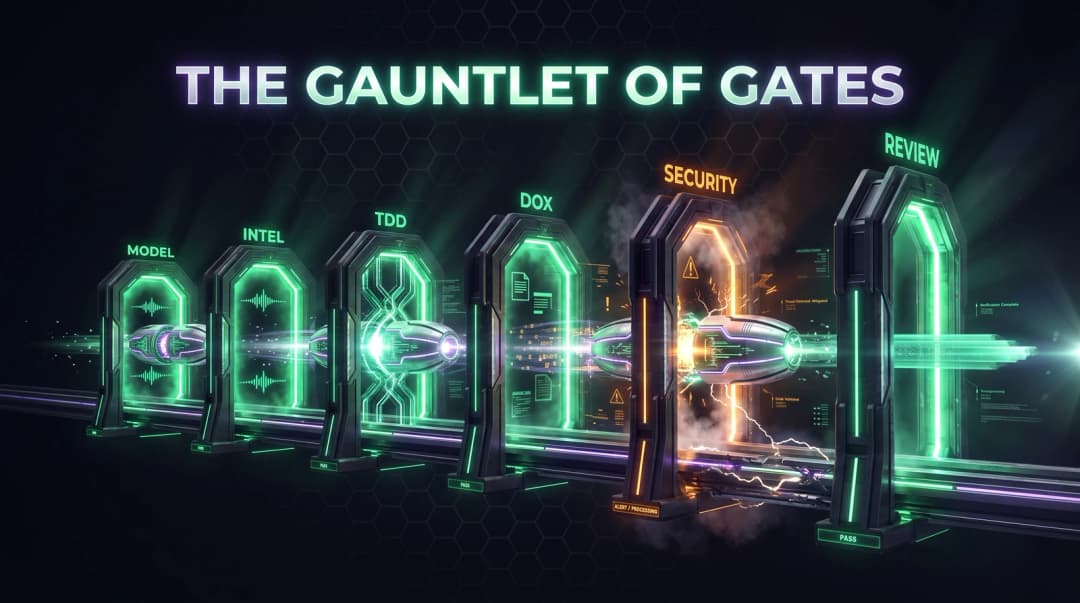
The gate chain — model routing, intel-first, TDD guard, dox tree, security scan, review — enforced by isolated links inside the pre-write and Stop dispatchers.
| Phase | What the dispatcher does | Isolated links (a few) |
|---|---|---|
| ① SessionStart | Boot knowing the codebase | jcodemunch-index-guard · memory-load-on-start · dox-tree-guard · tdd-guard-init-guard |
| ② UserPromptSubmit | Shape the request | the unified prompt router · sequential-thinking-mandate |
| ③ PreToolUse | Gate and route every action | opus-guard · jcodemunch-enforce · dox-write-gate · tdd-guard-gate · security-scan-gate |
| ④ PostToolUse | Clean up after every write | desloppify-cleanup · doc-update-enforcer · dox-child-scaffold |
| ⑤ Stop | Prove it's done, then learn | hard-completion-gate · santa-method-writer · session-memory-writer |
💸 Model cost autopilot
The right model runs each task, and one file decides. Sonnet handles everything by default; Opus is reserved for the work that earns it.
| Tier | When | Source of truth |
|---|---|---|
| Sonnet | The default for everything | hooks/model-policy.json |
| Opus | UI/UX work · genuinely heavy builds · the IMPLEMENT carve-out | invoke_categories.IMPLEMENT: "opus" |
| Fable | Explicit user request only — never automatic | user-driven flag |
model-policy.json is the single place model choice lives. opus-guard.py pins each subagent's model from its [sonnet]/[opus]/[fable] prefix, and workflow-model-guard.py keeps workflow subagents from inheriting an Opus parent — the silent token burn a stock setup never notices.
💰 The token economy
Here is the part that pays for itself. A stock agent answers a question by reading files — it grep-scans, opens a dozen, and drowns its own context. This workspace answers by querying a pre-built symbol index and dependency graph, then compresses everything that flows through. At the prompt layer, one classify-once router packs the highest-signal skills into a priority budget instead of spawning a fleet of injectors.
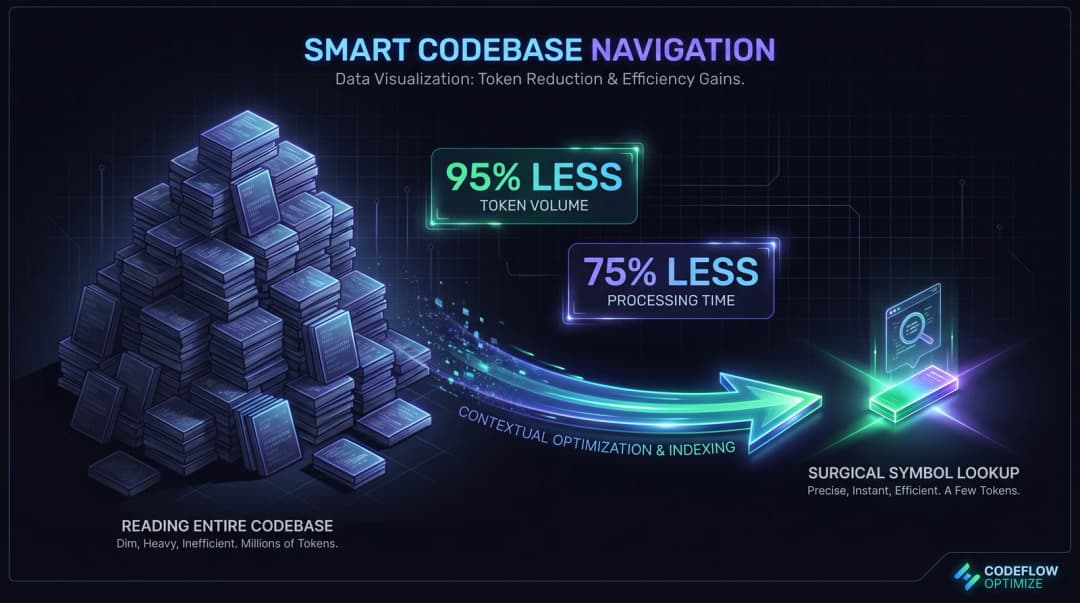
Two compounding wins: surgical index lookups instead of blind file dumps, and one classify-once router packed into a priority budget instead of many prompt-time injector spawns.
xychart-beta
    title "Tokens spent per task — stock agent vs agentic-mercy-10x (illustrative)"
    x-axis ["Find callers", "Grok a module", "Re-read a file", "Explain change"]
    y-axis "Tokens" 0 --> 80000
    bar [45000, 80000, 3000, 1200]
    bar [1500, 6000, 13, 300]
| Everyday task | 🐌 Stock agent | ⚡ agentic-mercy-10x | Saved |
|---|---|---|---|
"Who calls processPayment?" | grep + read ~15 files ≈ 45k tok | find_references ≈ 1.5k tok | ~97% |
| "Understand this module ahead of an edit" | read the whole dir ≈ 80k tok | assemble_task_context ≈ 6k tok | ~92% |
| "Re-read a file after an edit" | full re-read ≈ 3k tok | lean-ctx diff ≈ 13 tok | ~99% |
| "Explain the change you made" (output) | verbose prose ≈ 1.2k tok | caveman ≈ 300 tok | ~75% |
Numbers are illustrative estimates drawn from each skill's own stated savings (
jcodemunch-token-saver≈ 95% on retrieval,caveman≈ 75% on output,lean-ctx≈ 13-token re-reads). Your mileage varies with repo size — the shape of the win does not.
🧭 The agent always knows where to look
Point a stock agent at an unfamiliar repo and it wanders — opening files, guessing, backtracking. This workspace gives it a GPS: codebase-start-point-guide sets the entry point, and project-reference-linkage + project-structure-map trace the exact vertical slice a change touches, so it walks straight to the right files and skips the rest.

Start point, then the exact vertical slice, then done. The linkage map keeps every node in the chain traceable so nothing downstream is missed.
flowchart LR
    C["🧩 component"]:::fe --> H["🪝 hook"]:::fe --> A["🌐 api client"]:::fe
    A --> RT["🛣️ route"]:::be --> CT["🎛️ controller"]:::be --> SV["⚙️ service"]:::be
    SV --> SC["📐 schema"]:::be --> MD["🗄️ model"]:::be
    H -.->|"UI state"| ST["🗃️ store / slice"]:::fe

    classDef fe fill:#0EA5E9,stroke:#0369A1,color:#fff
    classDef be fill:#6E56CF,stroke:#4B3B9C,color:#fff
🗂️ Your codebase stays structured
Left unattended, an AI agent turns any codebase into spaghetti — files wherever, types inline, dead code everywhere. This workspace makes structure non-optional: every new domain lands in a known shape, every layer boundary holds, and the cross-module wiring is mapped up front.
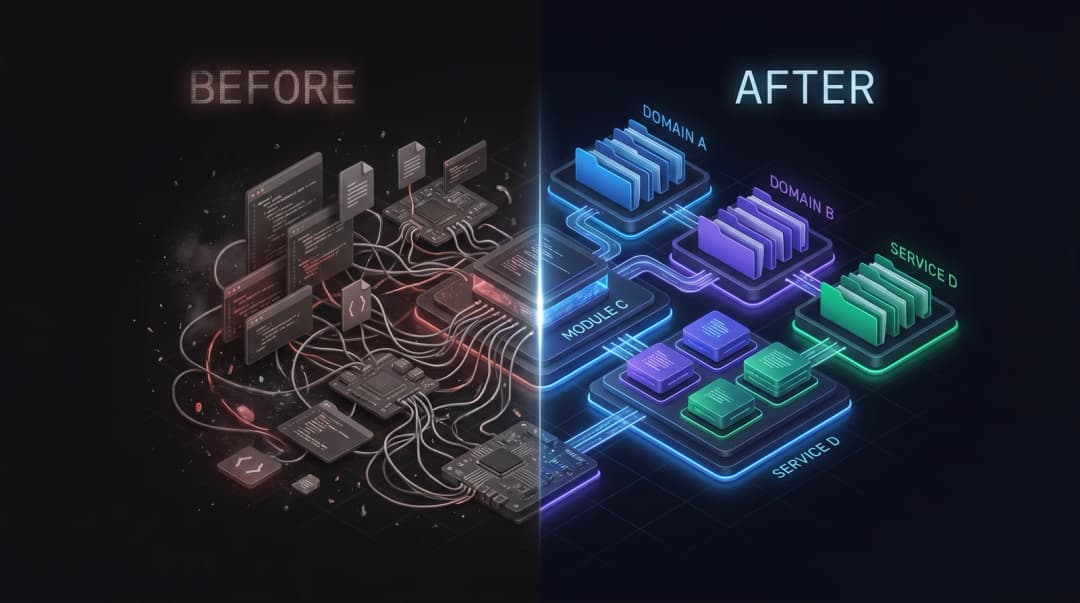
The default outcome, not the hoped-for one: domain-organized structure enforced at scaffold time, write time, and close time.
The standards, made visual
Four always-on skill sets decide where every file goes and what shape it takes — so the clean structure above is what you get by default:
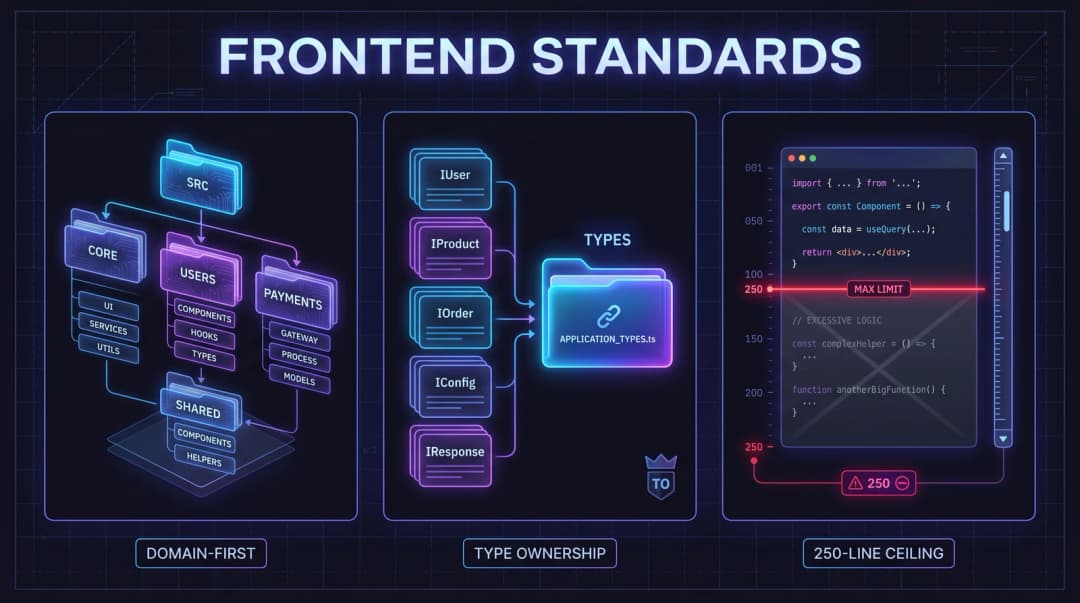 Frontend — frontend-structure-standards · frontend-standards-always-follow: domain-first folders, central type ownership, a hard 250-line file ceiling. | 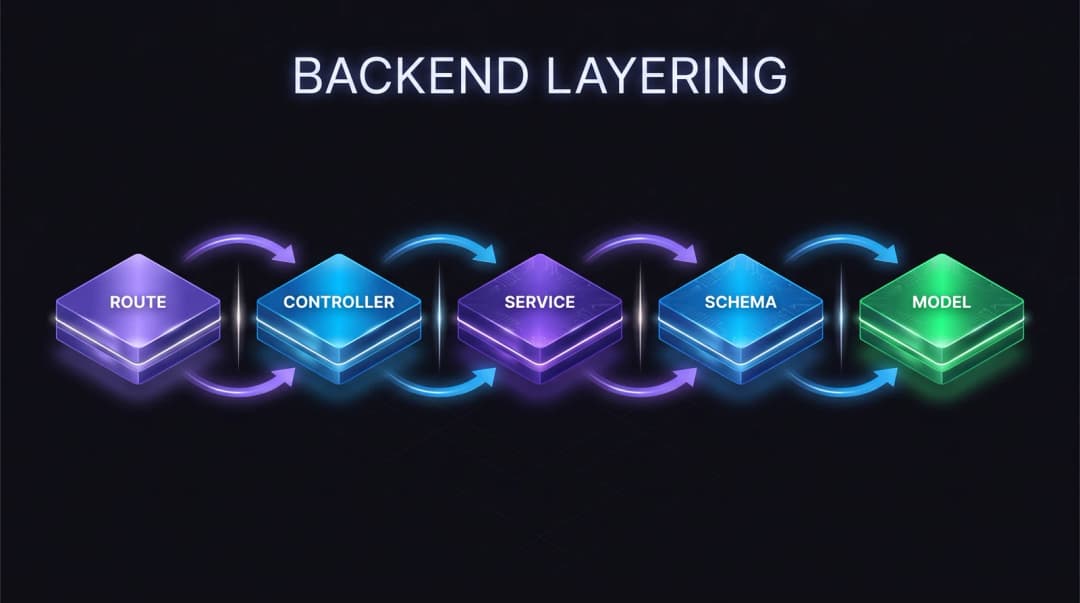 Backend — backend-standards-always-follow · service-layer-standards · backend-api-standards: route, controller, service, schema, model — boundaries that never blur. |
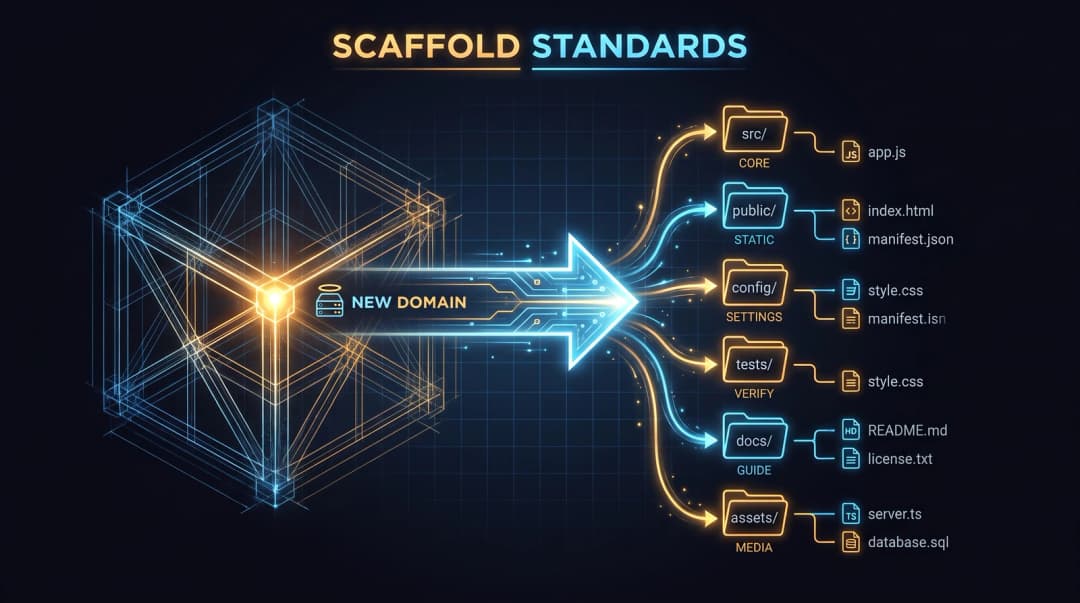 Scaffold — scaffold-standards · domain-scaffold-patterns: a new domain emits its exact file tree, validated against real Fastify/TS, FastAPI/Python, and Go/chi codebases. | 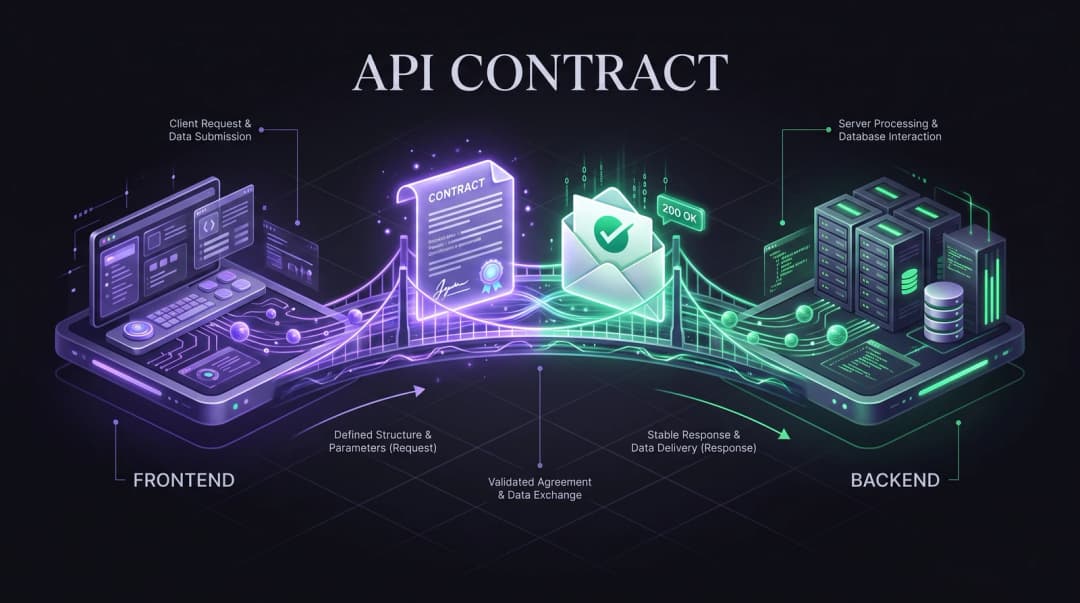 Contract — api-contract-standards · api-and-interface-design: one typed, stable envelope across the frontend/backend seam — no parallel shapes. |
Three enforcement layers keep it that way:
- At scaffold time —
scaffold-standards+domain-scaffold-patternsemit the exact file tree. - At write time — structure skills inject on every edit; the 250-line ceiling and layer boundaries are checked.
- At close time —
dead-code-and-change-auditsweeps orphans and thedoxtree drops aCLAUDE.mdinto any directory you touched.
📖 A self-documenting codebase
The dox tree guarantees every directory in every repo carries a CLAUDE.md (plus an AGENTS.md pointer) — and the moment you create a new folder, a link inside the PostToolUse dispatcher auto-scaffolds its doc. The agent reads root to target ahead of every edit, so it always inherits the local rules of the exact place it's working.
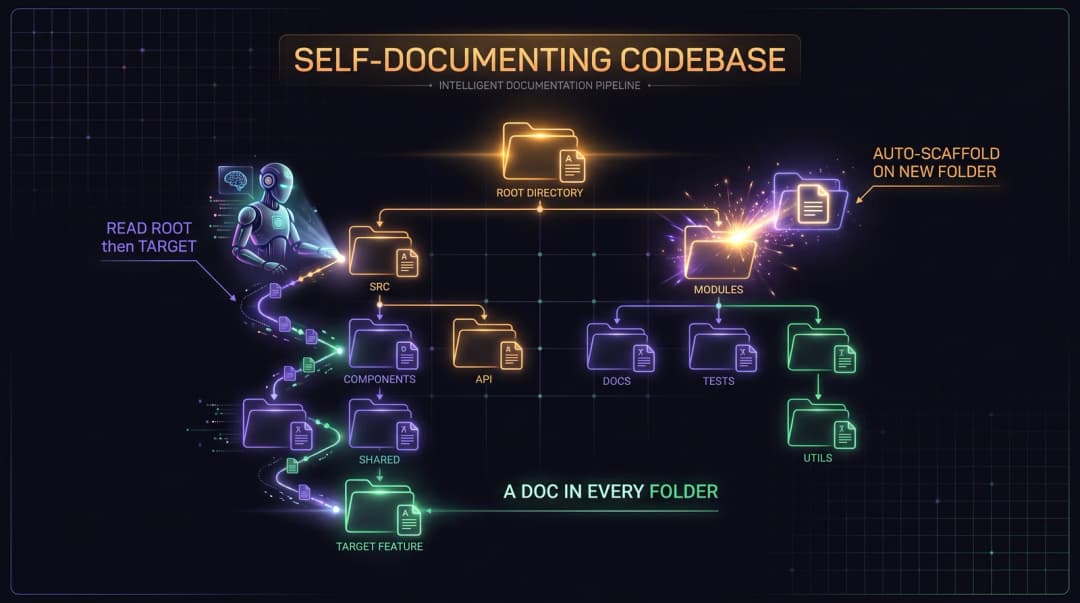
A doc in every folder, auto-scaffolded into new ones, read root to target ahead of any edit — so the agent never violates a local rule it didn't know existed.
🎨 UI that never looks AI-generated
Most AI writes slop UI — templated cards, the same purple gradient, zero intention. This workspace refuses. A six-skill anti-slop design stack — on top of the Higgsfield asset engine — turns a brief into interfaces that look deliberately crafted.
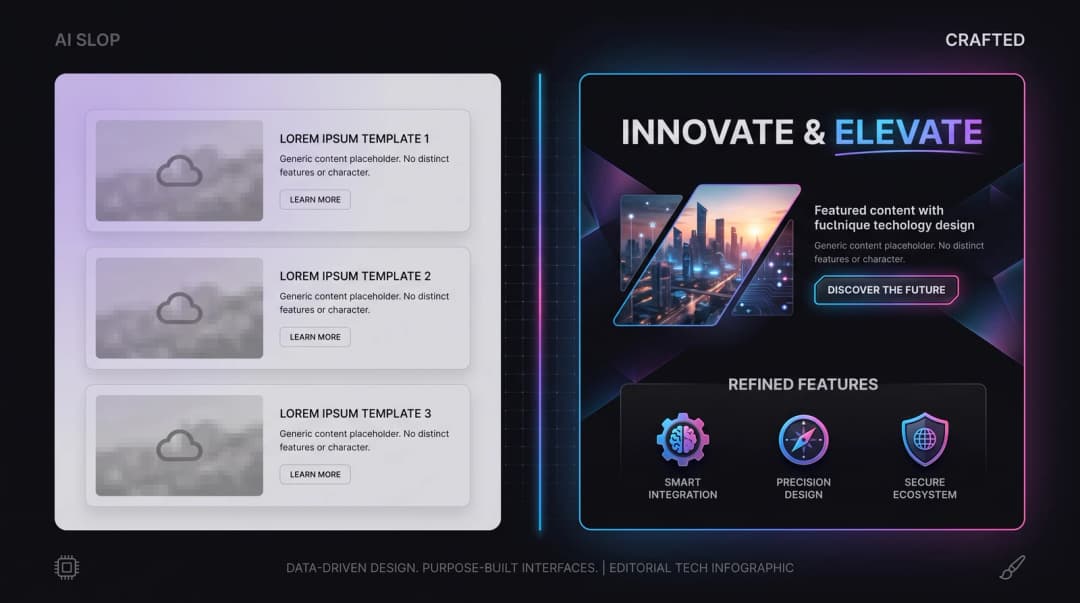
Slop in, craft out: the six-skill stack replaces templated defaults with intentional tokens, type, and hierarchy.
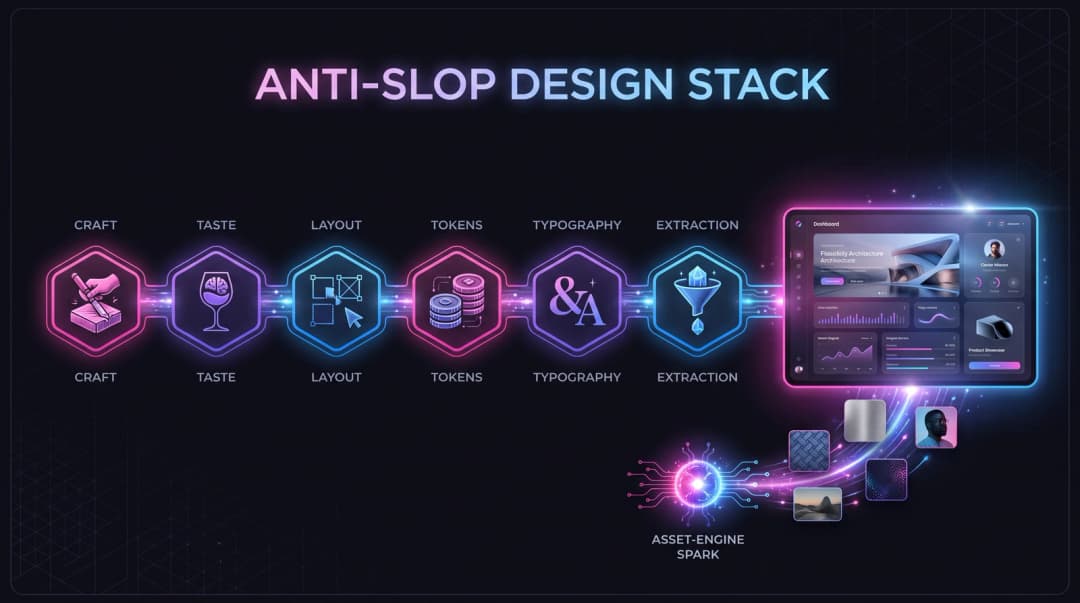 The stack — impeccable · taste-skill · ui-ux-pro-max · huashu-design · frontend-ui-engineering · design-extract, fed by Higgsfield-generated assets. | 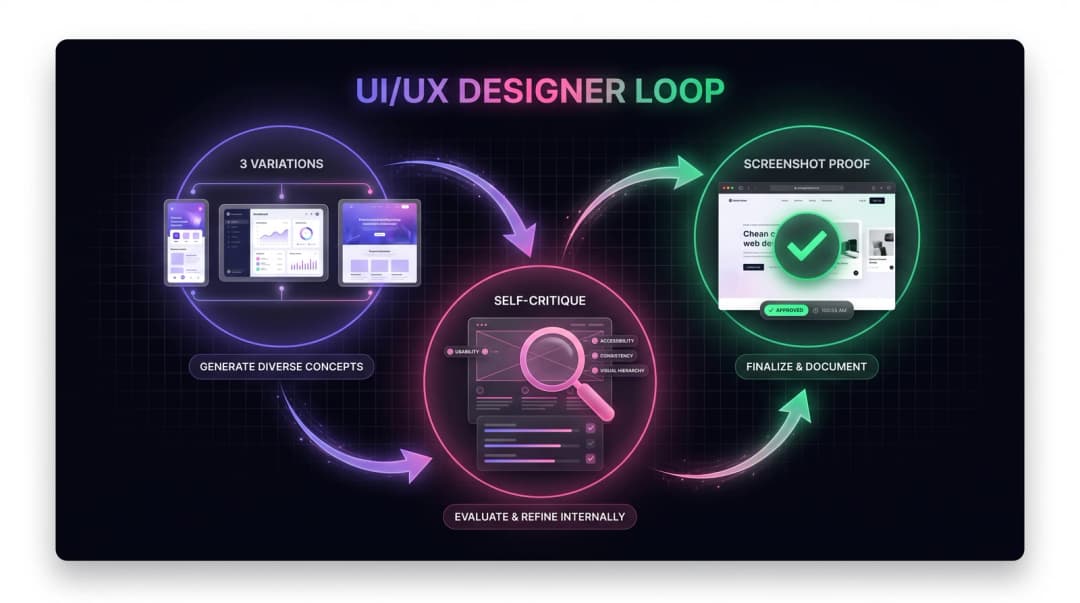 The loop — the frontend-uiux-designer agent explores 3 variations, runs a self-critique pass, then captures screenshot proof at real breakpoints ahead of presenting. |
🏛️ Five layers, one discipline
flowchart TD
    L1["🧭 <b>DOCTRINE</b> — CLAUDE.md + rules/<br/><i>always-in-context operating rules</i>"]:::l1
    L2["🎨 <b>CRAFT</b> — 218 skills<br/><i>how to do the work well</i>"]:::l2
    L3["🛡️ <b>ENFORCEMENT</b> — 8 dispatchers · isolated links<br/><i>makes the doctrine real at write-time</i>"]:::l3
    L4["🤖 <b>SPECIALISTS</b> — 13-act corps<br/><i>one expert per act</i>"]:::l4
    L5["🎼 <b>ORCHESTRATION</b> — parametric /invoke<br/><i>composes specialists into the 3-act flow</i>"]:::l5
    L1 --> L2 --> L3 --> L4 --> L5

    classDef l1 fill:#4B3B9C,stroke:#312566,color:#fff
    classDef l2 fill:#6E56CF,stroke:#4B3B9C,color:#fff
    classDef l3 fill:#0EA5E9,stroke:#0369A1,color:#fff
    classDef l4 fill:#EC4899,stroke:#9D174D,color:#fff
    classDef l5 fill:#F59E0B,stroke:#B45309,color:#1E293B
| Layer | Path | Role |
|---|---|---|
| 1 · Doctrine | CLAUDE.md, rules/ | Always-in-context operating rules — model routing, skill protocol, TDD/dox/codebase-intel doctrine. |
| 2 · Craft | skills/ | 218 skills the agent invokes to do the work well (standards, testing, security, design, forensics). |
| 3 · Enforcement | hooks/ | 8 event dispatchers wiring isolated links — skill injection, index guards, write gates, model guards, stop-gates. |
| 4 · Specialists | agents/ | A thirteen-act specialist corps plus a UI/UX designer and GSD/Figma/Vercel helpers. |
| 5 · Orchestration | commands/ | 20 /invoke files composing the specialists into the 3-act flow. |
🚀 Install
One command. Zero interaction. It installs itself to 100%. The installer is stdlib-only (Python ≥ 3.10), OS auto-detected through hooks/lib/platform.py, and fully automatic — you run one line and it does everything else: finds your global ~/.claude, moves the clone into it, installs every dependency, and then repairs and re-checks itself in a loop until every health check is green. No CLI flags, no folder picker, no manual steps.
First, install 4 base tools — Python ≥ 3.10, Node LTS, Git, Claude CLI. See PREREQUISITES.md for the per-OS commands. The installer auto-installs and auto-registers everything else (uv/pipx/semgrep/lean-ctx/tdd-guard/jcode/jdoc/graphify + all MCP servers + plugins) and reports any base tool still missing.
Clone anywhere, then run one command — it relocates into ~/.claude for you.
Ubuntu / macOS
git clone https://github.com/AjayIrkal23/agentic-mercy-10x ~/agentic-mercy && ~/agentic-mercy/install.sh
#   (equivalently: python3 ~/agentic-mercy/install.py  ·  or clone straight into ~/.claude — it detects that too)
Windows (PowerShell)
git clone https://github.com/AjayIrkal23/agentic-mercy-10x $env:USERPROFILE\agentic-mercy
powershell -ExecutionPolicy Bypass -File $env:USERPROFILE\agentic-mercy\install.ps1   # or: py -3 ...\agentic-mercy\install-ui.py
That single command, fully automatically and in order:
- Auto-detects your canonical
~/.claude(honours$CLAUDE_CONFIG_DIR). - Relocates the clone into
~/.claude— merge-copy that replaces workbench files but preserves your runtime (projects/,memory/,state/,settings.user.json) and never touches.git. If a Windows clone mangled line endings, it restores the pristine committed bytes from git first. - Opens the visual installer (127.0.0.1, stdlib only — no Node/Electron) and auto-starts on load. No button to click.
- Installs + wires everything: deps · registers all MCP servers · installs plugins · renders
settings.jsonfromsettings.template.json(+ optionalsettings.user.json) · builds & validates the skills catalog. - Self-heals in a loop — after each pass it runs the 13-check doctor, auto-repairs any failure (line-ending drift, catalog, settings), and re-checks — repeating until 0 FAIL, then shows a WORKFLOW ACTIVE — 100% banner.
[!TIP] It's the same one command everywhere.
install.py,install-ui.py,install.sh, andinstall.ps1are all thin launchers of the one automatic visual installer — there is deliberately no CLI install path and nothing to configure. Every path resolves throughhooks/lib/platform.py(no hardcoded usernames or drive letters, zero.shhooks), so it works for any user on Ubuntu or Windows. A read-onlypython check.pyreports live status any time.
[!TIP] Want a lighter footprint? Everything is à-la-carte. Prune
settings.jsonand any dispatcher links you don't want — the system fails open where it matters, so removing a gate degrades gracefully instead of breaking.
✅ Quality, proven on every push
Every push is verified on both ubuntu-latest and windows-latest. These checks run in CI and at install time, so a regression is caught the moment it lands — not mid-session.
| Check | Result |
|---|---|
| CI matrix | green on Ubuntu + Windows, every push |
Doctor (installer/doctor.py) | 13 / 13 PASS, 0 WARN, 0 FAIL |
| Test suite (hook + router + installer) | 136 / 136 passed |
| Skills validator | 0 hard failures; 128 upstream-locked skills hash-clean |
| Trigger floor | 1,973 entries, checksum-matched |
| Render equivalence | render(template) == settings.json, byte-identical |
| Symlinks | 0 (Windows-safe) |
| SessionStart wall | < 0.8s |
🛡️ Safety & reversibility
Every layer is safe to touch, and nothing is lost:
- Fail-open by design — every hook degrades to a pass on a crash, never a wedged session.
- One-command rollback — a tagged git anchor restores the entire workspace in a single command.
- Nothing is deleted — no skill is ever removed;
attic/holds a manifested archive so anything the active surface doesn't load is still on disk. - Regenerate on demand —
gen-invoke-commands.py --emit-combosexpands every command name to its own file whenever you want it.
🧩 What's NOT included
By design, the repo excludes anything that is a secret, a session artifact, personal data, or re-installable from elsewhere:
- Secrets —
.credentials.json, API keys, tokens, and~/.claude.json(your MCP config) are never committed.settings.jsonreferences env vars (e.g.${GITHUB_TOKEN}) instead. - Sessions & personal data —
projects/,history.jsonl,sessions/,file-history/,todos/, shell snapshots, and per-machine state. - Re-installable externals — the plugin cache/marketplaces,
skills/gstack/,ast-grep-mcp/, and the GSD (get-shit-done/) system. The installer and notes fetch these.
The installer fetches and registers these automatically — MCP servers (jcodemunch, jdocmunch, graphify, lean-ctx, memory, sequential-thinking, context7, and the rest), the plugin marketplaces + plugins, and the code-intelligence engines. On Windows it runs the claude .cmd shim through the shell so registration actually completes. The only things left to you are the ones no installer can do for you:
- claude.ai connectors (
higgsfield,penpot) — OAuth connectors added in the claude.ai → Connectors UI, not by any CLI. - Secrets — export your own tokens (
GITHUB_TOKEN, etc.) in your shell profile; nothing is shipped, and~/.claude.json(per-machine) holds your credential config.
Anything that needs the claude CLI or the network but can't reach it (offline box, CLI not yet installed) shows as a non-blocking WARN in the installer — it never gates the "100%" success, and self-completes the next time you launch it with the prerequisite in place.
🛠️ Customization
This workspace is meant to be forked and tuned. Edit the sources of truth, not the generated artifacts:
hooks/autonomous-skill-router.config.json— which skills each/invokecategory loads and how the acts compose.hooks/model-policy.json— the single model truth (sonnet default · opus UI+heavy+IMPLEMENT · fable explicit-only).hooks/dispatch.config.json— the 8 dispatchers and their per-link enable flags, priorities, and budgets.hooks/trigger-floor.json— the never-miss routing surface; rebuilt byhooks/build-trigger-floor.py.hooks/gen-invoke-commands.py— regenerates the 20/invokecommand files deterministically.hooks/skills-provenance.json— every skill's upstream source and pinned version (authored-here vs. vendored).settings.template.json— rendered byinstaller/render.pyintosettings.json; holds hook wiring, MCP servers, and permissions.
🚧 What the hooks enforce
So there are no surprises — the workspace ships opinionated gates. The notable ones:
- Skill routing — path-ranked skills inject on writes; the session manifest batches what you haven't read.
- Codebase-intel-first — blind source reads are steered toward the
jcodemunchsymbol index andgraphifydependency graph. - TDD guard (warn mode) — flags implementation written without a failing test first. Advisory, treated as a directive.
- dox documentation tree — every git repo gets a
CLAUDE.md+AGENTS.mdin every directory; code writes are gated until a rootCLAUDE.mdexists. - Model routing — subagents default to Sonnet unless explicitly escalated (
model-policy.json). - Stop-gates — docs sync, security scan (when auth files change), and a review pass — all gating the end of a session.
All hooks fail open where it matters, but they change how the agent behaves. For a lighter setup, prune settings.json and the dispatcher links you don't want.
🙏 Credits
This workspace stands on excellent third-party skills. Each keeps its own upstream license — see each project for terms. The 128 upstream-locked skills are hash-verified byte-intact at install, and hooks/skills-provenance.json records the exact source and pinned version of every vendored skill. Huge thanks to their authors:
| Skill / suite | Upstream |
|---|---|
| Impeccable (UI/UX craft) | pbakaus/impeccable |
| Huashu Design (花叔) | alchaincyf/huashu-design |
| UI/UX Pro Max | nextlevelbuilder/ui-ux-pro-max-skill |
| Taste-Skill (anti-slop frontend) | Leonxlnx/taste-skill |
| gstack (ship/QA/browse/design suite) | garrytan/gstack |
| Superpowers | obra/superpowers-marketplace |
| Ponytail (anti-over-engineering) | DietrichGebert/ponytail |
| Karpathy Guidelines | forrestchang/andrej-karpathy-skills |
| ast-grep MCP | ast-grep/ast-grep-mcp |
Frontend design assets are generated with Higgsfield; GSD (get-shit-done) supplies the gsd-* command system.
📄 License
The workspace's own authored content (hooks, agents, commands, rules, self-authored skills, and this documentation) is MIT-licensed — see LICENSE. © 2026 Ajay Irkal.
Third-party skills under skills/ retain their own upstream licenses (see the Credits table). MIT applies to the original work in this repository, not to vendored code.
If your agent has ever vibe-coded you into a corner — this is the way out.
⭐ Star it, fork it, bend it to your taste.
// faq
What is agentic-mercy-10x?
My complete Claude Code agentic workspace - 200+ curated skills, 9-agent specialist mesh, 3-act /invoke orchestration, enforcement hooks. Clone + one command = full setup.. It is open-source on GitHub.
Is agentic-mercy-10x free to use?
agentic-mercy-10x is open-source under the NOASSERTION license, so it is free to use.
What category does agentic-mercy-10x belong to?
agentic-mercy-10x is listed under mcp-servers in the Claudeers registry of Claude-compatible tools.
// embed badge

[](https://claudeers.com/agentic-mercy-10x)
// retro hit counter

[](https://claudeers.com/agentic-mercy-10x)
// reviews
// guestbook
// related in MCP Servers
 🔓
🔓f.k.a. Awesome ChatGPT Prompts. Share, discover, and collect prompts from the community. Free and open source — self-host for your organization with complete…
 🔓
🔓A cross-platform desktop All-in-One assistant for Claude Code, Codex, OpenCode, OpenClaw, Gemini CLI & Hermes Agent. Only official website: ccswitch.io
 🔓
🔓🪨 why use many token when few token do trick — Claude Code skill that cuts 65% of tokens by talking like caveman
 🔓
🔓An open-source AI agent that brings the power of Gemini directly into your terminal.