
agentfield
Build, run and scale AI agents like API and microservices - observable,auditable and identity-aware from day one.
Install with your AI
Paste into Claude Code, Cursor, or any agent — it reads the repo and wires the tool into your project.
Install and set up agentfield (release-binary project) into my current project.
Found on https://claudeers.com/agentfield
Repo: https://github.com/Agent-Field/agentfield
Homepage/docs: http://www.agentfield.ai
Detected install method: release-binary → inspect the README
Category: automation. Platforms: cli, api, web.
Read the repo's README for exact setup and env vars, then install it and wire it into my project.

Claudeers Health Verdict:
active; community-verified: false. Confirm the source before running anything.
Grab the latest release asset from GitHub.
# download a build from https://github.com/Agent-Field/agentfield/releases
git clone https://github.com/Agent-Field/agentfield
// compatibility
| Platforms | cli, api, web |
|---|---|
| Operating systems | — |
| AI compatibility | claude |
| License | Apache-2.0 |
| Pricing | open-source |
| Language | Go |
AgentField — The AI Backend
Build and scale AI agents like APIs. Deploy, observe, and prove.
AI has outgrown chatbots and prompt orchestrators. Backend agents need backend infrastructure.
Docs · Quick Start · Python SDK · Go SDK · TypeScript SDK · REST API · Examples · Discord

AgentField is an open-source control plane that lets you build AI agents callable by any service in your stack - frontends, backends, other agents, cron jobs - just like any other API. You write agent logic in Python, Go, or TypeScript. AgentField turns it into production infrastructure: routing, coordination, memory, async execution, and cryptographic audit trails. Every function becomes a REST endpoint. Every agent gets a cryptographic identity. Every decision is traceable.
https://github.com/user-attachments/assets/9fb7b1cf-26de-4b9b-9ba2-917252cc26ec
One prompt → a running containerized production ready multi-agent backend. No glue code, start using the agent API!
Build production agents with a prompt.
Describe the system in one line. Get a production-ready multi-agent backend. Works in Claude Code, Codex, Gemini CLI, OpenCode, Aider, Windsurf, and Cursor.
curl -fsSL https://agentfield.ai/install.sh | bash
Then in your coding agent, paste any spec with /agentfield :
/agentfield Build a claims processor with risk scoring, pattern detection,
and human approval for low-confidence decisions.
You get a Docker Compose stack wired up end-to-end — the agent, the control plane, and a production ready REST API endpoint you can paste and curl into a terminal to try it. See it in action →
The DX you get
Best in class Python (or Go / TypeScript) DX. With least intrusive abstraction. No DSL, no YAML, no graph wiring.
from agentfield import Agent, AIConfig
from pydantic import BaseModel

app = Agent(
    node_id="claims-processor",
    version="2.1.0",# Canary deploys, A/B testing, blue-green rollouts
    ai_config=AIConfig(model="anthropic/claude-sonnet-4-20250514"),
)

class Decision(BaseModel):
    action: str# "approve", "deny", "escalate"
    confidence: float
    reasoning: str

@app.reasoner(tags=["insurance", "critical"])
async def evaluate_claim(claim: dict) -> dict:

    # Structured AI judgment - returns typed Pydantic output
    decision = await app.ai(
        system="Insurance claims adjuster. Evaluate and decide.",
        user=f"Claim #{claim['id']}: {claim['description']}",
        schema=Decision,
    )

    if decision.confidence < 0.85:
        # Human approval - suspends execution, notifies via webhook, resumes when approved
        await app.pause(
            approval_request_id=f"claim-{claim['id']}",
            approval_request_url=f"https://internal.acme.com/approvals/claim-{claim['id']}",
            expires_in_hours=48,
        )

    # Route to the next agent - traced through the control plane
    await app.call("notifier.send_decision", input={
        "claim_id": claim["id"],
        "decision": decision.model_dump(),
    })

    return decision.model_dump()

app.run()
# This single line exposes: POST /api/v1/execute/claims-processor.evaluate_claim
# The agent auto-registers with the control plane, gets a cryptographic identity, and every
# execution produces a verifiable, tamper-proof audit trail.
What you just saw:
app.ai()calls an LLM and returns structured output.app.pause()suspends for human approval.app.call()routes to other agents through the control plane.app.run()auto-exposes everything as REST. Read the full docs →
Prefer to scaffold by hand? (Python / Go / TypeScript / Docker)
af init my-agent --defaults                            # Scaffold agent
cd my-agent && pip install -r requirements.txt
af server          # Terminal 1 → Dashboard at http://localhost:8080
python main.py     # Terminal 2 → Agent auto-registers
# Call your agent
curl -X POST http://localhost:8080/api/v1/execute/my-agent.demo_echo \
  -H "Content-Type: application/json" \
  -d '{"input": {"message": "Hello!"}}'
# Go
af init my-agent --defaults --language go && cd my-agent && go run .

# TypeScript
af init my-agent --defaults --language typescript && cd my-agent && npm install && npm run dev

# Docker (control plane only)
docker run -p 8080:8080 agentfield/control-plane:latest
Deployment guide → for Docker Compose, Kubernetes, and production setups.
How AgentField fits in your stack
Most agent tools help you write agent logic. AgentField is what runs it in production — the operating layer that makes agents callable by software, durable across failures, governed by policy, and provable by audit.
| Frameworks LangChain · CrewAI · PydanticAI · OpenAI Agents SDK | Workflow engines Temporal · Airflow | Visual builders n8n · Zapier | AgentField | |
|---|---|---|---|---|
| Build agent logic (prompts, tools, structured output) | ● | — | — | ● |
| Callable production ready REST APIs out-of-box | — | ◐ | ● | ● |
| Async + retries + webhooks | — | ● | ◐ | ● |
| Memory scopes (global · agent · session · run) | ◐ | — | — | ● |
| Service discovery + cross-agent calls | — | — | — | ● |
| Distributed agents | — | — | — | ● |
| Tamper-proof, verifiable audit per execution | — | — | — | ● |
| Harness orchestration (Claude Code · Codex · CLI) | — | — | — | ● |
| Identity and Access Management (IAM) for agents | — | — | — | ● |
| Fleet observability (DAGs · metrics · traces) | — | ◐ | — | ● |
| Multi-language SDKs (Python · Go · TypeScript) | ◐ | ● | — | ● |
● full · ◐ partial · — not the focus
Use a framework when you're proving behavior. Use AgentField when agents need to be production systems — callable by software, coordinating across services, surviving failures, and governed under audit.
Full comparison & decision guide →
What You Get
Build - Python, Go, or TypeScript. Every function becomes a REST endpoint.
- Reasoners & Skills -
@app.reasoner()for AI judgment,@app.skill()for deterministic code - Structured AI -
app.ai(schema=MyModel)→ typed Pydantic/Zod output from any LLM - Harness -
app.harness("Fix the bug")dispatches multi-turn tasks to Claude Code, Codex, Gemini CLI, or OpenCode - Cross-Agent Calls -
app.call("other-agent.func")routes through the control plane with full tracing - Discovery -
app.discover(tags=["ml*"])finds agents and capabilities across the mesh.tools="discover"lets LLMs auto-invoke them. - Memory -
app.memory.set()/.get()/.search()- KV + vector search, four scopes, no Redis needed
Run - Production infrastructure for non-deterministic AI.
- Async Execution - Fire-and-forget with webhooks, SSE streaming, retries. No timeout limits - agents run for hours or days.
- Human-in-the-Loop -
app.pause()suspends execution for human approval. Crash-safe, durable, audited. - Canary Deployments - Traffic weight routing, A/B testing, blue-green deploys. Roll out agent versions at 5% → 50% → 100%.
- Observability - Automatic workflow DAGs, Prometheus
/metrics, structured logs, execution timeline.
Govern - IAM for AI agents. Identity, access control, and audit trails - built in.
- Cryptographic Identity - Every agent gets a W3C DID (decentralized identifier) - not a shared API key. Agents authenticate to each other the way services authenticate with mTLS, but with cryptographic signatures that travel with the agent.
- Verifiable Credentials - Tamper-proof receipt for every execution. Offline-verifiable:
af vc verify audit.json. - Policy Enforcement - Tag-based policy gates with cryptographic verification. "Only agents tagged 'finance' can call this" - enforced by infrastructure, not prompts.
See the full production-ready feature set →

▼ Click to expand full capabilities
AI & LLM
| Feature | How |
|---|---|
| Structured output (Pydantic/Zod) | app.ai(schema=MyModel) |
| Multi-turn coding agents | app.harness("task", provider="claude-code") |
| LLM auto-discovers agents and tools | app.ai(tools="discover") |
| Multimodal (text, image, audio) | app.ai("Describe", image_url="...") |
| Streaming responses | app.ai("...", stream=True) |
| 100+ LLMs via LiteLLM | AIConfig(model="anthropic/claude-sonnet-4-20250514") |
| Temperature, max tokens, format | app.ai(..., temperature=0.2) |
Agent Mesh & Discovery
| Feature | How |
|---|---|
| Cross-agent calls with tracing | app.call("agent.func", input={...}) |
| Discover agents by tag (wildcards) | app.discover(tags=["ml*"]) |
| Discover by health status | app.discover(health_status="active") |
| Agent routers (namespacing) | AgentRouter(prefix="billing") |
| Auto context propagation | Workflow, session, actor IDs forwarded |
| Parallel agent execution | asyncio.gather(app.call(...), ...) |
| Auto-registration on startup | Service mesh with zero config |
Execution Engine
| Feature | How |
|---|---|
| Sync execution (REST) | POST /api/v1/execute/{agent}.{func} |
| Async (fire-and-forget) | POST /api/v1/execute/async/{agent}.{func} |
| Webhooks + HMAC-SHA256 signing | AsyncConfig(webhook_url="...", secret="...") |
| SSE streaming (real-time) | /api/v1/execute/stream/{id} |
| No timeout limits (hours/days) | Control plane allows unlimited duration |
| Execution polling | GET /api/v1/executions/{id} |
| Batch status checks | POST /api/v1/executions/batch-status |
| Progress updates mid-execution | Intermediate payloads during long tasks |
| Auto retries + exponential backoff | Transparent - control plane handles |
| Backpressure + queue depth limits | Fair scheduling, circuit breakers |
| Durable queue (PostgreSQL) | Atomic lease-based processing |
Memory (Distributed State)
| Feature | How |
|---|---|
| Key-value storage | app.memory.set(key, value) / .get(key) |
| Vector search (semantic) | app.memory.search(embedding, top_k=5) |
| Four scopes | Global, agent, session, run |
| Reactive memory events | @app.memory.on_change("order_*") |
| Metadata filtering | Filter stored values by metadata |
| Zero dependencies | Built into control plane - no Redis |
Human-in-the-Loop
| Feature | How |
|---|---|
| Durable pause/resume | await app.pause(reason="...") |
| Approval workflows with UI | approval_request_url for reviewers |
| Configurable timeouts | expires_in_hours=24 + auto-escalation |
| Crash-safe state | Survives agent restarts |
Canary Deployments & Versioning
| Feature | How |
|---|---|
| Traffic weight routing | 5% → 50% → 100% rollouts |
| A/B testing | 50/50 splits with X-Routed-Version |
| Blue-green deployments | Instant weight switch, zero downtime |
| Per-version health tracking | Unhealthy versions auto-removed |
| Agent lifecycle states | pending → starting → ready → degraded → offline |
Identity & Governance
| Feature | How |
|---|---|
| Cryptographic identity per agent | Auto-generated W3C DID + Ed25519 keys |
| Verifiable Credentials | Tamper-proof receipt per execution |
| Offline VC verification | af vc verify audit.json |
| Tag-based access policies | ALLOW/DENY rules on caller → target tags |
| Cryptographically signed requests | Ed25519 signatures on cross-agent calls |
| VC hierarchy (3 tiers) | Platform → Node → Function control |
| Agent notes (audit log) | app.note("Decision", tags=["critical"]) |
| Non-repudiation | Cryptographic proof of actions |
| Permission request workflows | Auto-created when access denied |
Observability & Fleet Management
| Feature | How |
|---|---|
| Automatic DAG visualization | Workflow graphs in dashboard |
| Prometheus metrics | /metrics out of the box |
| Structured JSON logging | Automatic from SDK |
| Execution timeline | Chronological decision trace |
| Health checks (K8s-ready) | /health, /ready endpoints |
| Correlation IDs | X-Workflow-ID, X-Execution-ID |
| Workflow DAG API | GET /api/v1/workflows/{id}/dag |
| Agent heartbeat monitoring | Auto health status transitions |
Harness (Multi-turn Coding Agents)
| Feature | How |
|---|---|
| 4 providers | Claude Code, Codex, Gemini CLI, OpenCode |
| Schema-constrained output | schema=ResultModel (Pydantic/Zod) |
| Cost capping | max_budget_usd=3.0 |
| Turn limiting | max_turns=100 |
| Tool access control | tools=["Read", "Write", "Bash"] |
| Environment injection | env={"KEY": "value"} |
| System prompt override | system_prompt="..." |
| Multi-layer output recovery | Cosmetic repair → retry → full retry |
Connector API (Fleet Management)
| Feature | How |
|---|---|
| Remote agent management | /connector/reasoners |
| Version traffic control | /connector/.../weight |
| Bearer token auth | AGENTFIELD_CONNECTOR_TOKEN |
| Air-gapped deployment | Outbound WebSocket only |
Developer Experience
| Feature | How |
|---|---|
| CLI scaffolding | af init my-agent --defaults --language python|go|typescript |
| Local dev with dashboard | af server → http://localhost:8080 |
| Hot reload | af dev auto-detects changes |
| Auto-REST from decorators | Every @app.reasoner() → POST /api/v1/execute/... |
| Python, Go, TypeScript SDKs | Native patterns per language |
| MCP server integration | af add --mcp --url <server> |
| Config storage API | POST /api/v1/configs/:key - database-backed |
| Docker + Kubernetes ready | Stateless control plane, horizontal scaling |
Built With AgentField

Autonomous Engineering Team One API call spins up PM, architect, coders, QA, reviewers - hundreds of coordinated agents that plan, build, test, and ship. View project → |

Deep Research Engine Recursive research backend. Spawns parallel agents, evaluates quality, generates deeper agents, and recurses -10,000+ agents per query. View project → |

Reactive MongoDB Intelligence Atlas Triggers + agent reasoning. Documents arrive raw and leave enriched - risk scores, pattern detection, evidence chains. View project → |

Autonomous Security Audit 250 coordinated agents trace every vulnerability source-to-sink and adversarially verify each finding. Confirmed exploits, not pattern flags. View project → |
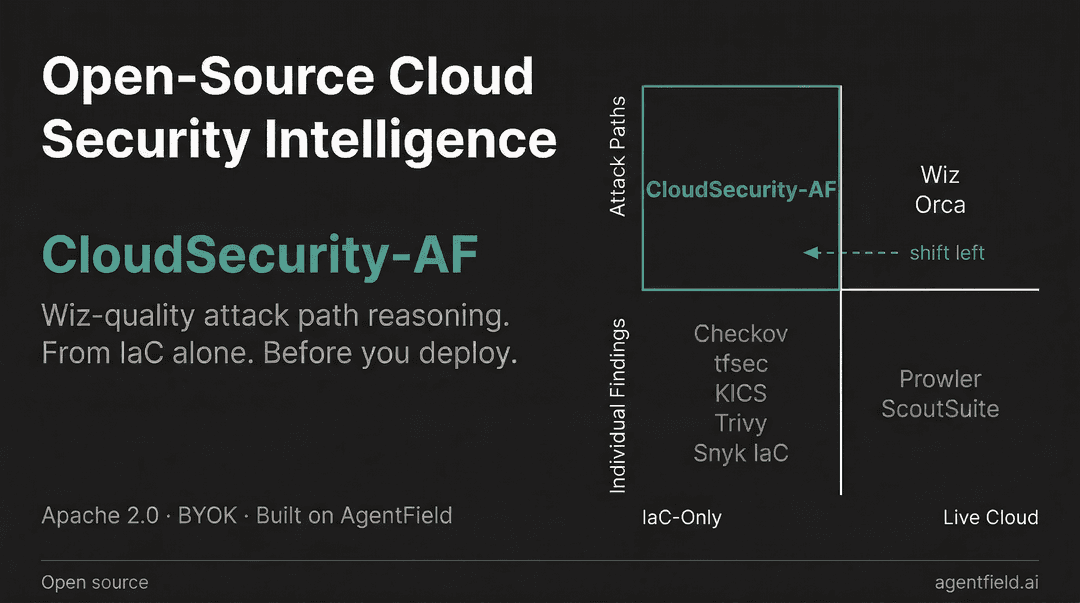
CloudSecurity AF AI-native cloud infrastructure security scanner that performs shift-left attack path analysis directly from IaC, prioritizing the most dangerous risk chains before deployment. View project → |

Agentic PR Reviewer Builds a custom review strategy for every PR - spawns parallel reviewer agents with runtime-crafted prompts, adversarially challenges its own findings, and posts evidence-grounded inline comments. View project → |
Built something with AgentField? Submit your project to be featured on the examples page.
See It In Action
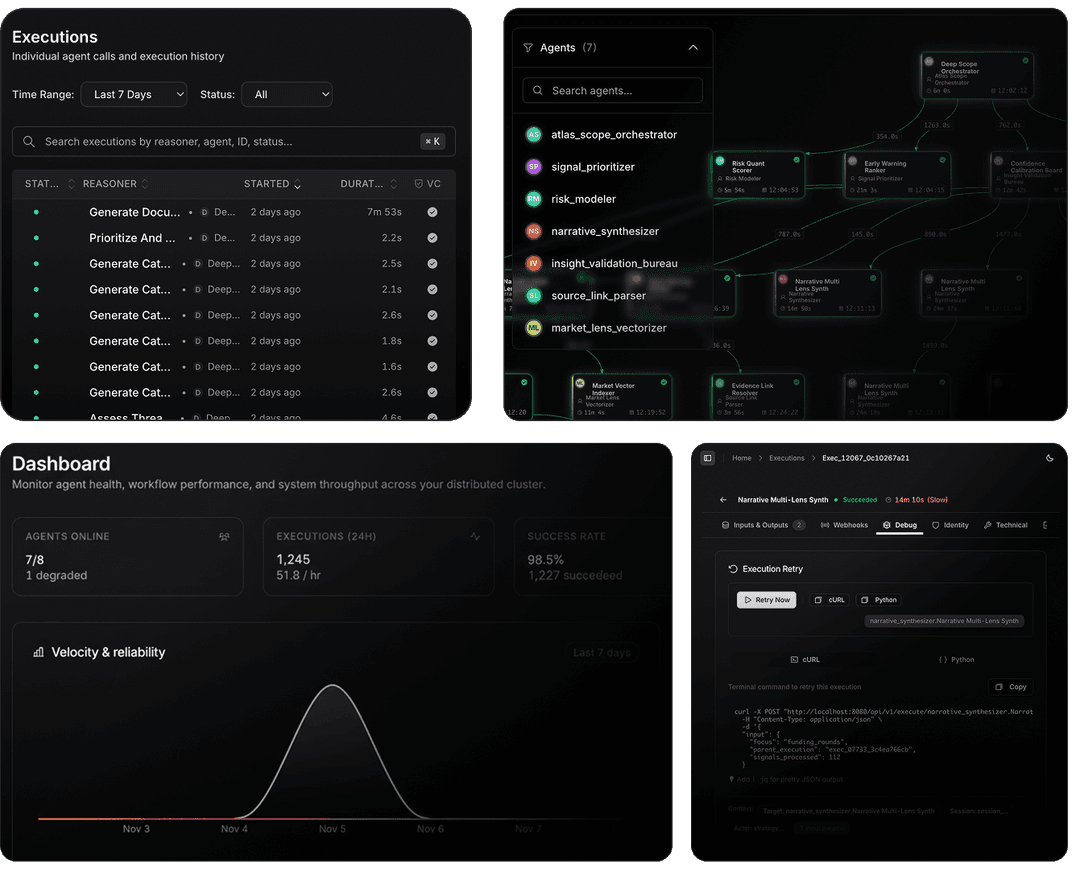
Real-time workflow DAGs · Execution traces · Agent fleet management · Audit trails
Architecture
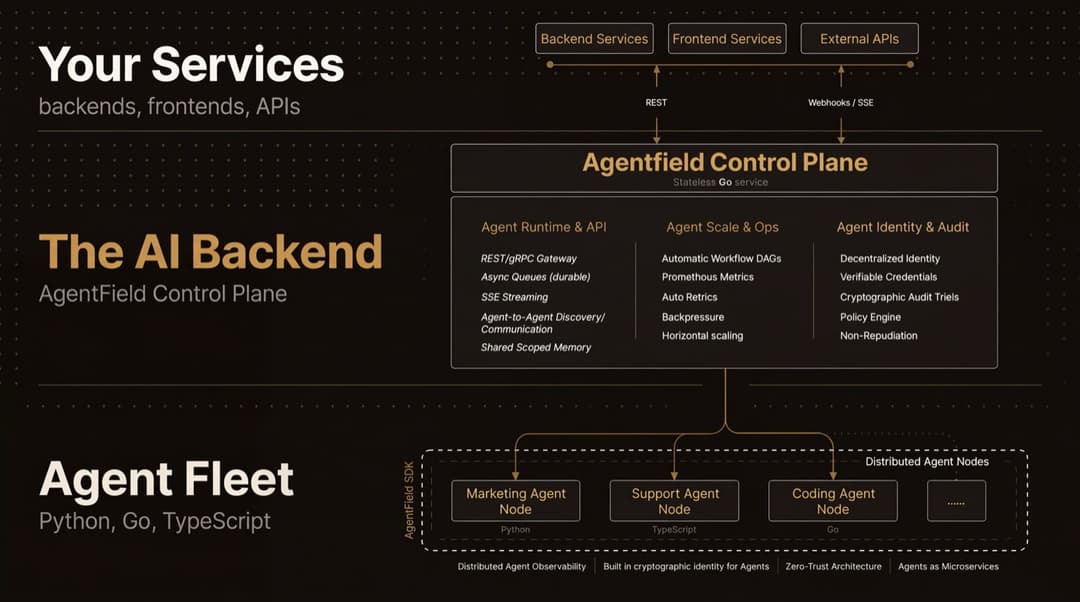
The control plane is a stateless Go service. Agents connect from anywhere - your laptop, Docker, Kubernetes. They register capabilities, the control plane routes calls between them, tracks execution as DAGs, and enforces policies. Full architecture docs →
Learn More
The thinking behind AgentField - essays on AI backends, harness orchestration, and the infrastructure production agents actually need.

What is harness orchestration? The atomic unit of intelligence is climbing from the model call to the autonomous harness - and what changes when it does. Read post → |

Part 1: The Black Box Treating harnesses like Claude Code and Codex as autonomous, embodied, persistent computational entities. Read post → |
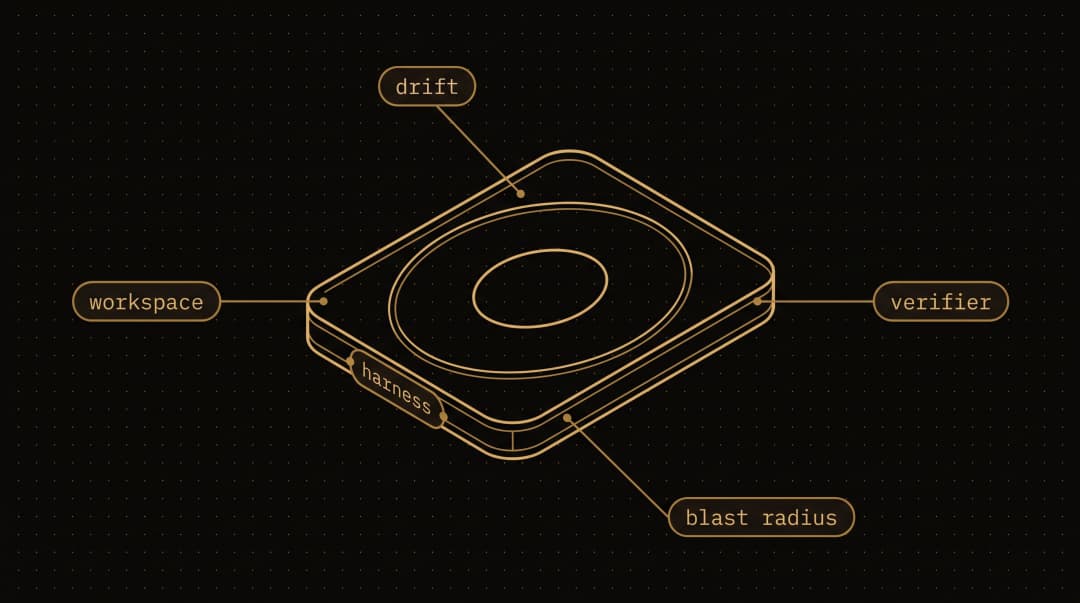
Part 2: Engineering the Membrane Shaping the boundary surface of a harness across four engineerable dimensions: workspace, drift, verifier placement, and recovery budget. Read post → |
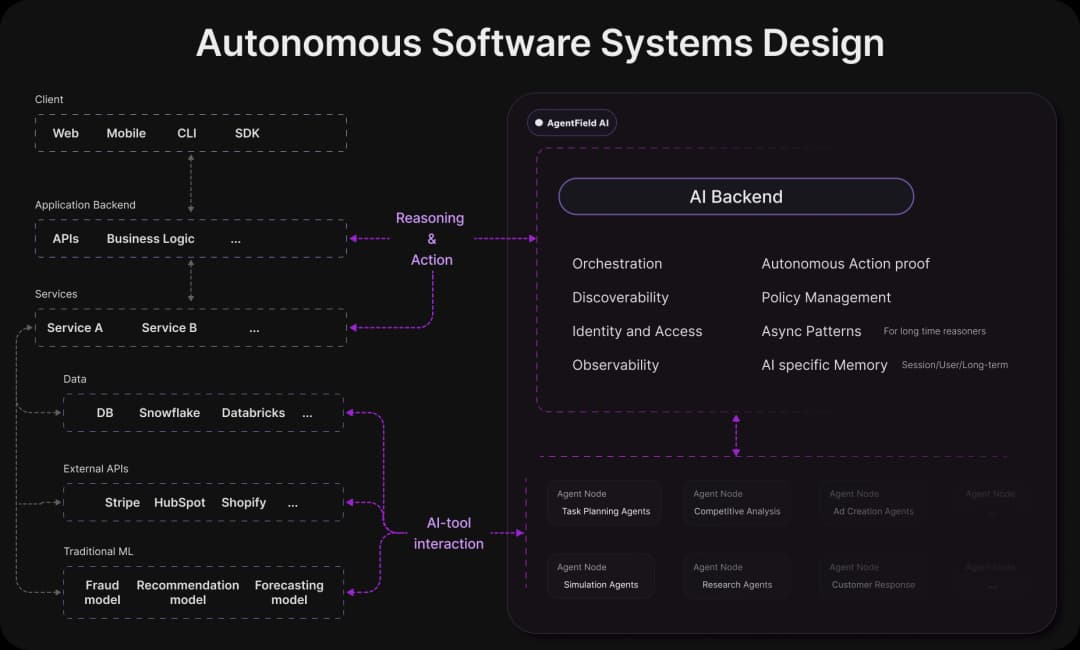
The AI Backend Our thesis: in five years every serious software company will run an AI backend - a reasoning layer that makes the decisions that used to be hardcoded. Read post → |
IAM for AI Backends Agents need identity, not API keys - how decentralized identifiers and verifiable credentials make agent-to-agent delegation auditable and accountable. Read post → |
Documentation
- vs Agent Frameworks - How AgentField compares to LangChain, CrewAI, and workflow engines
- Full Documentation
Community
License
// faq
What is agentfield?
Build, run and scale AI agents like API and microservices - observable,auditable and identity-aware from day one.. It is open-source on GitHub.
Is agentfield free to use?
agentfield is open-source under the Apache-2.0 license, so it is free to use.
What category does agentfield belong to?
agentfield is listed under devops in the Claudeers registry of Claude-compatible tools.
// embed badge

[](https://claudeers.com/agentfield)
// retro hit counter

[](https://claudeers.com/agentfield)
// reviews
// guestbook
// related in Automation & Workflows
 🔓
🔓 🔓
🔓The API to search, scrape, and interact with the web at scale. 🔥
 🔓
🔓🌐 Make websites accessible for AI agents. Automate tasks online with ease.
 🔓
🔓Taste-Skill - gives your AI good taste. stops the AI from generating boring, generic slop